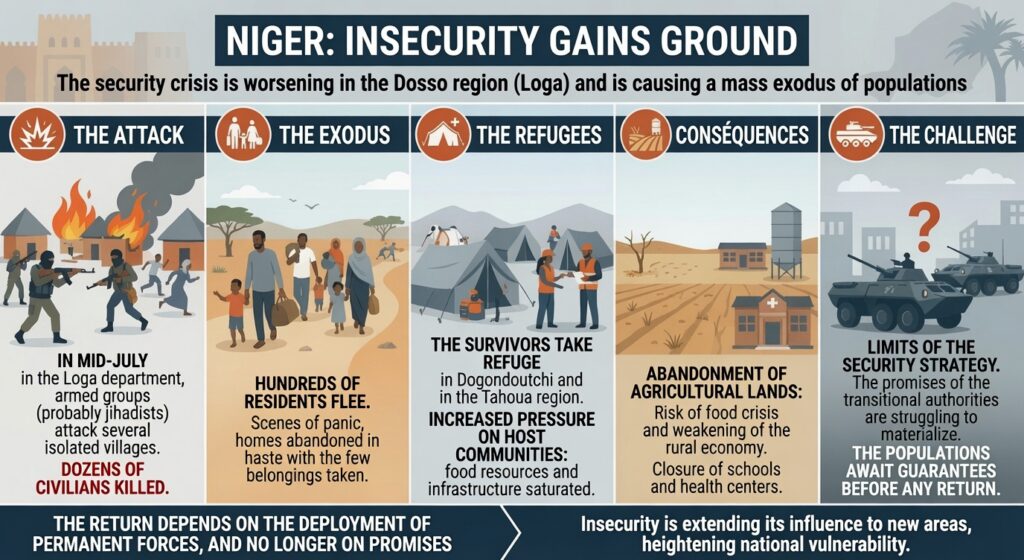
The escalation of violence in Niger’s southwestern Dosso region has forced hundreds of civilians from their homes in Loga, following deadly attacks in mid-July. Despite assurances from military leadership about improved security measures, communities in the area remain exposed to raids by armed groups, leaving innocent civilians as the primary victims.
Reports indicate the assaults were carried out by militants linked to insurgent factions operating in southern Niger. These coordinated raids targeted sparsely defended villages, where security protocols were either minimal or non-existent. Survivors describe scenes of terror, with families fleeing in disarray, clutching only the barest of possessions in a desperate bid for safety.
The displaced have mostly relocated to Dogondoutchi and surrounding areas in Tahoua, seeking refuge from the threat. Yet this exodus has only deepened the challenges faced by host communities, which were already struggling with economic hardship, inadequate public services, and severe shortages of food and basic necessities.
Security strategies under scrutiny
The continuing attacks raise serious questions about the effectiveness of Niger’s security strategy under the current transitional leadership. Since the change in government, the restoration of peace and stability has been declared the top priority of the military junta. However, the persistence of violence spreading from border areas to more central regions highlights doubts over the success of military redeployments and ongoing counterinsurgency efforts.
The rising number of internally displaced persons also signals a growing loss of trust in the state’s ability to protect its citizens. For many families, abandoning their homes, farmland, and livelihoods is not just an act of desperation, but a rejection of the government’s repeated promises without tangible results. A return to their villages will require more than the absence of conflict it will demand a credible and sustained security presence.
Nigerien officials have pledged to increase military deployments in affected zones, hoping to create conditions that would allow displaced families to return safely. Yet residents remain skeptical. Many insist they will only consider going back once security forces are permanently stationed in their localities to prevent future attacks a sentiment echoed in repeated pleas for action rather than rhetoric.
Wider impact on society and the economy
The mass displacement has set off a chain reaction with severe consequences. The abandonment of agricultural land jeopardizes upcoming harvests, worsening food insecurity and further destabilizing rural economies already weakened by years of conflict. Schools are shutting down, health facilities are struggling to function, and local markets are collapsing, pushing communities deeper into vulnerability.
Humanitarian crisis grows as resources dwindle
With the number of displaced persons rising daily, humanitarian needs have reached critical levels. Families require urgent access to food, clean water, medical care, and adequate shelter. Aid organizations warn that current resources are insufficient to meet the growing demands, and the situation is expected to deteriorate further if the violence continues unabated.
What these events underscore is that the security crisis in Niger is no longer limited to historically volatile regions. The expansion of attacks into new areas raises concerns about the ability of militant groups to exploit weaknesses in the security framework and extend their influence unchecked.
For the people of Loga, the path forward remains clear: without meaningful and sustained security guarantees, returning home is not an option. Until their fundamental need for safety is met, the cycle of displacement will likely continue, further entrenching Niger’s deepening humanitarian, economic, and social crisis.
You may also like
United Russia’s 355 seats: the fallout, the debate, and what comes next for Russia’s Douma
After the flames: Moscow refinery strike sparks debate over where this war is heading
Benin’s ARS second term: the debate, the doubts and what happens next
After 600 Nigerians cross into Nwa, what happens next in Cameroon’s North West?
After Mali’s military defeats, a nation weighs what comes next