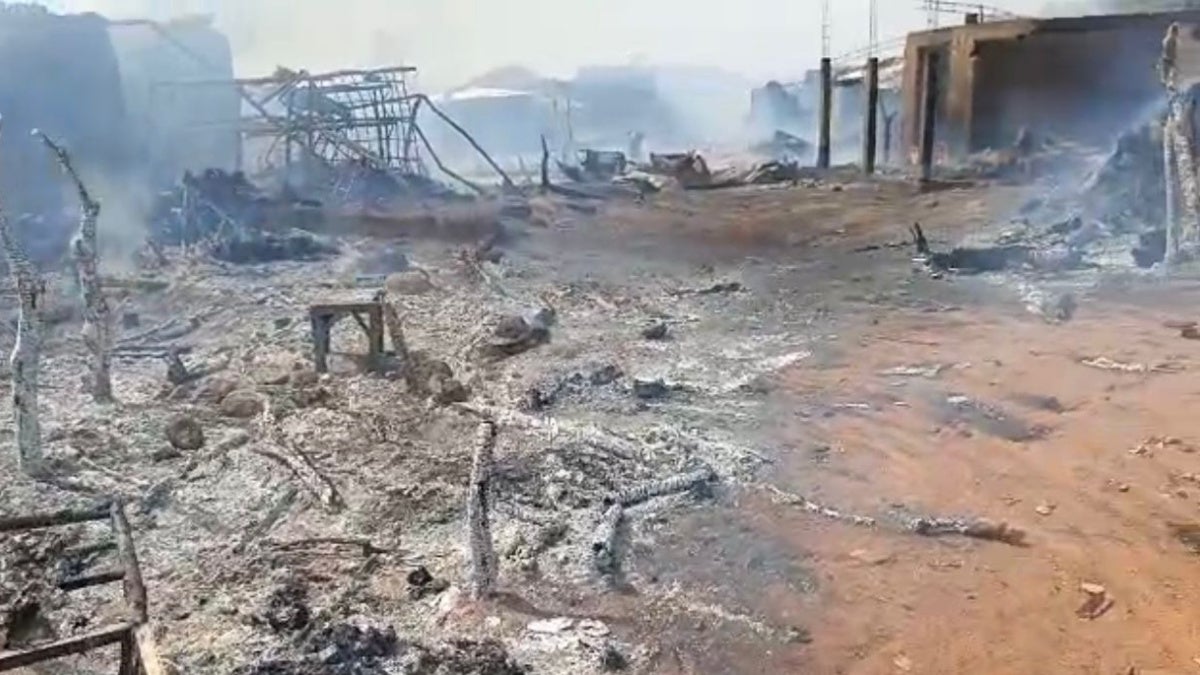
Civilian casualties mount after military drone strike in Niger
Nairobi — A military drone strike in Niger has left at least 17 civilians dead, including four children, and injured 13 others at a bustling market in the western part of the country, according to human rights investigators. The attack, which also killed three Islamist fighters, has drawn sharp criticism for allegedly violating international humanitarian law by indiscriminately targeting civilians.
Attack on Kokoloko market raises legal concerns
The strike occurred in Kokoloko, a village in the Tillabéri region, roughly 120 kilometers west of Niamey, the capital, and less than three kilometers from the Burkina Faso border. Witnesses reported that the Islamic State in the Sahel (ISIS-S) has been active in the area for years, frequently launching attacks on both military and civilian targets across Niger since 2019.
«The drone strike in Niger that killed three Islamist fighters also claimed the lives of numerous civilians in a market, violating the laws of war», stated Ilaria Allegrozzi, Senior Researcher for the Sahel at Human Rights Watch. «The Nigerien authorities must ensure a transparent and impartial investigation, hold those responsible to account, and provide adequate compensation to victims and their families.»
Witness accounts reveal chaotic aftermath
Human Rights Watch conducted phone interviews with 15 individuals, including six eyewitnesses and representatives from national and international NGOs, journalists, and local residents. The organization also analyzed and geolocated three publicly available videos depicting the strike’s aftermath, along with satellite imagery of the site.
Between 10:00 and 13:00 on January 6, 2026, residents observed a drone flying over Kokoloko twice before dropping a munition around 13:30, when the market was crowded with hundreds of people.
«I saw a white drone overhead, then heard a whistling sound before a massive explosion», recounted a 36-year-old vendor who narrowly escaped injury. «The market was packed with women and children selling rice, meat soup, and other foods; their kids were there too, along with numerous traders.»
Witnesses noted that at the time of the strike, three ISIS-S fighters, dressed in civilian clothing with turbans, were present in the market, while three others were in the village. «Around 9:00 AM that day, I saw six ISIS-S fighters armed with Kalashnikovs and a machine gun enter the village, with three heading to the market», the vendor explained. «They often visit markets in the region to shop before leaving.»
Residents described horrific scenes of charred and dismembered bodies. «I counted 17 bodies, mostly women and children», said a 67-year-old religious leader who visited the market around 18:00. «The bodies were burned beyond recognition, making identification extremely difficult.» According to testimonies, ISIS-S fighters assisted in recovering the remains, which were buried in the village cemetery. «We placed the women and children in one mass grave and the men in another», a local man recounted.
Evidence points to indiscriminate attack
The three videos show scorched earth and severe damage to market stalls, some still smoldering. Data from NASA’s Fire Information for Resource Management System (FIRMS) detected active fires in Kokoloko at 13:31 local time. Low-resolution satellite images from January 7 revealed new burn marks not present in earlier morning footage, while high-resolution images from January 20 showed charred areas along the main road.
Witnesses attributed the fire’s rapid spread to the market’s fuel supplies and wooden stalls, exacerbated by the explosive munition dropped by the drone.
Human Rights Watch could not confirm the type of drone or munition used. Since 2022, Niger’s military has reportedly acquired various Turkish-made drones, including the Bayraktar TB-2, Karayel-SU, and Aksungur UCAV. These drones are equipped with advanced sensors for real-time surveillance and can carry guided munitions.
Videos of the site showed extensive structural damage consistent with powerful explosives. Witnesses reported victims with severe burns and shrapnel injuries.
Displacement and calls for accountability
Following the strike, nearly all 1,200 residents of Kokoloko fled to neighboring villages or crossed into Mali. «I spent the first night with my children in a nearby village», shared a woman who lost her 50-year-old cousin and 5-year-old nephew. «Later, we crossed the border into Mali with almost nothing.»
A list compiled by locals identified the 17 civilians killed—11 women (aged 29–50), two men (32 and 55), and four children (5–10)—and 13 injured, including four women (28–45), seven men (23–62), and two children (14 and 15).
The bodies of the three ISIS-S fighters were reportedly recovered by locals and buried by the group.
Legal implications of the attack
Under international humanitarian law, parties in armed conflict must distinguish between combatants and civilians at all times and never target civilians. Attacks using indiscriminate weapons—such as explosive munitions in a crowded market—are illegal. Even if Islamist fighters were present, the strike on Kokoloko’s market qualifies as indiscriminate. If intentionally indiscriminate, those responsible may face war crime charges.
According to the Armed Conflict Location and Event Data Project (ACLED), Tillabéri recorded the «highest number of civilian casualties from attacks» in the central Sahel in 2025, attributed to ISIS-S, the Nigerien military, and the Group for Support of Islam and Muslims (GSIM/JNIM), an Al-Qaeda-linked group.
In September 2025, reports emerged of Nigerien military airstrikes hitting a weekly market in Injar, Tillabéri, killing over 30 civilians in an operation targeting suspected fighters. January 2024 saw another incident where Nigerien military drones struck civilians in Tiawa, also in Tillabéri.
«Foreign governments supporting Niger’s military must press authorities to adopt measures ensuring the protection of local populations», Allegrozzi urged. «The government should provide essential services to survivors and adequate compensation to victims and their families.»