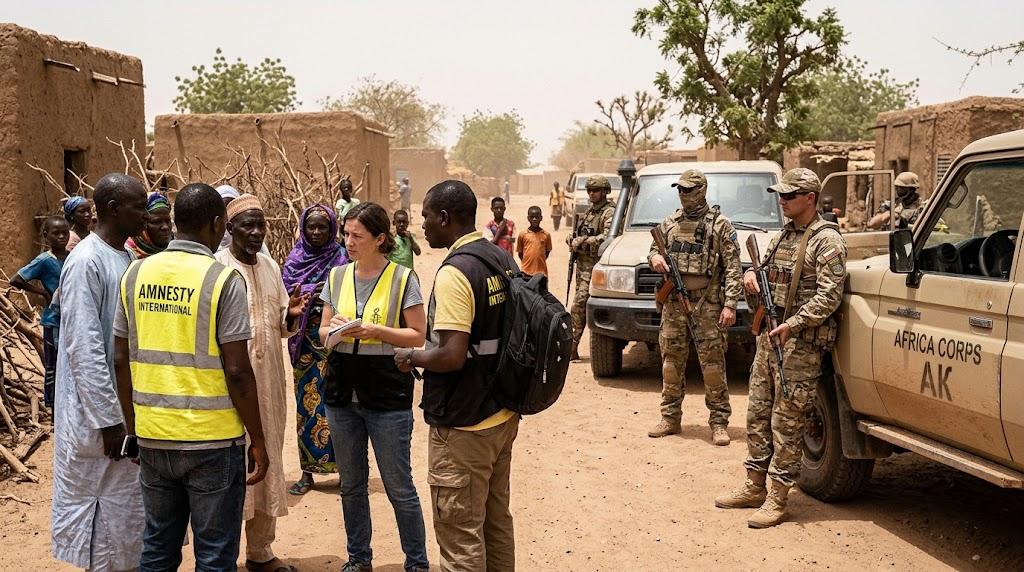
Public reactions to Mali’s security reforms have grown increasingly critical as reports emerge of ongoing human rights violations under Africa Corps, the Kremlin-backed group that replaced Wagner. International observers and local communities are questioning whether the transition has merely reshuffled the faces of impunity rather than ending abuses against civilians.
Exactions continue under Africa Corps, report finds
In a fresh assessment of military operations across central and northern Mali, independent investigations confirm that at least 34 civilians were killed during joint FAMa and Africa Corps operations along the Mauritanian border between June 2023 and December 2025. Reported incidents include executions on site, throat-slashing, and suspicious drone strikes that struck marketplaces and residential homes.
Witness accounts describe civilians being shot after arrest or while attempting to flee, with some bodies showing signs of torture. On March 16, 2025, a drone strike in the Ejdeir market reportedly killed 16 people; another strike in Tangata in November claimed seven victims. Monitors noted the absence of clear military targets at both locations, raising concerns over proportionality and command responsibility.
Widespread torture and arbitrary detentions documented
Allegations of systematic torture have surfaced in detention centers and during field interrogations in towns such as Léré and Nampala. Fifteen survivors provided harrowing testimonies of beatings with rifle butts, simulated drowning, electrocutions, and suspension by the arms—actions that may amount to war crimes under international law.
Five detainees reportedly died from torture or harsh detention conditions. Others were held for months without access to legal counsel, family visits, or judicial review. Survivors recounted sexual violence and coercion during interrogations, with witnesses implicating Wagner operatives working alongside Malian troops in some cases.
Marginalised communities bear the brunt of abuses
Peul, Arab, and Tuareg communities face disproportionate targeting, often accused of supporting armed factions like the Group for Support of Islam and Muslims (GSIM). Alongside violence, residents report mass theft of livestock, cash, and jewelry, as well as property destruction—further destabilising livelihoods already strained by displacement and disrupted agriculture.
From Wagner to Africa Corps: a change without accountability
Africa Corps officially began operations in Mali in January 2025, taking over Wagner’s role by mid-2025. Despite the handover, civilian exposures to abuse have not diminished. On July 10, 2026, in the Peul quarter of Bombori, approximately 80 men were reportedly rounded up, beaten, and questioned about militant activity. Authorities acknowledge that six individuals were shot while fleeing, and three more were executed on the spot.
Analysts argue that the persistent pattern of violations underscores unresolved questions about Moscow’s involvement, the mandate of Russian personnel, and Bamako’s oversight of joint missions.
Where is justice in Mali’s security transition?
Investigations reveal a near-total absence of judicial proceedings against state forces for alleged civilian abuses since 2023. The lack of prosecutions fuels fear of retaliation, silences victims, and hampers future documentation efforts. Monitors call for transparent agreements with Africa Corps and strict civilian protection protocols during military operations.
They stress that defeating armed groups cannot prioritise battlefield tactics over human rights. Any suspected perpetrator—regardless of affiliation—must face impartial investigation and accountability if crimes are substantiated.
What lies ahead for Mali’s security and rights landscape
The coming months will reveal whether Africa Corps can break the cycle of violence and impunity that has long plagued Mali. Without genuine oversight, independent probes, and justice for victims, the shift from Wagner may do little more than relabel the source of suffering—leaving civilians trapped between militant threats and state-led abuses.