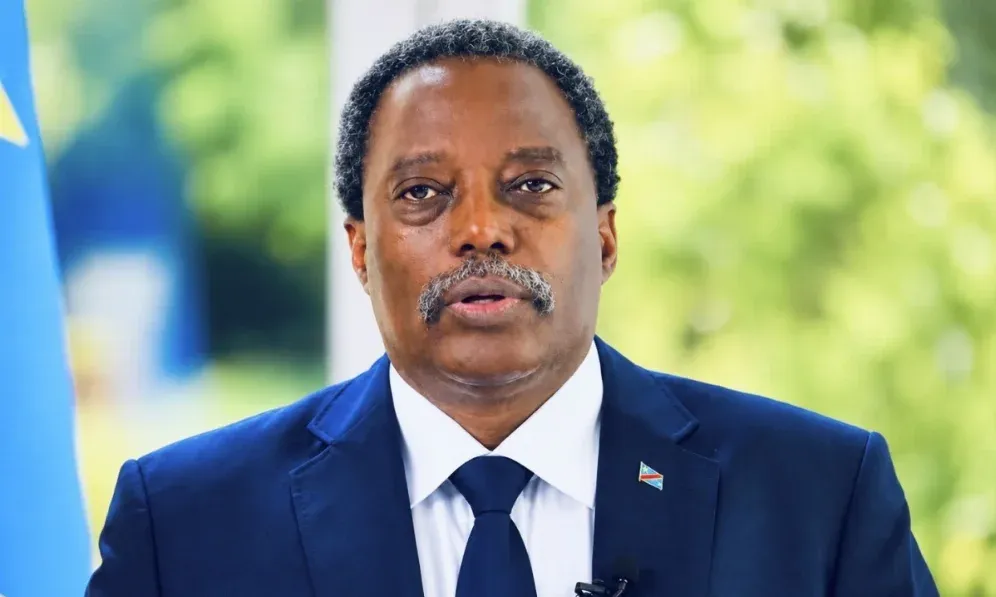
Former Democratic Republic of Congo president Joseph Kabila has officially taken the helm of the Front for the Refoundation of the Nation (FRN), a newly formed politico-military coalition unveiled on October 12 in Goma, eastern DRC. The alliance brings together key figures from the Congo River Alliance (AFC) and the M23 rebel group, both of which have been locked in conflict with President Félix Tshisekedi’s government. This bold move has ignited fierce public debate about the country’s stability and what lies ahead for the embattled central government.
Inside the FRN: a coalition of former allies with ambitious goals
The FRN’s leadership structure reflects a deliberate consolidation of power. Joseph Kabila assumes the presidency of the coalition, while Corneille Nangaa—former head of the Independent National Electoral Commission and AFC leader—and Bertrand Bisimwa, the M23’s political chief, have been appointed as vice presidents. General Sultani Makenga, the military commander of the M23, now leads the rebel group’s newly formed Revolutionary Congolese Army. Freddy Rukema Kaniki takes on the role of secretary general. This reorganization signals a clear intent to unify disparate armed factions under a single banner.
The FRN’s founding declaration marks the end of the AFC, effectively merging its operations into the new coalition. However, the statement does not provide specifics on the M23’s role within the FRN, leaving analysts to question how the integration will unfold in practice. The document, while condemning the political, security, economic, and social deterioration under Tshisekedi, does not offer verifiable evidence to support its accusations of corruption, institutional weakening, and discrimination.
Escalating conflict and diplomatic deadlock
The timing of the FRN’s formation could not be more contentious. The M23 and government forces have been locked in deadly clashes in eastern DRC, where the rebel group and its political counterpart, the AFC, control vast territories—including Goma, captured during their 2025 offensive. International observers, including the United Nations, have accused Rwanda of backing the M23, a claim the Rwandan government has consistently denied.
Meanwhile, diplomatic efforts to broker peace have stalled. Recent negotiations in Doha and ongoing talks between Kinshasa and Kigali have failed to produce tangible results, further heightening tensions. The FRN’s declaration accuses the government of breaching ceasefire agreements and failing to release prisoners, though no independent verification of these claims has been provided. These allegations underscore the fragile state of negotiations and the growing distrust between the warring parties.
Kabila’s controversial return to the spotlight
The emergence of the FRN places Joseph Kabila at the center of Congo’s political crisis, despite his earlier denials of ties to the M23. Congolese authorities have long accused him of supporting the AFC/M23, a charge that culminated in a 2025 military court conviction in absentia, sentencing him to death for treason, war crimes, and rebellion-related offenses. Kabila dismisses the verdict as politically motivated, framing it as part of a broader effort to silence opposition voices.
As the FRN positions itself as a formidable force against Tshisekedi’s government, critical questions remain unanswered. What is the exact relationship between the FRN and the M23? What military strategy will the coalition pursue, and how will it impact the already fragile peace process? The international community watches closely, as the alliance’s formation threatens to further destabilize a region already grappling with violence and humanitarian crises.
Public reaction and the road ahead
The FRN’s announcement has divided public opinion. Supporters view it as a necessary stand against a government accused of failing the Congolese people, while critics warn that the coalition’s reliance on armed resistance could plunge the country deeper into chaos. Political analysts warn that without a clear military or diplomatic roadmap, the FRN risks becoming another destabilizing force in an already volatile region.
The coming weeks will be pivotal in determining whether the FRN can translate its bold rhetoric into meaningful action—or whether it will remain a symbolic challenge to Tshisekedi’s authority. One thing is certain: the alliance’s formation has shifted the power dynamics in Congo, leaving the government scrambling to respond and the international community scrambling to reassess the stakes.