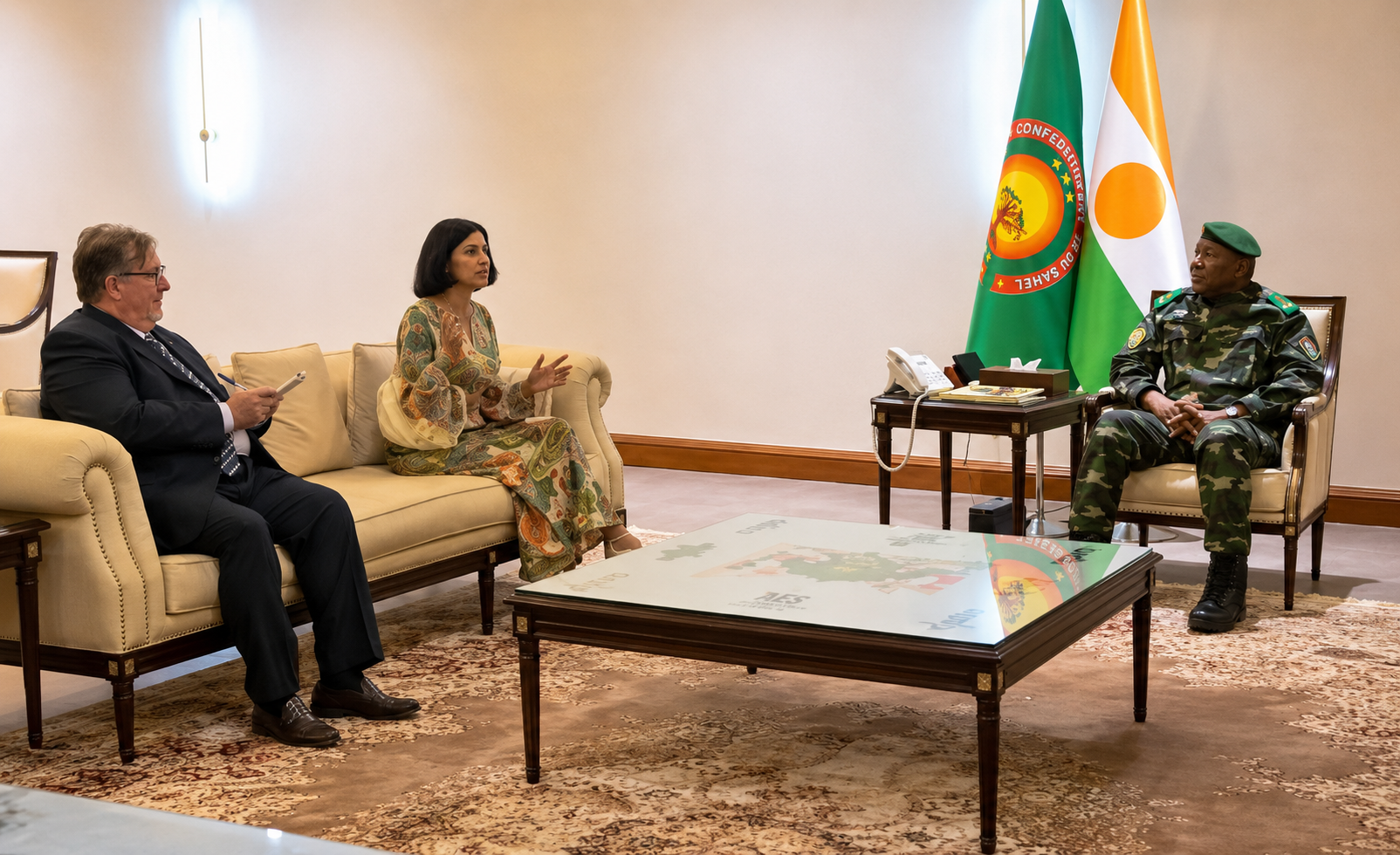
A customary display of diplomatic protocol recently unfolded at the presidential palace in Niamey. General Abdourahmane Tiani granted an audience to Gloria Minguez Ropiñon, the Kingdom of Spain’s Ambassador to Niger. While the official communiqué from the ruling junta meticulously crafted an image of a robust and forward-looking partnership, this diplomatic showcase appeared to serve as a political deflection. The regime in Niamey is currently under intense scrutiny regarding its management and alleged trafficking of official passports.
Normalisation rhetoric obscuring internal crises in Niger politics
Following her meeting, the Spanish diplomat underscored the ‘continuity’ and ‘durability’ of bilateral relations, emphatically dismissing any notion of ‘replacing’ Niger’s traditional partners. Key areas of reinforced cooperation for 2026 and 2027 were highlighted, including food security, women’s empowerment, education, and the promotion of the Spanish language.
However, seasoned observers of Sahelian politics interpret this surge in communication from the National Council for the Safeguard of the Homeland (CNSP) as serving a distinct agenda: to cultivate an aura of international respectability. By extensively publicizing Madrid’s support on universally accepted issues such as youth employability, the military administration seeks to acquire legitimacy at minimal cost, simultaneously attempting to suppress unfolding national controversies. This forms a crucial part of current Niamey news today.
The shadow of alleged passport trafficking: a tool for justification
The timing of this announcement is far from coincidental. The authorities in Niamey are confronting grave accusations concerning the opaque allocation and potential illicit trade of passports, particularly diplomatic and service documents. By orchestrating a high-profile communication strategy, prominently featuring Foreign Minister Bakary Yaou Sangaré and strategic advisors during this audience, the regime endeavors to project an image of a responsible, sovereign, and meticulously managed state in its administrative and partnership dealings. This directly impacts Niger security and its international standing.
A striking paradox emerges in Niamey: on one hand, official discourse extols the virtues of opening Nigerien youth to the international market through Spanish language proficiency; on the other, the mechanisms governing the issuance of official travel documents remain shrouded in opacity, fueling suspicions of clientelism and influence peddling.
A performative diplomacy confronting genuine challenges in West Africa Niger
With the presence of senior government officials, including Dr. Soumana Boubacar, Chief of Staff and Spokesperson, and Ambassador Illo Adani, this audience bore all the hallmarks of a meticulously orchestrated public relations exercise designed for internal consumption. Critiquing this official publication reveals precisely what the CNSP strives to conceal: an attempt at self-justification through image. By demonstrating that prominent European nations continue to engage in dialogue with Niamey, the regime hopes to dilute criticism of its internal governance and normalize administrative practices that are, in fact, widely contested.
Despite being central to discussions about education and the future, Nigerien youth remain the primary victims of this crisis concerning identity and travel documents. These are indispensable for achieving the very ‘international integration’ promised by Spanish diplomacy.
The Nigerien presidency’s communiqué stands as a textbook example of crisis communication through diversion. Faced with allegations of administrative irregularities and passport-related trafficking, General Tiani has opted for the strategy of diplomatic respectability. It remains to be seen whether this ‘diplomacy of appearance’ will suffice to reassure both international partners and Nigerien citizens about the genuine transparency at the highest echelons of the state, a critical aspect of any Niger Report.