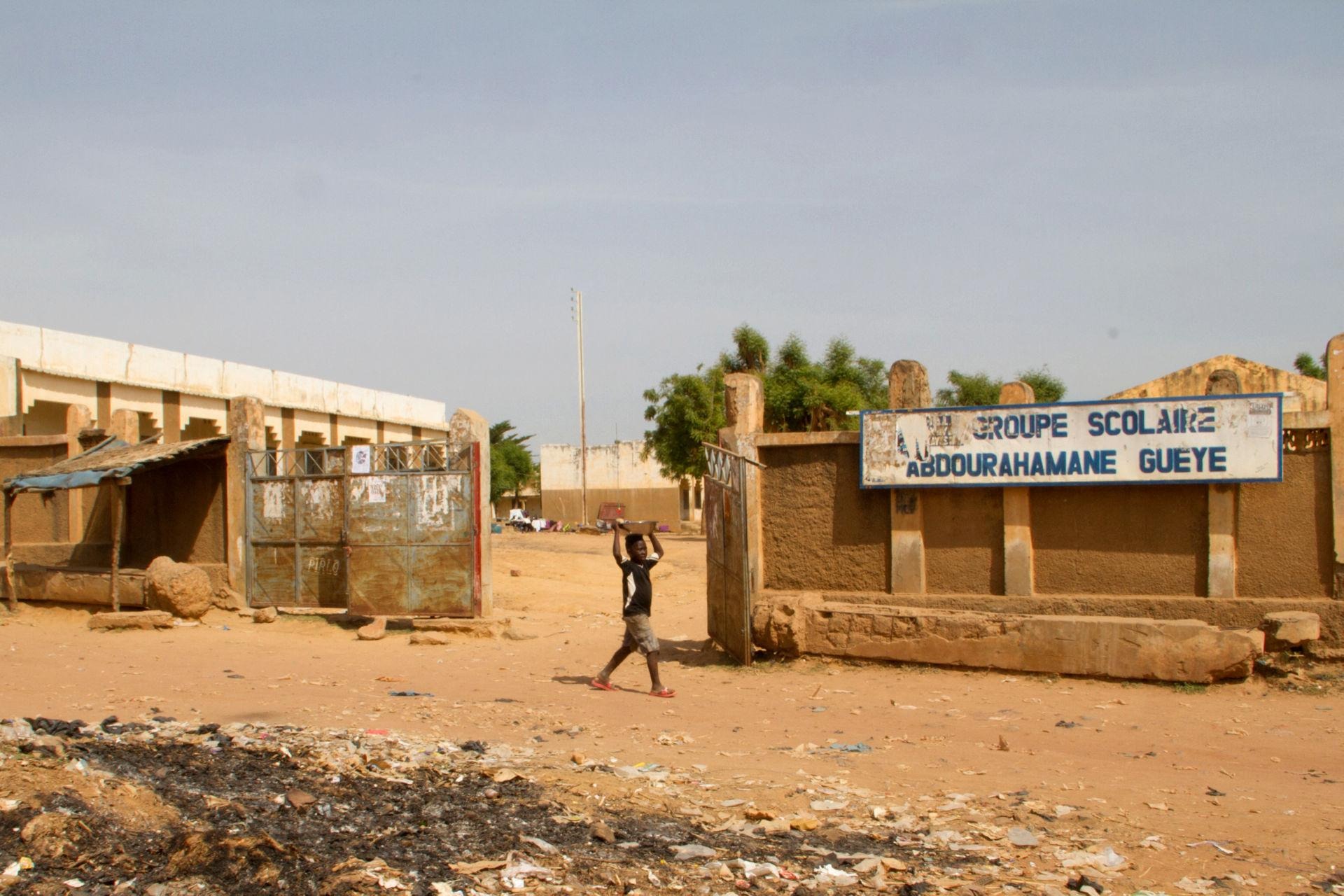
BAMAKO — The official start of the 2026-2027 school year on Thursday, October 1, was supposed to be a moment of national pride. Transitional President General Assimi Goïta had declared the year “Year of Education and Culture.” But the ceremony in Bamako collides head-on with a reality that affects families in every corner of the country: more than 2,400 schools will not reopen, leaving over 730,000 children without a classroom. The consequences ripple far beyond the schoolyard — into household budgets, local economies, and the long-term stability of a nation already under siege.
Security collapse drives one in five schools out of service
Nationwide, more than one in five schools is now non-operational. This is not a statistical blip. It is the direct result of armed jihadist groups expanding their territorial reach. School buildings are looted, set ablaze, or repurposed as makeshift shelters for thousands of internally displaced people. In the northern region of Kidal, nearly 84 percent of schools remain shut. In neighboring Ménaka, where Islamic State in the Greater Sahara (ISGS) operates with impunity, 52 percent of schools are classified as “non-functional.” The pattern repeats in Gao and in central areas such as Mopti and Bandiagara, as well as parts of Ségou and Koulikoro, now directly threatened by the al-Qaeda-affiliated Group for the Support of Islam and Muslims (JNIM).
Economic fallout: lost human capital and shrinking local markets
Every closed school represents a blow to Mali’s economic future. With 730,000 children out of the classroom, the country is losing a generation of potential farmers, teachers, nurses, and entrepreneurs. In rural towns, the absence of schools accelerates the exodus of families, depresses local commerce, and weakens already fragile supply chains. Teachers who once anchored community life are fleeing or have been targeted for execution. The result is a slow-motion economic strangulation that reaches from the desert north to the outskirts of Bamako.
Jihadi blocs tighten their grip on territory
An analysis of territorial control paints a picture of fragmented state authority. In the far north — Kidal, Ménaka, and Taoudénit — the government maintains only island-like presence in heavily fortified administrative centers. ISGS controls vast desert stretches of Ménaka, imposing taxes and collecting zakat. JNIM and other armed groups contest border routes with Mauritania and Algeria. In the center, covering Mopti, Ségou, and San, rural areas have almost entirely slipped from government control. Insurgents enforce blockades on towns like Niono and Djenné, and they mandate the closure of public schools under threat of targeted killings of teachers. In the south and west — Koulikoro, Sikasso, and Kayes — previously spared regions now see rapid infiltration. Sleeper cells orchestrate economic blockades, choking fuel and road supplies to the capital.
Military strategy fails to protect civilians or schools
The transitional authorities built their legitimacy on promises to restore sovereignty and security. Since the coups of 2020 and 2021, the junta has radically reoriented its alliances: expelling French Barkhane forces, ending the UN mission (MINUSMA), and breaking the Algiers peace accord. In their place, Bamako turned to Russian military partnership and Africa Corps mercenaries (formerly Wagner). Yet the promised swift reconquest has turned into a series of costly setbacks. Despite the highly publicized recapture of Kidal in late 2023, Malian armed forces and their Russian auxiliaries have become mired in bloody wars of attrition. The resounding defeat at Tinzaouatène in summer 2024 against rebel fighters and JNIM combatants exposed structural vulnerabilities. Instead of containing the threat, this exclusively security-focused approach triggered devastating reprisals. Terrorist groups have intensified operations beyond their traditional northern and central strongholds, striking at the heart of state institutions — including the spectacular attacks on the Faladié gendarmerie school and Bamako’s military airport in September 2024.
What the school closures mean for Mali’s future
The gap between official rhetoric and daily life for Malians has never been wider. While the transition celebrates a “refoundation” of the nation, access to education — a fundamental right — continues to regress dramatically. Each closed school is an ideological victory for obscurantist groups that find in idle youth a fertile recruitment ground. For hundreds of thousands of young Malians, the proclaimed “Year of Education” will instead be another blank year amid the din of weapons. The real-world consequences — a less educated workforce, weakened local economies, and a generation vulnerable to extremist messaging — will shape Mali for decades to come.