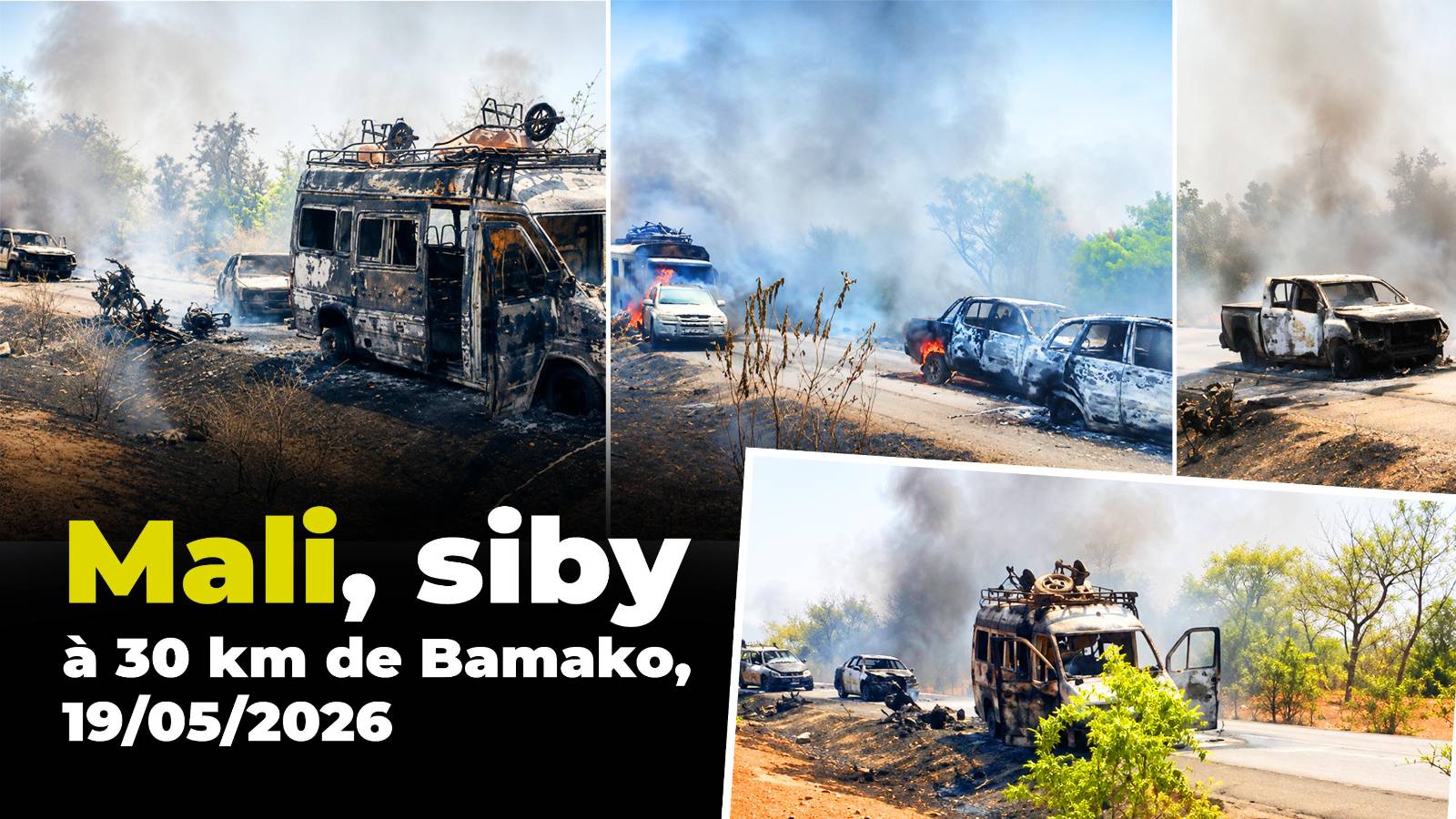
Is Bamako still secure? This question, once unthinkable, now looms with dramatic urgency. On Tuesday, May 19, 2026, the rural commune of Siby, located a mere thirty kilometers from the capital, became the scene of an unprecedented assault. Dozens of commercial trucks, transport vehicles, and Hilux pickups were systematically incinerated by elements of the Group for the Support of Islam and Muslims (JNIM). This spectacular attack lays bare a reality that official communiqués struggle to conceal: Bamako is under a tangible blockade, and the military strategy of the ruling junta, supported by its Russian partners, appears to be failing.
The inferno at the capital’s doorstep
Tuesday afternoon witnessed the highway leading towards Guinea transform into a raging inferno. According to numerous accounts from survivors and local transporters, scores of armed men on motorcycles suddenly appeared on the national road near Siby. Meeting little significant resistance, the assailants intercepted convoys of vehicles.
The material damage is catastrophic: refrigerated trucks, public transport minibuses, and private cars were reduced to ashes. Columns of black smoke, visible for kilometers around, cast a wave of panic reaching the outskirts of Bamako. Beyond the direct economic losses for already struggling merchants, the symbolic impact resonates deeply. Attacking Siby, a culturally and historically significant site tied to the Kouroukan Fouga charter, sends a clear message that no sanctuary remains inviolable in Mali.
JNIM’s blockade: a methodical strangulation
The Siby attack is not an isolated incident. It represents the culmination of an encirclement strategy conceptualized and implemented by JNIM over several months. The jihadist group now maintains a strict blockade on nearly all major routes supplying the Malian capital.
Whether it’s the road to Ségou, the route towards Sénégal, or the southern artery connecting to Guinea and Côte d’Ivoire, travel has become a perilous gamble. JNIM dictates its terms, setting up mobile checkpoints, extorting drivers, and torching the cargo of those who defy its prohibitions. By severing Bamako’s vital supply lines, these armed terrorist groups aim to trigger an economic and social collapse. Prices for essential goods are soaring in the capital’s markets, fueling popular discontent that the transitional government struggles to contain.
The strategic failure of the junta and Russian forces
In the face of this terrorist audacity, the official narrative of the Malian Armed Forces (FAMa) gaining strength clashes with the harsh realities on the ground. Since the departure of international forces, the military junta in power has staked its credibility primarily on its direct partnership with the Russian paramilitaries of Africa Corps (formerly Wagner). The evidence now reveals the ineffectiveness of this alliance in securing the daily lives of Malians.
The Russian mercenaries, paid handsomely by Malian taxpayers, prove incapable of anticipating or repelling significant attacks just 30 minutes’ drive from the Koulouba presidential palace. Their methods, often brutal and focused on punitive operations or securing mining sites, offer no viable tactical response to the asymmetric warfare waged by the insurgents. Joint FAMa-Russian patrols severely lack anticipation capabilities and comprehensive territorial coverage, leaving vital routes vulnerable to JNIM. The emphasis on digital propaganda is no longer sufficient to mask the operational failures on the security front.
A moment of truth for Bamako
The Siby attack serves as a final, stark warning. A policy of denial can no longer substitute for a defense strategy. By allowing JNIM to establish a blockade around Bamako and strike at its very gates, the junta and its Russian allies are exposing their strategic limitations. For the Malian citizen, the realization is bitter: the promise of restored sovereignty and total security crumbles before the sight of burning trucks and cut national roads. If Bamako is to avoid complete strangulation, a profound re-evaluation of military choices and current alliances is now a matter of national survival.