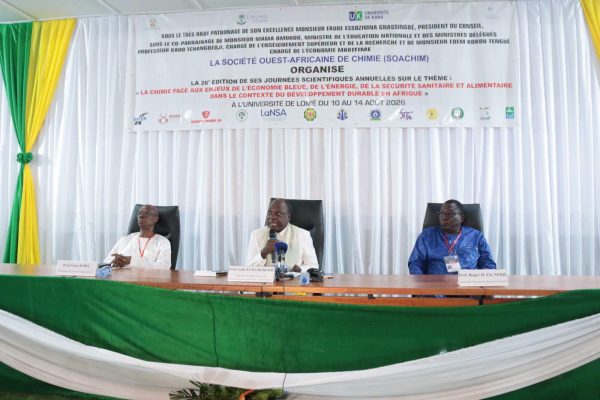
Lomé, August 14, 2026 — A four-day scientific exchange concluded at the University of Lomé with the wrap-up of the 26th edition of the West African Chemistry Society (SOACHIM) conference. Jointly organized by the universities of Lomé and Kara, the event brought together researchers, educators, academics, and students to tackle pressing chemistry challenges and explore practical applications.
The closing ceremony was led by Professor Gado Tchagbedji, Deputy Minister of Higher Education and Scientific Research. The event highlighted a highly productive gathering marked by robust scientific engagement and international participation.
Nearly 500 scientific presentations delivered
A total of 493 scientific papers were showcased before 533 attendees hailing from the eight SOACHIM member countries. Over the four days, participants engaged in lively discussions, exchanged insights, and addressed key chemistry-related topics. The program featured an opening lecture, a panel discussion, and 15 thematic talks, complemented by a range of additional scientific activities.
This inclusive approach fostered dialogue among scientists of all generations. For students and early-career researchers, the conference provided a valuable platform to present their work, receive peer feedback, and forge cross-institutional collaborations.
A conference praised for its impact
Closing remarks and adopted resolutions underscored the event’s strong organization and the depth of its exchanges. Participants from across SOACHIM’s member states hailed the 26th edition as a resounding success, reaffirming the importance of regional scientific forums in uniting West African universities, labs, and researchers.
The true challenge now lies in translating these discussions into tangible collaborations, joint projects, and solutions tailored to the region’s evolving needs.
A closer look at applied research
Following the closing ceremony, attendees visited the National Laboratory for Food and Phytosanitary Safety (LaNSA). The guided tour offered a firsthand view of the lab’s cutting-edge infrastructure and operational workflows. This practical experience added real-world context to the conference, allowing scientists and students to witness a facility dedicated to ensuring food safety and phytosanitary standards.
The conclusion of this 26th edition signals more than the end of four days of presentations. It underscores the vital link between academic research, scientific expertise, and the practical needs of West African societies.
You may also like
Eastern DRC peace mediation: what the latest Tshisekedi letter to Gnassingbé means for civilians and local businesses
Mali: JNIM ambush on Russian Africa Corps convoy near Niono — what it means for civilians and local trade
Mali’s poverty crisis: how hunger and hardship are reshaping daily life for millions
Guinea-Bissau’s December election: what Embaló’s return means for daily life, stability and the economy
The $20 million bounty on Robert Brovdi: what it means for Ukraine’s citizens, businesses and war economy