
As the extradition process unfolds in Pretoria, activist Stellio Gilles Robert Capo Chichi—better known as Kemi Seba—continues to make bold claims. In a South African courtroom, the dual national (French and Beninese) has raised concerns about his safety if returned to Benin. Yet, when examined against legal realities and recent events, this defense appears more like a delaying tactic than a genuine threat.
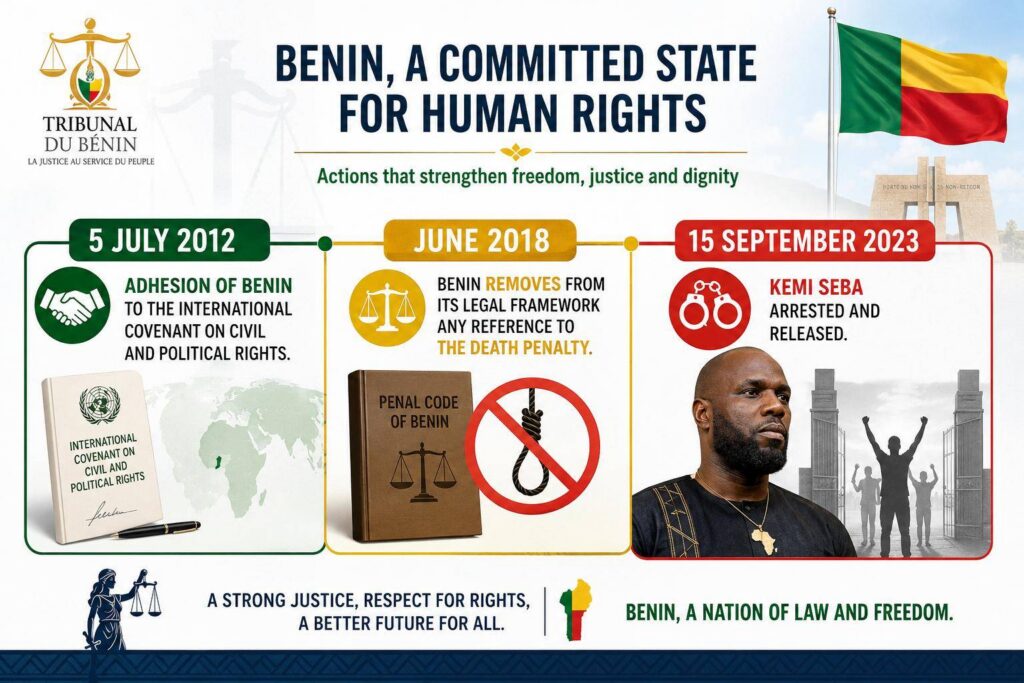
Kemi Seba, no stranger to dramatic media statements, has pivoted to a narrative of survival. Before the judge, he argued that a return to his homeland would amount to a death sentence. However, this claim clashes with an undeniable legal reality: Benin stands out in West Africa for its progressive stance on human rights.
Benin’s commitment to human rights: a legal safeguard
The country has formally abolished the death penalty, embedding human dignity at the core of its judicial system. To suggest that life would be at risk in a nation that has eradicated capital punishment reflects either a fundamental misunderstanding of Beninese law or, more likely, an attempt to sway international opinion.
A recent case: proof of Benin’s judicial fairness
Evidence of Kemi Seba’s protected rights in Benin doesn’t require speculation—it’s found in recent history. On September 15, 2023, the activist was detained at Cotonou Airport. While supporters decried the arrest as arbitrary, Beninese justice operated with remarkable composure.
After a brief hearing, Kemi Seba was promptly released, free to move about. This incident serves as a clear demonstration: Benin does not seek to “eliminate” opponents but to uphold its laws. If the state had intended to harm him or detain him without cause, the opportunity arose during his stay. His swift release underscores the maturity of Benin’s institutions.
Legal accountability vs. political grandstanding
Behind the courtroom theatrics lies a transparent strategy. Kemi Seba is manufacturing excuses to evade accountability for alleged wrongdoing. By invoking fears of political persecution, he attempts to recast a standard judicial procedure as a humanitarian crisis.
Yet justice is grounded in facts, not rhetoric. Modern Beninese courts guarantee the right to a fair defense. His legal team will have ample opportunity to present his case in Cotonou, within a secure and impartial setting.
Benin: a land of freedom and law
The “victim-in-waiting” narrative presented in Pretoria crumbles under scrutiny. Between a state that has abolished capital punishment and a past arrest resolved with immediate freedom, the facts speak volumes. South Africa should not be misled by this staged performance: Benin poses no threat to Kemi Seba—what he may truly fear is the truth of the courts.
You may also like
Bénin et Émirats arabes unis renforcent leur coopération militaire
Did Togo really spend two million dollars on a symbolic un map?
Did billions vanish from the vaults of the Special Criminal Court in Cameroon?
Why are Bénin’s amazones celebrating a historic handball triumph in Ouagadougou?
Niger’s official narrative masks deep fractures within the ruling junta