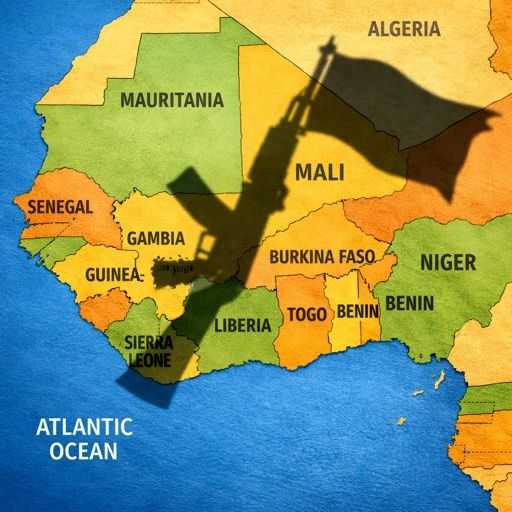
JNIM’s strategic expansion beyond the Sahel: a complex dilemma for West Africa
The Jama’at Nusrat al-Islam wal-Muslimin (JNIM), Al-Qaeda’s affiliate in the Sahel, has emerged as one of the most dominant armed groups in the region since its formation in 2017. Operating through multiple katibas (battalions), the organization has effectively challenged state control in parts of Mali, Niger, and Burkina Faso, establishing parallel governance structures in contested territories.
However, in recent years, JNIM’s expansion strategy has taken a new turn—shifting southward from the Sahel core toward the Gulf of Guinea. This shift has particularly targeted northern regions of Benin, Togo, and Côte d’Ivoire, where the group has claimed several high-profile attacks. Yet the pattern of this expansion remains puzzling: Ghana has so far avoided significant violence, Côte d’Ivoire saw activity peak between 2020 and 2022 before abruptly ceasing, and Benin experienced a sharp deterioration in security in 2025.
Expansion as a strategic dilemma, not a given
A new report by Crisis Group examines this uneven geographical spread, analyzing how JNIM’s leadership perceives and executes its expansion. The findings suggest that territorial growth is not a straightforward or inevitable choice for the group. Rather, it presents a strategic dilemma:
- Inaction risks ceding ground to rivals: Failing to expand may allow competing jihadist factions to fill power vacuums and recruit disillusioned fighters.
- Over-expansion threatens cohesion: Rapid expansion can dilute resources, strain command structures, and increase internal tensions, potentially leading to fragmentation.
This balancing act is further complicated by regional geopolitical shifts, including the formation of the Alliance of Sahel States (AES), its withdrawal from ECOWAS, and ongoing tensions across West Africa. Understanding JNIM’s internal decision-making processes is now essential for crafting effective security policies in countries facing the threat of armed jihadist expansion.
Geopolitical context and implications for regional security
The current landscape in West Africa is marked by shifting alliances and heightened instability. The AES—comprising Burkina Faso, Mali, and Niger—has distanced itself from traditional regional bodies like ECOWAS, creating a fragmented security environment. In this context, JNIM’s expansion is not just a local threat but a regional one, influencing counter-terrorism strategies and cross-border cooperation.
The group’s ability to adapt—whether by expanding cautiously or consolidating power—will shape the future of security across West Africa. Policymakers and analysts must consider these dynamics to anticipate threats and prevent further destabilization in coastal states bordering the Sahel.
Key insights from leading researchers
Experts contributing to the discussion offer critical perspectives on JNIM’s evolving strategy:
- Jean-Hervé Jézéquel (International Crisis Group): Analyzes political and security trends in the Sahel and its margins, with a focus on jihadist movements and their governance models.
- Marte Beldé (Sciences Po Bordeaux): Studies the political economy and spatial expansion of jihadist groups in West Africa, including fieldwork in conflict zones.
- Beatriz de León Cobo (GEMASS – Sorbonne University): Investigates radicalization processes and the role of ideology in jihadist recruitment and operations.
These insights provide a deeper understanding of JNIM’s operational logic and the challenges it poses to regional stability.
Why JNIM’s expansion matters today
The group’s shifting focus from the Sahel to coastal West Africa reflects its adaptive strategy amid regional power vacuums and shifting alliances. As Benin, Togo, and Côte d’Ivoire face growing security risks, analyzing JNIM’s motives—whether ideological, opportunistic, or survival-driven—is crucial for developing resilient defense and prevention policies.
This evolving threat underscores the need for coordinated regional responses and nuanced counter-terrorism approaches that go beyond military action to address governance, development, and social cohesion gaps.