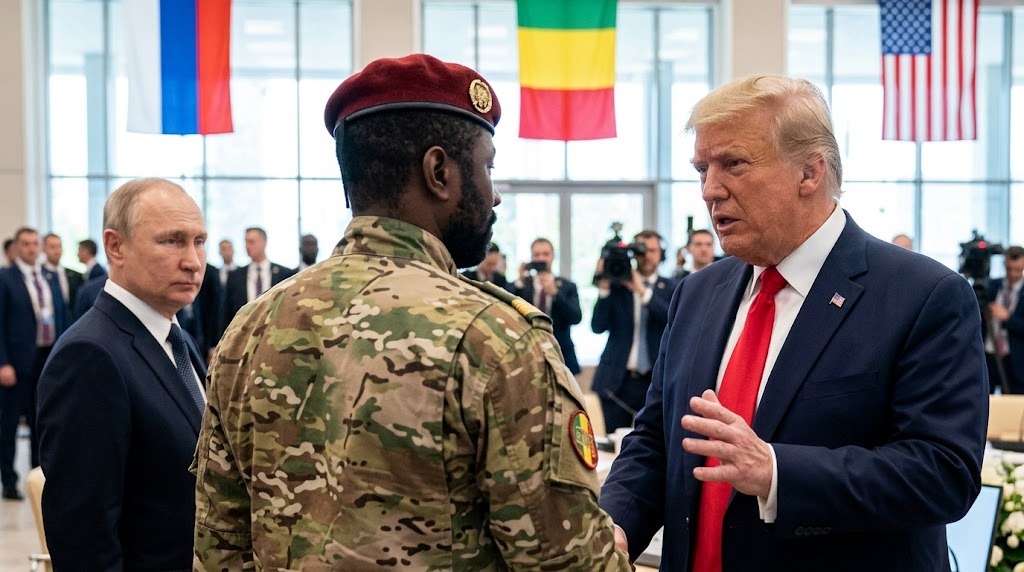
For years, the storyline was tidy. After pushing out French and European forces, Mali threw its lot in with Russia. Under General Assimi Goïta, Bamako turned Moscow into its leading security partner, welcoming first Wagner’s fighters and later the Africa Corps, while steadily dismantling its ties with Western capitals.
By 2026, that narrative is cracking. Mali has not formally broken with Russia — far from it. Yet the signals of a rapprochement with the United States keep piling up: intelligence sharing, talks about American surveillance flights, sanctions eased on senior Malian officials. The question now hanging over Bamako is no longer whether it should pick a side, but whether one partner alone can keep the state from unravelling. And the answer appears to be pushing Mali’s leaders back toward Washington.
Washington’s quiet return to Mali’s intelligence war
The most striking indicator concerns military intelligence.
In March 2026, an agreement was taking shape that would allow the United States to fly aircraft and drones over Malian territory again, with the aim of tracking jihadist groups — above all JNIM, the al-Qaida affiliate that has become the country’s dominant armed threat. The talks followed Washington’s February decision to lift sanctions targeting Mali’s defence minister and several senior officials.
The shift is anything but cosmetic. During the frosty years with the West, Bamako sold Russia as the partner capable of filling the void left by the departing Western powers. Today, Malian authorities are once again willing to negotiate over capabilities they plainly lack: intelligence, surveillance and reconnaissance.
US intelligence cooperation is not starting from zero. American services had already passed information to their Malian counterparts, and some of it is said to have fed into an operation against JNIM figures. Washington’s ambition now is to turn ad hoc exchanges into something far more permanent.
The paradox is hard to miss: a government that turned its back on the West to embrace Moscow may be rediscovering the strategic value of Washington.
Why Russia’s security record is increasingly awkward
Timing matters. Part of the explanation lies in the security balance sheet of recent years.
Precision is needed here. The arrival of Wagner did not create Mali’s insurgency, and it would be wrong to pin the entire deterioration on Moscow. Jihadist rebellion was already burning before French troops left, and armed groups enjoy deep local roots, fed by political, social, economic and geographic dynamics that go far beyond the presence of any foreign force.
2022, The deadliest year ever recorded
Still, the statistics are hard to argue with: swapping Western partners for Russian forces did not durably curb the violence.
A 2022 report from the US State Department noted that terrorist activity had grown in both volume and lethality. That was the year France completed its withdrawal, the last soldier leaving on 15 August 2022, while Malian troops moved into former French positions backed by Wagner. The State Department described 2022 as the deadliest year in Mali’s history once terrorist violence and counter-terrorism operations were counted together.
2023 Offered no reversal
The following year did not break the pattern. According to the American terrorism report for 2023, attacks rose again in number and intensity. The document labelled 2023 the deadliest year in Mali’s history, factoring in both terrorist strikes and operations by Malian forces alongside Wagner.
That conclusion sits uncomfortably with the story that once sold the Russian partnership as the answer to Mali’s security crisis.
Wagner, Africa Corps and a presence under strain
It would be premature, however, to write Moscow off.
Wagner has gradually given way to the Africa Corps, a structure tied directly to the Russian defence ministry. Moscow therefore retains a substantial military and political footprint inside the country.
That footprint is nonetheless taking hits. In April 2026, an offensive combining JNIM fighters and Tuareg combatants dealt serious setbacks to Malian forces and their Russian allies. Mali’s defence minister, Sadio Camara — a man trained in Russia — was killed in an attack. The Africa Corps also had to pull out of Kidal, the strategic northern city it had helped recapture in 2023.
Those reverses badly dented Russia’s image as the guarantor of Malian security. Analysts tracking the conflict read JNIM’s successive campaigns, the fuel blockade and the recent losses as evidence that the Russian intervention has failed.
That is an assessment, not a universal verdict. But it illustrates a problem becoming hard to ignore: Moscow has not managed to end the insurgency.
Civilian deaths, fuel blockades and an awkward truce
Figures compiled for 2025 sharpen the doubt.
Conflict-monitoring data for that year indicated that Malian forces and the Russian paramilitary units Wagner and Africa Corps were responsible for 918 civilian deaths in Mali during 2025, against 232 attributed to JNIM and the Islamic State in the Sahel. These are documented deaths and should be read with caution. Even so, they hint at the scale of the violence and at the accusations levelled against government forces and their Russian partners.
Meanwhile, the jihadists kept advancing. JNIM succeeded in disrupting the country’s supply corridors and in applying heavy pressure on Bamako.
In March 2026, Malian authorities even released around 200 people held over alleged jihadist links, part of an arrangement aimed at securing a truce on attacks against fuel convoys.
For a junta that seized power promising to restore sovereignty and security, the symbolism is heavy.
Gold, lithium and the reasons Moscow stays
Talk of a rupture with Russia would still be premature.
Moscow holds considerable interests in Mali, notably in gold, lithium and energy. Russia has backed mining and power projects and continues to proclaim its commitment to Bamako.
Mali’s strategy looks less like a switch than a calculation: stop depending on a single partner.
After making Moscow its main security lifeline once French forces left, Bamako now seems to accept that Russia alone cannot cover the full range of its military and intelligence needs.
That is where Washington comes back in. The United States offers what Moscow does not necessarily deliver on the same terms: airborne and satellite intelligence, substantial technological resources and deep knowledge of jihadist networks.
The end of a monopoly, not the end of an alliance
Mali’s recent history is turning once more.
Yesterday, Bamako denounced French and European presence and marketed Russia as the sovereign alternative. Today, talks with Washington are resuming at a level that would have seemed implausible only a few years ago.
Russia remains in Mali. But its security record is contested, its forces have suffered setbacks, and the jihadists keep threatening the country.
Seen that way, the American-Malian rapprochement is far more than a diplomatic episode. It could mark the start of a new foreign policy in Bamako: no longer replacing one partner with another, but playing great-power rivalry to extract from each what Mali needs.
Mali has not abandoned Russia yet. One thing, though, is now clear: Moscow’s monopoly over Mali’s security partnership may already belong to the past.
You may also like
In Mali, drones were meant to be precise — so why are 731 civilians dead?
Nigeria’s presidential election: what is really at stake in the police promise of a neutral vote?
Mali’s prison crossroads: can the crackdown on crime coexist with humane detention?
At what cost does Burkina Faso pursue sovereignty if Tougan’s farmers cannot earn a living?
Will Niger’s youth answer the FPL’s call, and what is really at stake?