Gabon’s State and Religious Institutions Forge New Partnership
Libreville, Saturday, June 13, 2026 — In times of political transition, governments often turn to institutions to restore balance, but they also seek solutions within the hearts of citizens.
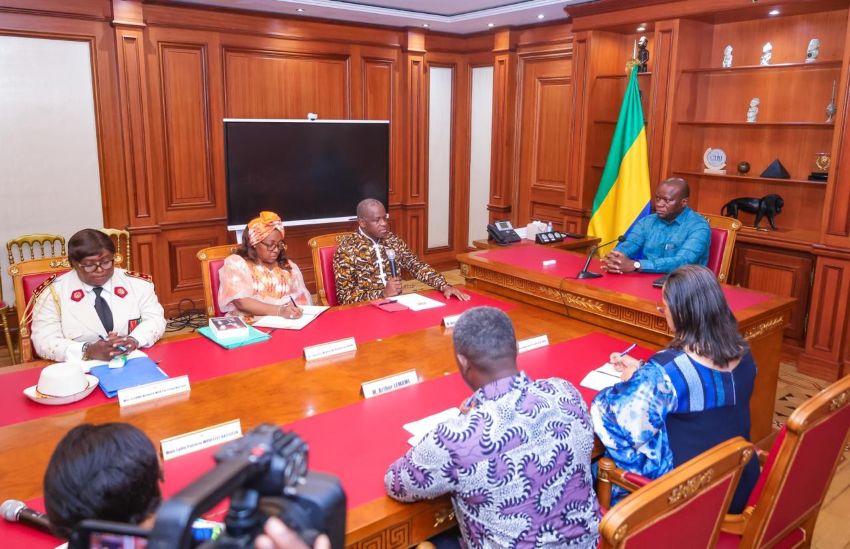
Gabon is experiencing a pivotal moment in its history as President Brice Clotaire Oligui Nguema meets with Reverend Louis Sylvain Allogo Engo, leader of the Evangelical Church of Gabon. This meeting transcends mere protocol; it reflects a deeper dimension of modern governance: the strategic role of religious organizations in strengthening national stability, social cohesion, and the foundations of the Fifth Republic.
As Gabon rebuilds its institutions following a period of political transition, the dialogue between the state and spiritual leaders emerges as a vital tool for governance. Across Africa, religious groups often wield more influence in society than some government agencies. This meeting at the presidential palace carries significant political, social, and symbolic weight.
Religious institutions as silent pillars of stability
The audience granted to the president of the Evangelical Church of Gabon is part of a broader effort to engage with the nation’s moral forces. For decades, religious institutions have played a central role in the daily lives of Gabonese citizens, contributing to education, social action, healthcare, youth mentorship, and community mediation.
To the head of state, these organizations are more than spiritual bodies—they are trusted local partners that promote values of civic responsibility, solidarity, and collective accountability. This reality is not unique to Gabon. Across Africa, religious groups are instrumental in preventing social tensions and preserving peace, shaping citizen behavior through their moral authority.
The presence of the Vice President during the meeting underscores the strategic importance of these exchanges. The government now openly acknowledges that institutional consolidation depends not only on legal frameworks but also on continuous dialogue with the forces that shape society.
Secularism as the foundation of renewed cooperation
One of the most notable aspects of this meeting is the message delivered by President Oligui Nguema, who reaffirmed his commitment to balanced collaboration between the Republic and religious institutions, firmly grounded in the principle of secularism.
This clarification is pivotal. It reflects a determination to preserve the autonomy of both public institutions and religious organizations while fostering cooperation on matters of national interest.
In contemporary democracies, secularism does not imply a lack of dialogue between the state and faith communities. Instead, it establishes a framework where each entity operates within its domain while contributing to the common good.
The Evangelical Church of Gabon stands as a major religious player in the country, with a presence across all regions. For generations, it has accompanied Gabon’s social evolution. Reverend Louis Sylvain Allogo Engo highlighted during the meeting the church’s role in providing spiritual guidance during critical moments in the nation’s recent history.
This mutual recognition underscores a relationship built on trust and a shared understanding of the challenges facing the nation.
Human development at the heart of the partnership
Beyond institutional matters, discussions also focused on the upcoming national synod of the Evangelical Church of Gabon, scheduled for July 20–26, 2026, in Baraka Mission.
The request for state support from religious leaders and the president’s positive response illustrate a broader vision of development—one that encompasses not just infrastructure and economics but also moral guidance, civic education, and community cohesion.
This perspective aligns with contemporary global development priorities, where resilient societies are those that integrate economic performance, institutional stability, and social capital.
By prioritizing engagement with spiritual leaders, Gabon’s government sends a powerful message: modernization is not solely an administrative endeavor but also a community-driven process where shared values are cultivated.
This meeting symbolizes the approach embraced by the Fifth Republic—a commitment to dialogue, consultation, and the pursuit of lasting national consensus. In a world marked by identity fractures and social tensions, Gabon’s choice to strengthen bridges between public institutions and spiritual forces may well be one of the most solid foundations for its future stability.
You may also like
Senegal: how Sonko’s playful jab at Sadio Mané over 2029 is reshaping the political conversation
Senegal’s shadow funds: How unchecked spending drains public trust and budgets
Bénin: le Sénat tient sa séance inaugurale sous la conduite de Patrice Talon
Gabon : la participation citoyenne au cœur de la Ve République
Is Chad truly experiencing a political easing of tensions?