
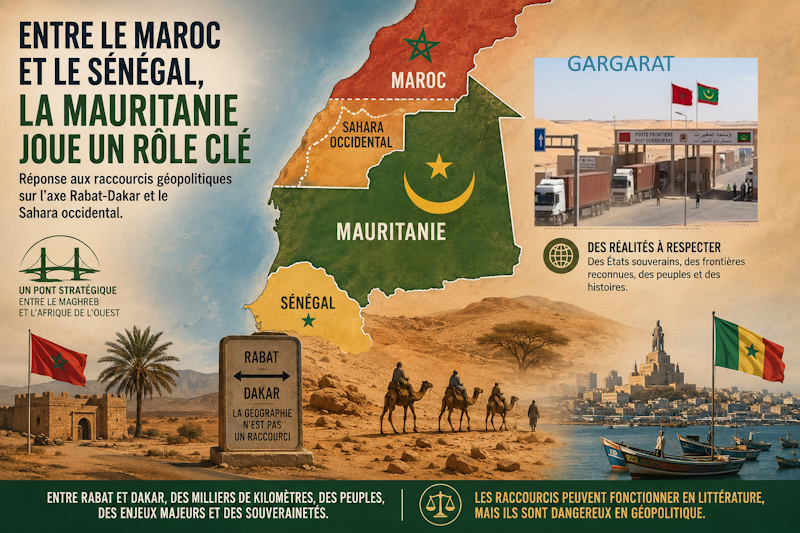

A late July 2026 diplomatic flare-up in Dakar has once again put Mauritania’s unique stance on the Western Sahara conflict under the spotlight. Between a declared policy of “positive neutrality,” economic imperatives, and the preservation of its territorial sovereignty, Nouakchott’s carefully crafted ambiguity has become its defining diplomatic strategy.
When history clashes with diplomacy: The Dakar incident
What began as a diplomatic reception in the Moroccan embassy in Dakar took an unexpected turn when former Senegalese foreign minister Cheikh Tidiane Gadio delivered a speech that sparked regional tensions. By asserting that in Senegalese collective memory, Morocco lies “just a few kilometers” away—an implicit reference to pre-colonial borders—Gadio’s words triggered an immediate reaction from Mauritania’s representative, Mohamed Ould Abdellahi Ould Ethmane. The Mauritanian envoy cut short the address, condemning what he termed a deliberate attempt to rewrite history by denying Mauritania’s very existence.
While Morocco’s ambassador, Hassan Naciri, swiftly stepped in to mediate the escalation, the episode laid bare the tightrope Mauritania walks. The country finds itself caught between attending events celebrating Morocco’s claim to Western Sahara and maintaining its official neutrality in a decades-old territorial dispute.
The fallout from Gadio’s remarks has continued to resonate across Mauritania, with former Mauritanian foreign minister Isselmou Ahmed Izidbih taking a firm stance. In a public statement, Izidbih declared that as a Mauritanian citizen, he would seek to have Gadio declared persona non grata in Mauritania’s territorial waters, airspace, and on its soil.
The diplomatic tightrope: Recognizing without endorsing
This incident in Dakar encapsulates the contradictions inherent in Mauritania’s foreign policy. On one hand, Nouakchott officially recognized the Sahrawi Arab Democratic Republic (SADR) back in 1984, maintains regular communication with the Polisario Front, and carefully avoids alienating Algeria, a key regional ally whose support is vital for Mauritania’s northern border security.
On the other hand, Mauritania stops short of granting the SADR full diplomatic status in its capital. This calculated concession to Rabat underscores Nouakchott’s refusal to endorse Morocco’s territorial ambitions, even indirectly. By participating in official Moroccan commemorations, Mauritania signals respect for its northern neighbor—but only as long as Rabat does not revive, even subtly, the historical concept of a “Greater Morocco” that once included Mauritanian lands.
Guerguerat: Where economics trumps ideology
Beyond symbolic gestures, Mauritania’s approach is driven by raw economic pragmatism. The Guerguerat border crossing, straddling Western Sahara and Mauritanian territory, has become the lifeline connecting Morocco to West Africa. Daily convoys of Moroccan trucks transit through this zone, delivering essential agricultural and manufactured goods to markets in Mauritania, Senegal, and Mali.
For Nouakchott, blocking this trade would be economic self-sabotage. By keeping its borders open and ensuring the security of this commercial artery, Mauritania effectively acknowledges—without formally recognizing—Morocco’s operational control over the territory. This delicate balancing act allows the country to reap economic benefits while preserving its strategic autonomy.
A strategy of survival: Why Mauritania refuses to take sides
To regional analysts, Mauritania’s “both at once” diplomacy is not indecision but a deliberate survival strategy. Geographically trapped between an economically assertive Morocco and a geopolitically vigilant Algeria, Nouakchott cannot afford to openly side with one camp without risking economic retaliation or border instability.
The controversy ignited by Cheikh Tidiane Gadio’s comments serves as a stark reminder: Mauritania’s neutrality, however carefully managed, remains highly volatile. Whenever its national identity or territorial integrity appears threatened by neighboring ambitions, Nouakchott swiftly abandons its usual restraint to reassert its role as the indispensable—and sovereign—stabilizing force in the Maghreb.
You may also like
Bénin: le Sénat tient sa séance inaugurale sous la conduite de Patrice Talon
Gabon : la participation citoyenne au cœur de la Ve République
Is Chad truly experiencing a political easing of tensions?
Accord FMI-Sénégal : Thierno Bocoum exige la transparence sur les conditionnalités
Ousmane Sonko demands full transparency on Senegal’s new FMI agreement