Gabon and EU elevate partnership to strategic partnership
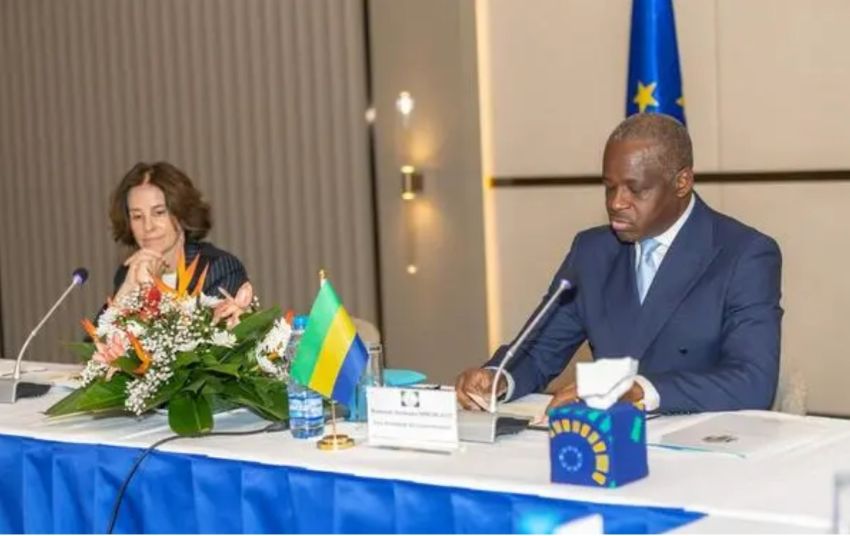
Libreville, June 9, 2026 — The high-level strategic dialogue between Gabon and the European Union held in Libreville marks a turning point in bilateral relations. Far from a routine diplomatic exchange, this meeting reflects Gabon’s ambition to transition from aid recipient to equal partner in economic, political, and environmental spheres.
The discussions, held at the Palais des Congrès Omar Bongo Ondimba, brought together Gabonese Vice-President of the Government Hermann Immongault and EU Ambassador to Gabon Cécile Abadie. Together, they outlined a new cooperation framework built on investment, local value creation, skills transfer, and recognition of Gabon’s strategic role in regional and global stability.
Assessing Gabon’s democratic transition
The second session of the Gabon-EU political dialogue was closely watched as the first major international assessment of the new institutional cycle following the 2025 presidential election. Political reforms and governance took center stage, with Minister of Reform and Relations with Institutions François Ndong Obiang detailing the new Constitution’s provisions.
Key highlights included institutional recognition of indigenous peoples and the integration of the diaspora into national institutions. Authorities emphasized these changes as steps toward a more inclusive governance model aligned with contemporary realities. The 2025 elections were also reviewed, with Libreville citing over 70% voter turnout as proof of public trust in the new order.
The underlying goal remains clear: bolstering Gabon’s democratic credibility to secure investments and enhance economic appeal.
From aid to co-investment: redefining Gabon-EU relations
Vice-President Immongault delivered a bold message to Brussels: it is time to shift from aid dependency to reciprocal economic partnership. This approach aligns with the Samoa Agreement, the EU’s framework for cooperation with African, Caribbean, and Pacific states.
Gabon’s priorities include attracting European capital for industrial development, infrastructure, local resource processing, renewable energy, digital innovation, and workforce training. President Brice Clotaire Oligui Nguema’s economic diversification agenda—reducing reliance on raw material exports and accelerating industrialization—finds strong resonance here.
Ambassador Abadie echoed this sentiment, stressing the need for cooperation tools that prioritize tangible economic outcomes and mutual interests.
Gabon’s green diplomacy takes center stage
Environmental cooperation dominated discussions, with Gabon highlighting its 88% forest cover and role as a vital part of the Congo Basin—Earth’s second-largest carbon sink after the Amazon. Libreville argues that preserving these ecosystems merits greater financial recognition.
Immongault underscored the significant costs borne by forest nations in protecting biodiversity. Gabon advocates for stronger international mechanisms to fund ecological transitions, balancing conservation with economic progress—a demand increasingly echoed in global climate debates.
The talks also covered regional cooperation, Central African stability, CEEAC’s role, Gulf of Guinea security, and multilateralism. Ultimately, this dialogue signals Gabon’s intent to redefine its place in the international order: more stable domestically, assertive diplomatically, and ambitious economically.
For both Libreville and Brussels, the stakes extend beyond bilateral ties. The challenge is to forge a partnership model that addresses growth, ecological transition, and regional stability simultaneously. The future of Gabon-EU relations hinges on their ability to blend national sovereignty with international collaboration.