DRC’s UN address highlights Rwanda’s inaction over critical minerals and peace
Women
- Security
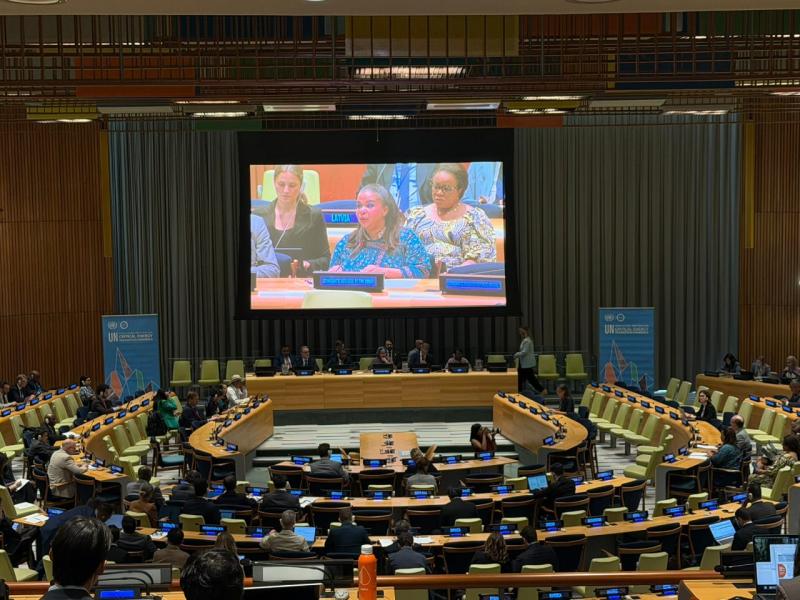
As a global leader in critical minerals essential to the energy transition, the Democratic Republic of the Congo took center stage on Tuesday, 14 July, at a high-level United Nations meeting in New York. The event, convened by the UN Secretary-General, brought together member states to address the governance challenges surrounding minerals vital for the world’s shift to cleaner energy sources.
The Congolese delegation, led by State Minister Thérèse Kayikwamba Wagner, Minister of Foreign Affairs, International Cooperation, Francophonie, and Congolese Abroad, included members of the DRC’s Permanent Mission to the United Nations.
In her address, the foreign minister emphasized that for the DRC, the issue of critical minerals transcends mere economic considerations. She highlighted the situation in the country’s eastern provinces, particularly the Rubaya mining basin, a key coltan production hub, to illustrate her point.
« For countries like mine, this is no longer just a development issue. Illicit exploitation weakens state authority, erodes sovereignty, and can even lead to violations of territorial integrity. The case of Rubaya is stark. Its mines account for roughly 15% of global tantalum demand. According to UN experts, at least 1,400 tons of coltan were clandestinely smuggled into Rwanda in the year following their seizure by the M23—a rebel group backed by Kigali—which generated approximately $800,000 per month for the armed faction, » she stated.
The minister also condemned the UN’s failure to impose sanctions on Rwanda’s Defence Forces, despite documented evidence provided by UN experts.
« Yet, despite overwhelming proof, Rwanda’s Defence Forces remain unsanctioned by the UN. This exposes both a failure to enforce existing tools and a broader flaw in the international system, which often confines the governance of natural resources to the realm of development—even when illicit exploitation fuels armed conflicts, undermines sovereignty, or violates territorial integrity, » she declared.
During the meeting, the DRC reaffirmed its commitment, as president of the UN Security Council, to promote a framework linking natural resource governance directly to conflict prevention and peacebuilding.
« That is why, during our presidency of the Security Council, the DRC advocates for a more coherent framework linking natural resources to conflict prevention, international peace and security, and shared prosperity. We welcome the Secretary-General’s guiding principles and concrete recommendations, but these will only matter if they translate into measurable changes on the ground, » she noted.
At the UN, Thérèse Kayikwamba Wagner also underscored the need for more balanced partnerships with countries producing critical minerals. She called for shared responsibility among all actors in the mineral value chain.
« Partnerships must extend beyond securing access to raw materials. They should support local and regional value addition, infrastructure, technology transfer, research, skills development, industrialization, and access to financing and markets. Responsibility must span the entire value chain—from the mine to the end user. Producers, traders, processors, financial institutions, manufacturers, and consumer countries must all share this burden, » she stressed.
Addressing traceability, the foreign minister argued that it must effectively combat fraud and armed group financing without penalizing legitimate artisanal miners.
« Traceability must target fraud, smuggling, and conflict financing while safeguarding legitimate artisanal producers, avoiding new market barriers, or placing the full burden of compliance on producing countries. This initiative aligns with the Sustainable Development Goals: clean energy, decent work, industrialization, responsible production, climate action, strong institutions, and global partnerships, » she explained.
The Congolese diplomat further stressed that the success of the global energy transition should be measured not only by industrial output but also by its impact on the people of resource-rich nations.
« Progress toward one goal must never come at the expense of another. Ultimately, the success of the energy transition will not be measured solely by the number of batteries, electric vehicles, or wind turbines produced. It will also be judged by whether the countries, workers, and communities whose resources make this transition possible are safer, more sovereign, and more prosperous because of it, » she insisted.
These initiatives come amid a strategic partnership between the DRC and the United States on critical minerals, as well as the Washington Agreement signed between Kinshasa and Kigali. This accord includes de-escalation measures, the gradual withdrawal of Rwandan forces from Congolese soil, and the neutralization of armed groups operating in eastern DRC—particularly the FDLR, which Kigali considers a security threat. Despite this diplomatic framework, widely praised at the time of its signing, the security situation remains highly fragile. On the ground, the Doha process, brokered under Qatar’s auspices to facilitate dialogue between Kinshasa and the M23 rebels, remains stalled. The AFC/M23 rebels, accused by Kinshasa, the UN, and several international partners of receiving Rwandan support, continue to control cities such as Goma and Bukavu, along with several other localities in North Kivu and South Kivu provinces. Clashes persist in various areas, while diplomatic efforts struggle to yield lasting results, reigniting debates about the persistent gap between announced diplomatic progress and ground realities.
Related Posts
Morocco and Benin strengthen bilateral ties with 14 key agreements in Cotonou
In a landmark gathering that underscored shared ambitions for growth and stability, Morocco and Benin elevated their bilateral relationship to…
Ivorian education system to embrace national languages with new linguistic policy
Grand-Bassam recently hosted a pivotal event as Côte d’Ivoire advances its educational reform. From July 10 to 12, 2026, stakeholders…
Wagner’s abduction of humanitarian Joseph Figueira in Central African Republic raises alarm
On the evening of Sunday, May 26, 2024, as dusk settled over Zemio, a sense of camaraderie filled the courtyard…