DRC east: UN mission ready to enforce ceasefire monitoring
- Security
In a region plagued by persistent clashes between government forces and the AFC/M23 rebellion—backed by Rwanda and controlling vast areas of North Kivu and South Kivu—the United Nations Organization Stabilization Mission in the DRC (MONUSCO) has reaffirmed its readiness to support ongoing peace processes. These initiatives include the Washington Agreement and the Doha process, backed by the African Union, aimed at restoring peace and stability in eastern DRC.
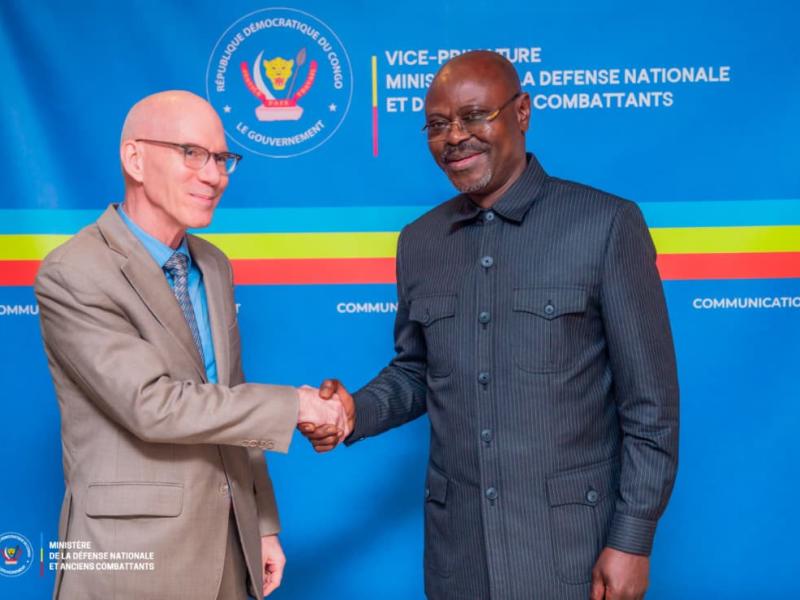
James Swan, UN Special Representative and head of MONUSCO, made this clear on July 2 following a meeting at the Defense Ministry with Vice Prime Minister and Minister of National Defense and War Veterans, Guy Kabombo. He highlighted that MONUSCO has bolstered operational and logistical capabilities of the Enhanced Joint Verification Mechanism (MCVR+), aligning with its mandate to support regional efforts for peace and stability in eastern DRC.
“Since December 2025, following UN Security Council Resolution 2808, we have received a new mandate to support the ceasefire monitoring and verification mechanism. We discussed our ongoing efforts to implement this mandate and how we intend to collaborate with the Ministry of National Defense and War Veterans to achieve MONUSCO’s objectives,” Swan stated after the meeting.
With urgent calls from DRC partners—including during the Washington Agreement review in London and recent UN Security Council sessions—for the swift deployment of the first ceasefire verification mission in eastern DRC, Swan confirmed that MONUSCO is fully prepared. The mission awaits only the official designation of sites for verification operations.
“MONUSCO has already contributed to implementing the Enhanced Joint Verification Mechanism (MCVE+). Under our mandate, we are tasked with providing logistical support and security oversight for MCVE+ activities. Following additional requests, we have provided logistical assistance and are already planning to support missions at identified ceasefire monitoring sites. We are ready as soon as the mechanism finalizes site selections,” Swan assured.
During the discussions, Swan and the Vice Prime Minister also reviewed other aspects of MONUSCO’s mandate. Swan emphasized the need for stronger collaboration between MONUSCO, the Ministry of National Defense, and the Armed Forces of the Democratic Republic of the Congo (FARDC).
“MONUSCO maintains close collaboration with the Ministry of National Defense and War Veterans, as well as DRC authorities. With over 8,000 military personnel and working closely with FARDC—particularly in the Grand Nord and Ituri—we sought to share key activities with the minister and reaffirm our core mandates: protecting civilians, supporting disarmament, demobilization, and reintegration of armed groups, and contributing to security sector reform,” Swan explained.
This meeting follows renewed pressure from DRC partners, including the U.S., after the London session of the sixth Joint Oversight Committee (CMS) meeting, which assessed progress on the Washington Agreement. This agreement aims to restore peace and security in the Great Lakes region, particularly eastern DRC.
Following the discussions, Kinshasa and Kigali reiterated commitments to accelerate the implementation of agreed measures. According to the final communiqué issued by the U.S. State Department, both parties pledged to “request an adjustment to the EJVM+ mandate to include verification of commitments made under the Washington Agreements.” They also agreed to “support the rapid deployment of EJVM+ to undertake its first verification mission” and “urge all actors on the ground to support this initiative.”
Additionally, the DRC and Rwanda vowed to “create conducive political and security conditions for joint verification processes,” a critical step for the effectiveness of peace mechanisms.
Under UN Security Council Resolution 2808 (2025), MONUSCO is authorized to support the implementation of a permanent ceasefire, including technical and logistical assistance to the International Conference on the Great Lakes Region (ICGLR) through the Enhanced Joint Verification Mechanism Plus (EJVM+).