Escalating Terrorist Threats and Military Setbacks
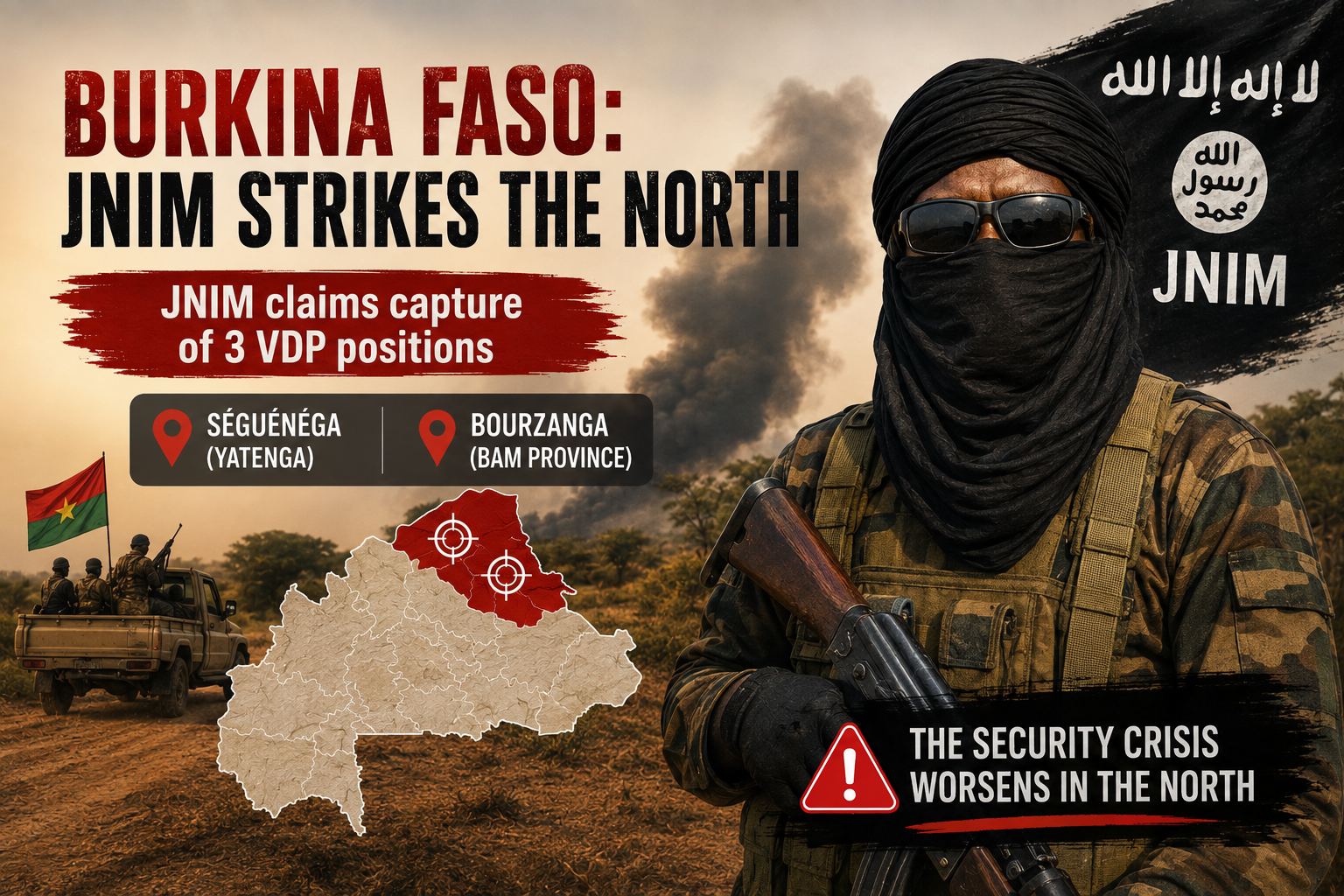
The ongoing security crisis in Burkina Faso continues to deepen, with government communication strategies drawing increasing scrutiny. On 19 August, the militant group Jama’a Nusrat ul-Islam wa al-Muslimin (JNIM) claimed responsibility for seizing three strategic positions held by the Volunteers for the Defence of the Homeland (VDP) in the country’s North. The attacks, marked by extreme violence, specifically targeted Séguénéga in the Yatenga region and Bourzanga in the Bam province, underscoring the persistent expansion of armed groups across the region.
The recent assaults highlight a critical vulnerability in counter-terrorism efforts: the inability of security forces to sustain control over reclaimed or secured areas. The frequency of attacks, relentless pressure on civilian populations, and persistent weaknesses in defence infrastructure reveal that military victories alone are insufficient. A comprehensive approach encompassing sustained state presence, intelligence-driven operations, logistical support, and robust civilian protection is essential to counter the threat effectively.
The Role of the VDP and Escalating Risks
The VDP, integral to Burkina Faso’s security architecture, frequently bears the brunt of these attacks. Unlike conventional military forces, VDP units often lack advanced weaponry and mobility, leaving them disproportionately exposed to well-armed militant factions. The loss of each position extends beyond mere military setback; it erodes public trust, triggers mass displacement, and obstructs humanitarian access—compounding the crisis.
Government Communication and Strategic Leadership
In response to the deteriorating security landscape, Captain Ibrahim Traoré, leader of the transitional government, has faced criticism for his approach to crisis communication. Rather than addressing systemic security failures through transparent assessments, his administration has resorted to disjointed media engagements. These speeches, often populist in tone and lacking cohesive direction, appear to serve as distraction tactics rather than genuine crisis management strategies. Such attempts to deflect public frustration fail to address the daily realities of insecurity that continue to plague Burkinabè communities.
It is crucial to recognize that political rhetoric cannot substitute for tangible progress on the ground. Declarations emphasizing sovereignty, resistance, or ideological shifts may resonate with certain segments of the population, yet they do little to safeguard villages, secure road networks, or prevent attacks on military and auxiliary installations. What citizens demand is visible, measurable improvement in their security and quality of life.
The Erosion of Accountability and Independent Reporting
The capacity for critical analysis and public scrutiny has significantly diminished in Burkina Faso. Once a vibrant media landscape, the sector now faces severe restrictions. Journalists and dissenting voices attempting to document or report on ground realities increasingly encounter systematic repression. Many have been detained, forcibly relocated to so-called ‘re-education’ camps, or conscripted into frontline service under the guise of patriotism punished for the sole act of reporting the truth.
This suppression of independent journalism poses a grave concern. In conflict zones, unbiased reporting serves as a vital mechanism for evaluating progress, identifying weaknesses, and exposing humanitarian crises. Silencing those who document reality does not eliminate problems; it widens the gap between official narratives and lived experiences. By controlling the national discourse, authorities may manipulate perception, yet they cannot alter the enduring realities of war attacks, displacement, and loss of life remain unaddressed truths.
The Consequences of Rejecting Criticism
The current approach to governance reflects a paradox: while the security situation demands transparency, honesty, and open debate, the space for constructive criticism continues to shrink. Effective counter-terrorism strategies require the ability to acknowledge failures, assess their causes, and implement corrective measures promptly. Avoiding contradiction may yield short-term political gains, but it deprives decision-makers of essential insights needed to refine their approach.
By restricting free and independent information, the government entrenches itself in a cycle of denial that fails to resolve the root causes of the crisis. Counter-terrorism demands resilience and collective action, but it also requires accountability, openness, and the courage to confront challenges directly. Ultimately, the most telling indicator of success lies not in speeches or slogans but in the tangible safety of civilians. As long as militant groups continue to advance and exert pressure, Burkina Faso’s leadership must be held accountable for the outcomes of its strategies. Propaganda may win a battle of perception, but it cannot by itself prevail in the war against terrorism.