When administrative edicts override fundamental rights
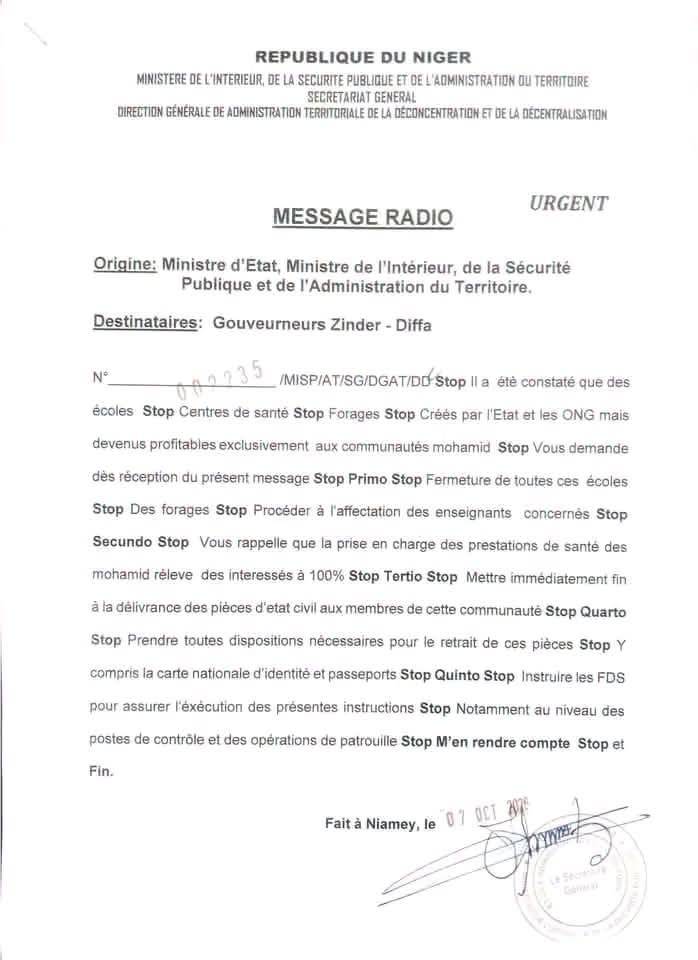
On October 7, 2026, a blunt radio bulletin from Niger’s Ministry of Interior sent shockwaves across Zinder and Diffa: schools serving the Mohamid community were to close, water boreholes supplying their households were to be shut down, and health posts were ordered to stop collective billing for their treatment. Worse, the notice directed local officials to withhold birth certificates, national identity cards and passports from every Mohamid household, and even to revoke documents already issued. Security forces were instructed to enforce these measures immediately.
This sweeping ban is more than routine policy; it strikes at the core of citizenship under General Abdourahamane Tiani’s transitional junta. The question now facing Niamey is stark: can a state suspend the most basic rights of an entire population in the name of national security?
The pillars of dignity under siege
School attendance, clean water, medical care and legal identity are not privileges to be granted or revoked on the basis of ethnicity or tribe. They are the bedrock of human dignity, everyday survival and full participation in society.
Education – With schools shut down and teachers reassigned, hundreds of Mohamid children risk learning gaps that could endure for generations. Where will displaced students register, and who will provide qualified instructors?
Water – In the Sahel, boreholes are life. Cutting off water sources does not just inconvenience families; it endangers their livestock, the primary asset of many pastoral households.
Health – Removing collective health coverage means parents must choose between paying for medicine or feeding their families. The result: preventable illnesses surge, and maternal mortality climbs.
Legal identity – Without identity documents, travel, banking, land transactions and even food aid become impossible. A suspended passport can trap a breadwinner abroad, while the loss of a birth certificate may condemn a child to statelessness.
Law-abiding administration is not served by blanket punishments; it is undermined by them.
Collective guilt versus individual justice
The stated rationale is security. Diffa’s borderlands face real threats from armed groups and illicit trafficking. Yet, security cannot be built on the assumption that every member of a single ethnic community is a suspect. Criminal responsibility is personal; suspicion must be evidence-based, not inherited.
If criminal activity is suspected within the Mohamid community, investigators have lawful tools: targeted surveillance, controlled deliveries, undercover operations and due process. Closing schools and revoking IDs do not detect bombs; they punish innocence.
The junta’s transitional charter guarantees equal protection under the law. When a decree labels an entire group a risk without naming individuals or presenting evidence, that charter is torn.
From political crackdown to ethnic targeting
Since the July 26, 2023 coup toppled President Mohamed Bazoum, Niger’s military leadership has steadily narrowed civic space. Human rights monitors have documented the dissolution of opposition parties, the shuttering of civil-society groups, detention of journalists and the revocation of citizenship for exiled critics.
On September 22, 2026, authorities stripped five opposition figures of provisional nationality, bringing the total to 25 since 2024. Although these cases target named individuals rather than entire communities, they share a disturbing tactic: the use of executive power to strip rights without robust judicial review.
Whether the October 7 directive originated at the highest level or filtered down the chain of command, it reveals a pattern: administrative coercion replacing legal accountability.
Human and economic fallout beyond the headlines
The Mohamid are not isolated: they run shops, transport goods and herd livestock across Diffa and Zinder. When their children cannot attend school, their sick cannot see doctors and their merchants cannot cross borders, the entire local economy contracts.
- Farmers lose access to water, reducing fodder and milk yields.
- Traders face border closures and document seizures, stranding goods in transit.
- Households burn savings on inflated private healthcare, pushing families deeper into poverty.
The junta must quantify these costs and compensate affected households—not through vague promises, but through transparent, verifiable relief programs.
The road ahead: safeguarding equality before the law
General Tiani has pledged to restore order. But order built on discrimination is not stability—it is a time bomb of resentment. Niger’s international partners, including regional blocs and development lenders, should make continued cooperation conditional on immediate rescission of discriminatory measures and the creation of an independent commission to investigate the October 7 directive.
The test of any government is not how swiftly it can suppress perceived threats, but how firmly it can uphold the principle that no citizen is above the law and no law is above justice. For the Mohamid, that test has already failed.