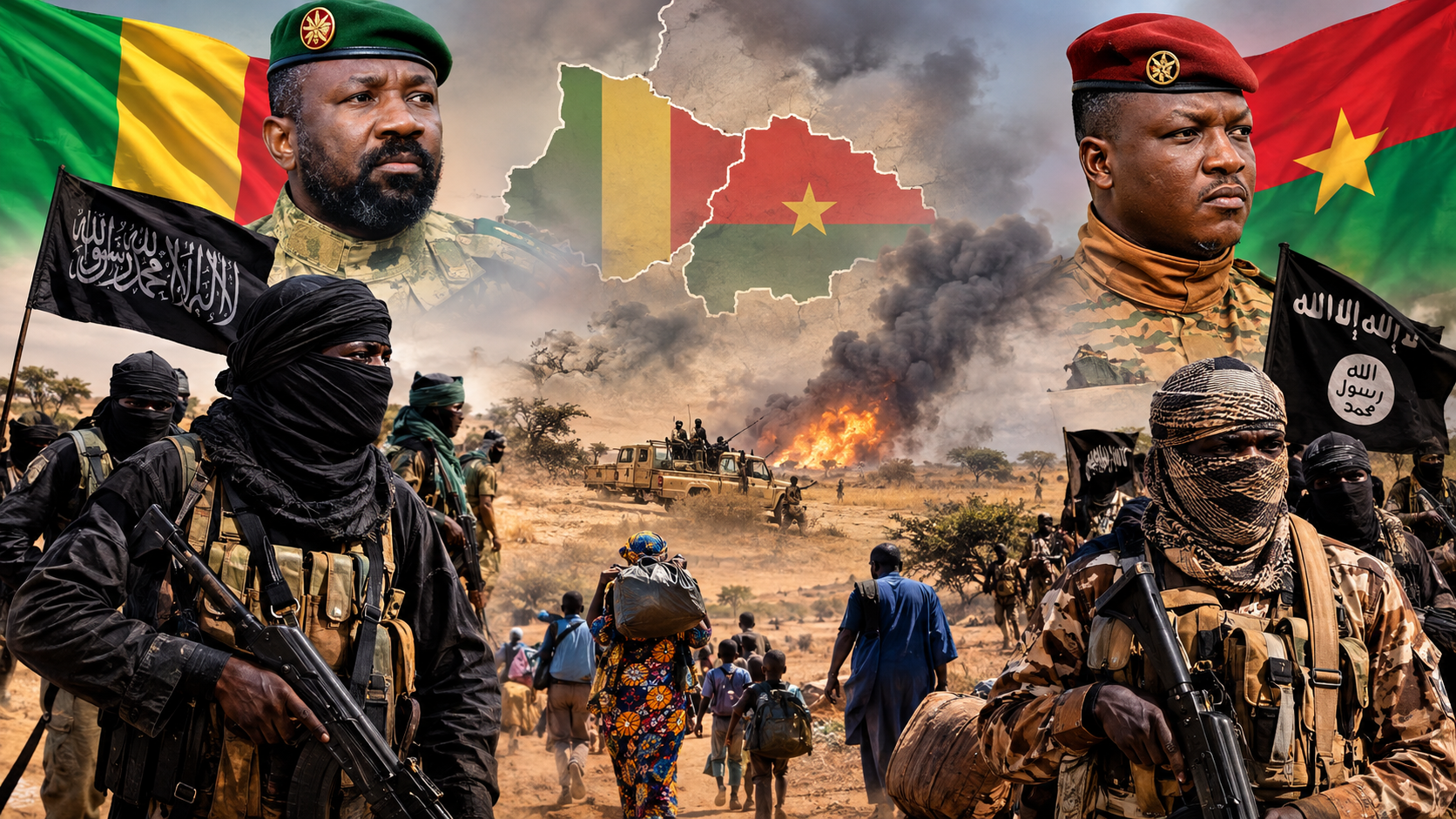
The stretch of land along the Mali-Burkina Faso border has emerged as one of the most volatile fronts in the Sahel’s ongoing conflict. Escalating clashes between militants from the Support Group for Islam and Muslims (JNIM), an Al-Qaeda affiliate, and the Islamic State in the Sahel (EIS) underscore a stark reality: armed groups now dictate the terms of engagement, while state authorities struggle to assert control over contested zones.
From promises to paralysis: how juntas failed to fulfill security pledges
The military-led governments in both Bamako and Ouagadougou rose to power on promises to restore order, reclaim lost territory, and dismantle jihadist networks. Yet years after their ascent, the security situation remains dire. Civilians in border regions face unrelenting violence, forced displacements, and a collapsing social fabric, as state forces prove unable to curb armed group expansion.
The rivalry between JNIM and EIS adds a dangerous layer to the crisis. These factions, which already target national armies, now engage in pitched battles for territorial dominance, control over trade routes, and influence over local populations. The result is a humanitarian catastrophe, with communities caught in the crossfire of competing jihadist agendas.
Sovereignty vs. reality: the widening gap between rhetoric and results
Both Malian and Burkinabe authorities have framed their governance around reclaiming sovereignty and reasserting state authority. However, the unchecked clashes along the shared border expose a glaring disconnect. Political declarations, military posturing, and assurances of security have failed to translate into tangible protection for citizens.
For citizens in conflict zones, the consequences are immediate and devastating. Displacement camps swell as families flee violence, while infrastructure collapses under the weight of repeated attacks. The juntas’ inability to stabilize these areas raises critical questions about the viability of their counterterrorism strategies.
Beyond military tactics: the missing pillars of Sahel security
A sustainable solution to the crisis cannot rely solely on armed confrontation. Effective stabilization requires a multi-faceted approach: robust intelligence networks, sustained administrative presence, civilian protection mechanisms, and cross-border cooperation tailored to the region’s unique challenges. The current approach, dominated by military operations, has proven insufficient in breaking the cycle of violence.
A shifting balance of power
The escalation between JNIM and EIS is not merely a tactical shift but a strategic realignment. By consolidating control over swathes of territory, these groups are redefining the power dynamics across the Sahel. For the juntas, the challenge is twofold: countering the jihadist threat while curbing internal fragmentation that undermines their legitimacy.
What future for the Mali-Burkina Faso border?
The border region’s descent into chaos serves as a microcosm of the broader Sahel crisis. While juntas assert their commitment to restoring stability, the persistence of jihadist warfare challenges the very foundations of their authority. For civilians, the question is no longer about political promises but about survival.
The time for action is now. Without a fundamental rethinking of security strategies, the cycle of violence will continue unabated, further eroding trust in state institutions and leaving populations at the mercy of armed groups. The juntas face an urgent choice: double down on failed tactics or embrace a comprehensive approach to reclaim their territories and protect their people.
By Daniel Mbami — Journalist