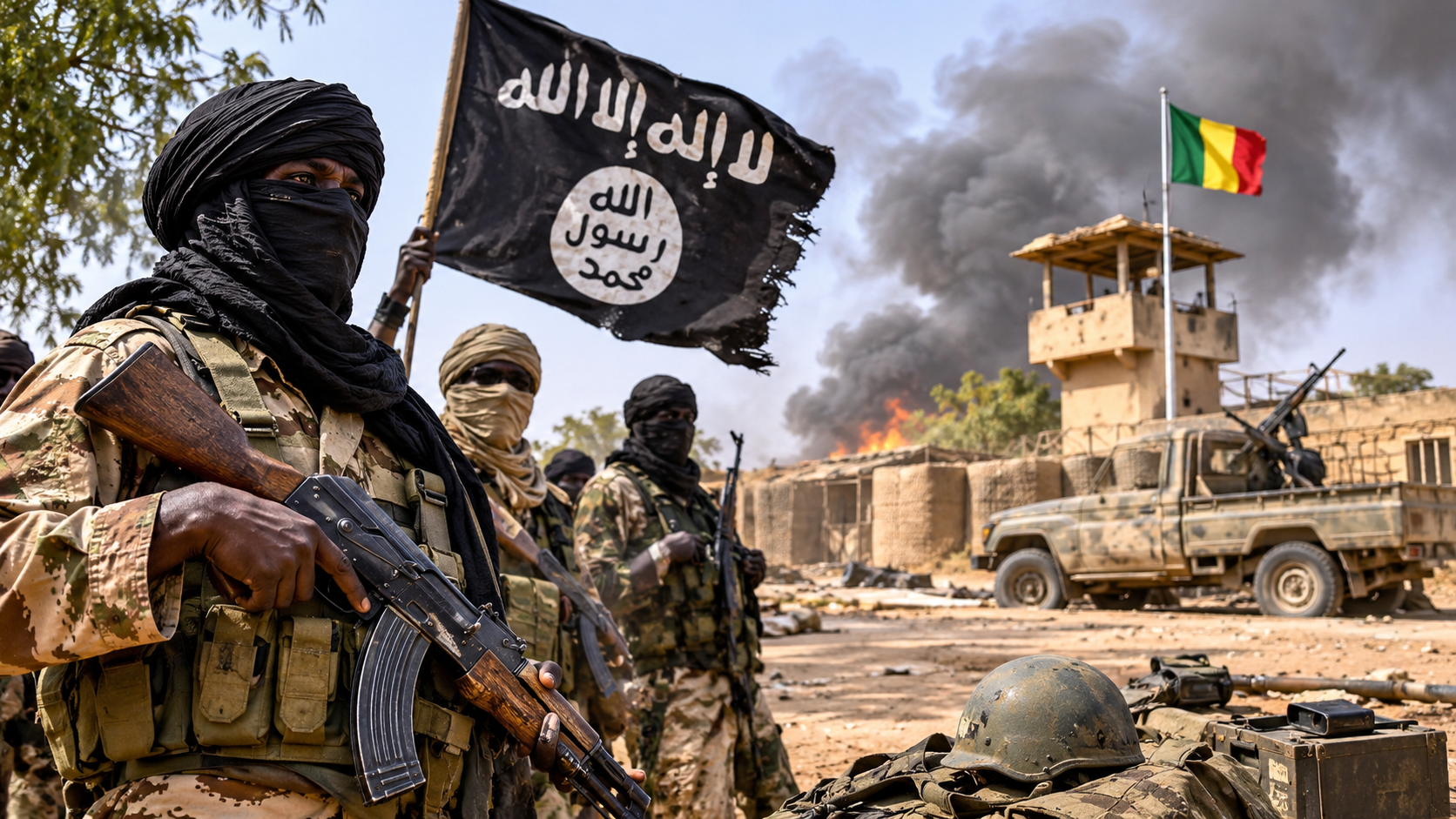
The security landscape in Mali’s Mopti region has taken a dramatic turn following a high-impact attack claimed by the Group for the Support of Islam and Muslims (JNIM). In the early hours of Saturday, October 31, 2026, the jihadist coalition targeted a strategic position near Bayman, held by pro-junta militias aligned with Mali’s military leadership. The assault, which the JNIM describes as a decisive operation, has raised urgent questions about the resilience of Bamako’s security strategy.
JNIM’s offensive exposes vulnerabilities in Mali’s defense network
The attack, claimed through an official statement, asserts that the militants neutralized several fighters stationed at the site. More critically, the JNIM claims to have seized control of the position, previously manned by militias it refers to as “Russafricans” a term highlighting their alleged ties to the Russian-Malian security apparatus. While the militant group’s claims remain unverified, the incident underscores a troubling pattern of jihadist incursions into areas previously considered secure.
Unverified casualties and the shadow of past setbacks
As with many recent clashes in the region, the human toll of the Bayman attack remains unclear. The JNIM’s claim of neutralizing enemy combatants lacks independent confirmation, leaving the exact number of casualties a mix of dead, wounded, and potential captives unknown. This ambiguity is not unprecedented; earlier this year, the JNIM’s assault on Dioura on September 10 resulted in significant losses for Malian forces, with reports of over 100 soldiers and five Russian paramilitaries killed, alongside dozens of others captured.
Russian partnership fails to deter jihadist advances
The persistent threat posed by the JNIM has cast doubt on the effectiveness of Mali’s military alliances, particularly its collaboration with Russian security contractors. Despite joint operations, aerial bombardments, and repeated military victories announced by Bamako, jihadist groups continue to infiltrate and overrun key positions. Official military reports, including one released on October 31, boast of neutralizing over 4,800 militants and conducting more than 850 airstrikes since May 2026. However, the credibility of these figures is questionable, as they rely solely on Malian military sources and lack independent verification.
The stark contrast between these claims and the reality of ongoing attacks paints a concerning picture. While the military’s rhetoric emphasizes progress, the ground situation suggests a far more precarious security environment. If the JNIM’s capture of Bayman is confirmed, it would mark another operational failure for forces allied with Mali’s ruling junta, further destabilizing the region.
A critical moment for Mali’s security strategy
Beyond the immediate aftermath of the Bayman attack, a broader question looms: How long can Mali’s military sustain its positions against an emboldened insurgency? The repeated failures to secure key areas, despite external support and military campaigns, highlight systemic weaknesses. With populations caught in the crossfire and trust in state security forces eroding, the stakes could not be higher. The international community’s role, particularly that of Mali’s allies, is now under scrutiny as the country grapples with an insurgency that shows no signs of abating.
Key takeaways from the Bayman assault
The JNIM’s attack on Bayman signals a new phase in Mali’s security crisis, challenging the junta’s narrative of military progress.
Unverified casualty reports and past setbacks, such as the Dioura attack, underscore the fragility of Mali’s defense infrastructure.
The Russian-Malian military partnership, while prominent in official communications, has yet to translate into tangible security improvements on the ground.
With jihadist groups continuing to exploit gaps in Mali’s defenses, the junta faces mounting pressure to reassess its strategy.
By Élise Ntamag — Journalist