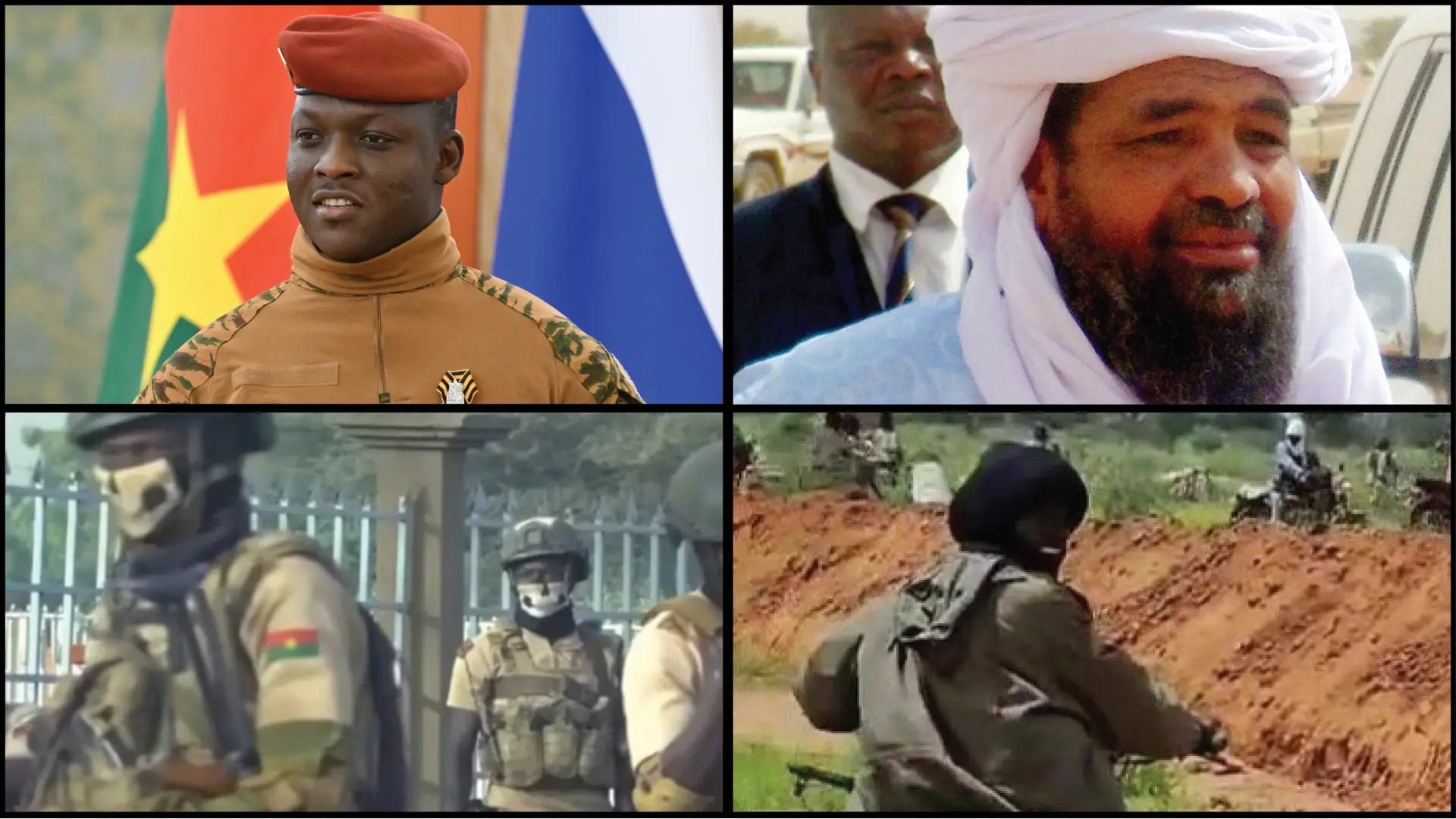
At 36, Captain Ibrahim Traoré, adorned with freshly minted captain’s insignia, presides over a presidential palace he did not secure through democratic elections. Such polls, after all, have been abolished under his rule. This arrangement offers a convenient pathway: with democracy set aside, the need to mislead voters vanishes, replaced by direct misrepresentation to journalists.
This is precisely the scene unfolding within the Koulouba palace. For a full two hours, the youthful captain regales six assembled journalists with a carefully constructed narrative. He asserts that the military is reclaiming lost territories, that local industry is thriving, gold reserves are accumulating, the national highway network is expanding, and the people of Burkina Faso are experiencing unprecedented levels of freedom. One might almost expect a triumphant musical score and a flag majestically billowing in the background.
The disturbing counter-narrative
Yet, as Captain Traoré delivers his uninterrupted discourse, a starkly different account emerges. Human Rights Watch (HRW) releases a comprehensive 351-page document, replete with survivor testimonies, irrefutable satellite imagery, and chilling lists of the deceased. Titled “No One Will Escape,” the report details the tragic deaths of 1,837 civilians over a two-and-a-half-year period. The perpetrators, according to the findings, include the national army, the VDP militias, and jihadist groups like JNIM. While violence stems from multiple sources, the report underscores a critical distinction: state-affiliated forces are documented engaging in systematic killings, often with drone surveillance and explicit directives from higher command.
The report lays bare a litany of atrocities: war crimes, crimes against humanity, and the deliberate ethnic targeting of the Fulani population. It meticulously records the summary execution of 223 civilians, including 56 children, in Nondin in February 2024. Hundreds more perished in Baraboulé in December 2023, and approximately 130 Fulani individuals were brutally massacred near Solenzo in March 2025. The evidence includes numerous mass graves and compelling survivor accounts, corroborated by satellite data.
Naturally, such damning evidence is often dismissed as a mere Western conspiracy.
Towns ‘liberated’ from their inhabitants
Ironically, Captain Traoré proudly cites the very same towns — Baraboulé, Pétégoli — that feature prominently in the HRW investigation, proclaiming them “recaptured!” A commendable achievement, perhaps, were it not for HRW’s documentation of “Operation Tchéfari 2” in these areas. Known as “The Warriors’ Honey” in Fulfulde, even massacres, it seems, can be given a euphemistic label. This operation saw the military responsible for the deaths of hundreds of civilians across 16 villages. While state television hailed it as a resounding “success,” survivors paint a grim picture of a slaughterhouse. Perception, it appears, is everything.
Traoré attempts to deflect blame by asserting that the killings are perpetrated by terrorists disguised in military uniforms who then film their own actions. This explanation suggests an astonishing level of operational sophistication for individuals who, by Traoré’s own description, merely “read the Quran in the bush.” It would imply these terrorists don Burkinabè army fatigues, call upon military drones, coordinate multiple battalions, execute their acts, and then seamlessly vanish.
The unmentionable community
During his two-hour interview, the term “Fulani” remained conspicuously absent. Not once. Zero. Nada. This omission is akin to recounting the history of World War II without acknowledging the Jewish people – technically feasible, yet morally reprehensible.
HRW’s findings extensively document the systematic persecution of the Fulani community, which constitutes 8% of the population. They are collectively accused of terrorism, their villages subjected to massacres, and hundreds of thousands forcibly displaced. The report even quotes Traoré himself, addressing Fulani leaders in February 2023: “There will be many dead. And it will be more complicated for your community.” His chief of presidential guard reportedly delivered an even more chilling message: “We will kill them all.”
Evidently, there isn’t a “Fulani problem” in Burkina Faso; rather, there is a problem with the Fulani.
A peculiar definition of freedom
Traoré emphatically declares that citizens in Burkina Faso are “much freer” than their European counterparts. This assertion rings true in a disturbing sense: they are indeed free to vanish. Journalists have been abducted and conscripted into militias, independent media outlets forcibly shut down, and human rights advocacy websites blocked. The electoral commission has been dismantled, and the death penalty reinstated.
Adding to this oppressive environment, pro-junta troll networks — dubbed the “BIR-C,” or Rapid Communication Intervention Battalions — inundate social media platforms with propaganda and deepfakes that idolize the young captain. In comparison, the propaganda machinery of Kim Jong-un might almost appear rudimentary.
Justice, selectively applied
Human Rights Watch advocates for Captain Traoré to face investigation for command responsibility, identifying six generals by name. To date, none have been brought to trial. The junta’s decision to withdraw from the International Criminal Court is telling; it suggests that when one has nothing to conceal, the natural inclination is to distance oneself from international tribunals.
In stark contrast, Traoré publicizes videos of minor traffic infractions, humiliating corrupt police officers for pocketing sums as meager as 500 CFA francs. Such petty corruption is framed as a national disgrace, while the massacre of hundreds of civilians by the army is conveniently labeled “terrorist perfidy.” The regime’s priorities are unmistakably clear.
The perennial scapegoat: the West
Any criticism is swiftly dismissed: a European Parliament resolution is deemed “interference,” the French army chief is told to “mind his own business,” NGOs are branded “manipulators,” and the media are labeled “liars.” The internet is “fake,” territorial maps are “fake,” and even a 351-page report based on 450 interviews is declared “also fake.” In this narrative, everything is fabricated except for his own pronouncements.
The historical grievance of postcolonial exploitation is undeniably real; France’s historical plundering of Africa is an established fact. However, leveraging this legitimate historical wrong as an impenetrable shield against accountability, while simultaneously orchestrating the massacre of one’s own populace, mirrors the tactics of a rapidly accelerating Mugabe. Anti-imperialism, it must be stated unequivocally, does not confer a license to kill.
In a final, ironic flourish, Traoré urges Burkinabè citizens to “have children” because “the land is rich.” A statement that, tragically, gains a new layer of meaning when considering how many people are being buried within it.