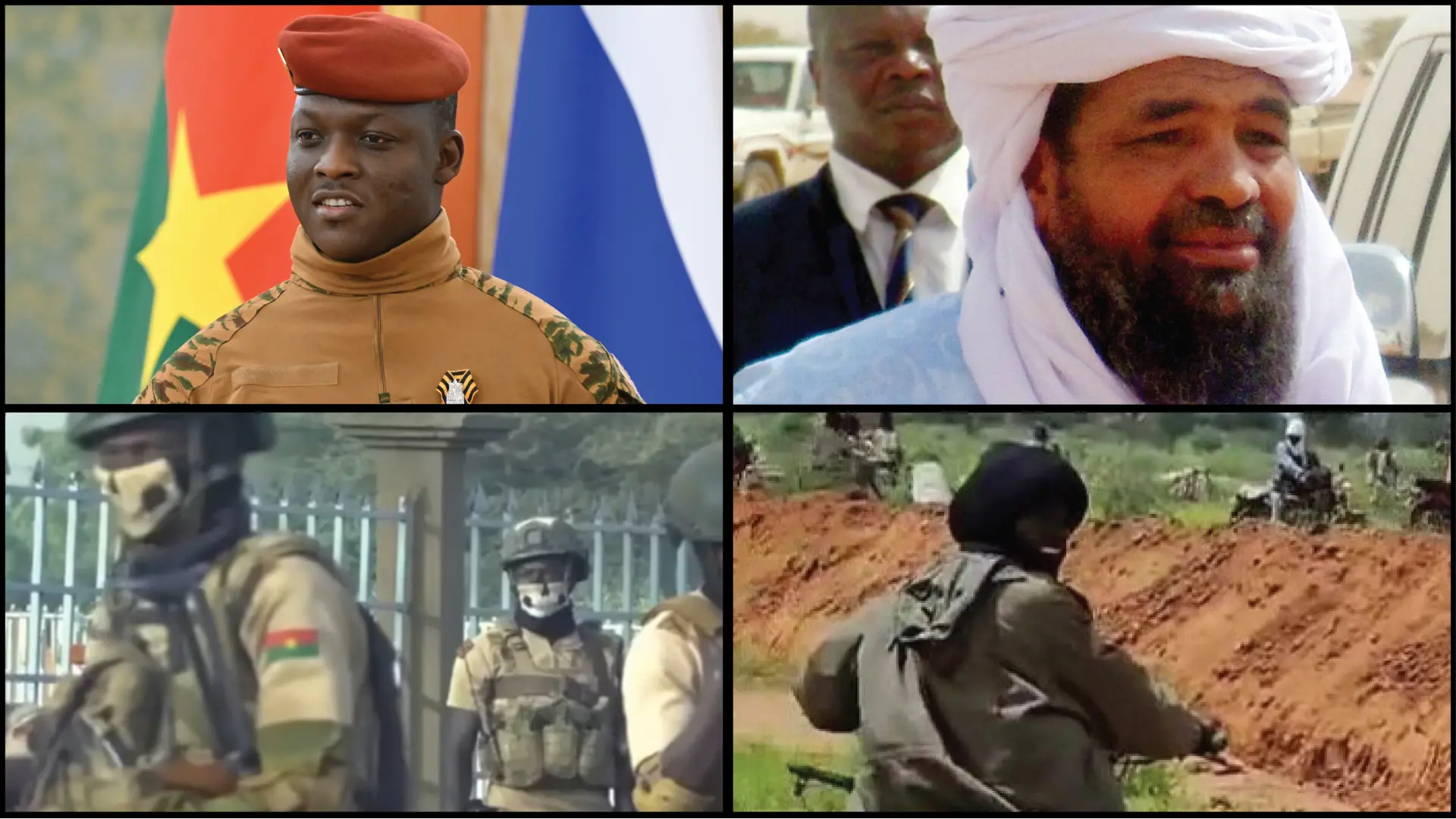
At 36, Captain Ibrahim Traoré, adorned with newly minted captain’s insignia, presides over a presidential palace secured not through electoral victory but by the outright abolition of democratic processes. This convenient political maneuver negates the need to court voters with false promises, allowing for direct misdirection to the press.
This modus operandi was evident during a recent two-hour session at the Koulouba palace, where Traoré addressed six journalists. During this extended monologue, the self-proclaimed leader painted a rosy picture: the national army was reclaiming lost territories, industrial growth was soaring, gold reserves were accumulating, infrastructure projects like highways were expanding, and the Burkinabè populace enjoyed unprecedented freedom. One could almost imagine a triumphant soundtrack and a flag waving majestically in the background.
The report that shatters the illusion
Yet, as Captain Traoré basked in his own narrative, a stark counterpoint emerged. Human Rights Watch (HRW) released a comprehensive 351-page report, titled “No One Will Escape,” replete with survivor testimonies, satellite imagery, and detailed death rosters. This damning document revealed a grim toll of 1,837 civilian deaths over two and a half years. The report implicates not only jihadist groups like JNIM but also, disturbingly, the Burkinabè army and its allied VDP militias. A critical finding highlighted that state-affiliated forces engaged in systematic killings, often directed from above and even monitored by drones.
The HRW investigation meticulously documented a litany of atrocities: war crimes, crimes against humanity, and the specific ethnic targeting of the Fulani community. These included summary executions of 223 civilians, among them 56 children, in Nondin in February 2024. Hundreds more perished in Baraboulé in December 2023, and 130 Fulani were massacred near Solenzo in March 2025. The evidence points to mass graves, corroborated by eyewitness accounts and satellite data.
Of course, such extensive findings are often conveniently dismissed as a “Western conspiracy.”
‘Reclaimed’ territories, built on tragedy
Adding a layer of disturbing irony, Traoré proudly cited the very towns mentioned in the HRW report, such as Baraboulé and Pétégoli, as examples of successful military recaptures. However, HRW’s documentation reveals a different story: Operation Tchéfari 2, or “The Warriors’ Honey” in Fulfulde – a chillingly poetic name for massacres – saw the army responsible for the deaths of hundreds of civilians across 16 villages in these same areas. While state television lauded these operations as “successes,” survivors recount them as brutal slaughters, a stark contrast in perspectives.
Traoré’s explanation for these killings is equally perplexing: he posits that they are the work of terrorists in military disguise, who meticulously film their own actions. This narrative suggests an impressive level of coordination and sophistication from individuals whom Traoré himself describes as merely “reading the Quran in the bush,” implying these ‘terrorists’ don Burkinabè uniforms, deploy military drones, coordinate multiple battalions, and then vanish.
The unspoken word: Fulani
In his two-hour interview, the term “Fulani” was conspicuously absent, never once uttered. This omission carries profound moral weight, akin to discussing World War II without acknowledging the Jewish people.
HRW’s report unequivocally details the systematic targeting of the Fulani community, which constitutes 8% of Burkina Faso’s population. Accused collectively of terrorism, Fulani villages have been subjected to massacres, leading to the displacement of hundreds of thousands. The report even cites Traoré himself, who, in February 2023, warned Fulani leaders: “There will be many dead. And it will be more complicated for your community.” His presidential guard chief reportedly used even more direct language: “We will kill them all.”
Despite this evidence, the official stance maintains that there is no “Fulani problem” in Burkina Faso, only a “problem of Fulani.”
Freedom of expression: a bitter joke
Traoré boldly claims that Burkinabè citizens enjoy greater freedom than those in Europe. In reality, this “freedom” often translates into the freedom to disappear. Journalists have been abducted and forcibly conscripted into militias. Independent media outlets have been shut down, human rights websites blocked, and the electoral commission dissolved. The death penalty has also been reinstated.
Further exacerbating the suppression of dissent, pro-junta troll networks, known as the “BIR-C” (Rapid Communication Intervention Battalions), actively flood social media with propaganda and deepfakes designed to glorify the current leader, making even the meticulously crafted image of Kim Jong-un seem rudimentary by comparison.
Justice, selectively applied
HRW has urged an investigation into Traoré for command responsibility, naming six generals. To date, none have faced trial. The junta’s decision to withdraw from the International Criminal Court (ICC) raises significant concerns, as it suggests an attempt to evade international scrutiny when facing serious allegations.
Meanwhile, Traoré focuses on publicizing the humiliation of corrupt traffic officers caught pocketing small sums, portraying a 500 CFA franc bribe as a national scandal. In stark contrast, the massacre of hundreds of civilians by the army is dismissed as “terrorist perfidy,” clearly illustrating the regime’s skewed priorities.
Blaming the West: a familiar refrain
Any external criticism is swiftly rejected: a European Parliament resolution is labeled “interference,” a French army chief is told to “mind his own business,” NGOs are dismissed as “manipulators,” and the media, the internet, and even territorial maps are branded as “fake.” The 351-page HRW report, based on 450 interviews, is similarly deemed fabricated. In this narrative, everything is false except the leader’s own pronouncements.
While acknowledging the legitimate grievances stemming from postcolonial exploitation by France, using this historical fact as an impenetrable shield against accountability for internal massacres is a dangerous precedent, reminiscent of figures like Mugabe. Anti-imperialism, however justified, does not grant a license to commit atrocities against one’s own populace.
In a final, chilling statement, Traoré recently encouraged Burkinabè to “have children” because “the land is rich.” Indeed, it appears to be rich in the sense that it is increasingly used to bury many people.