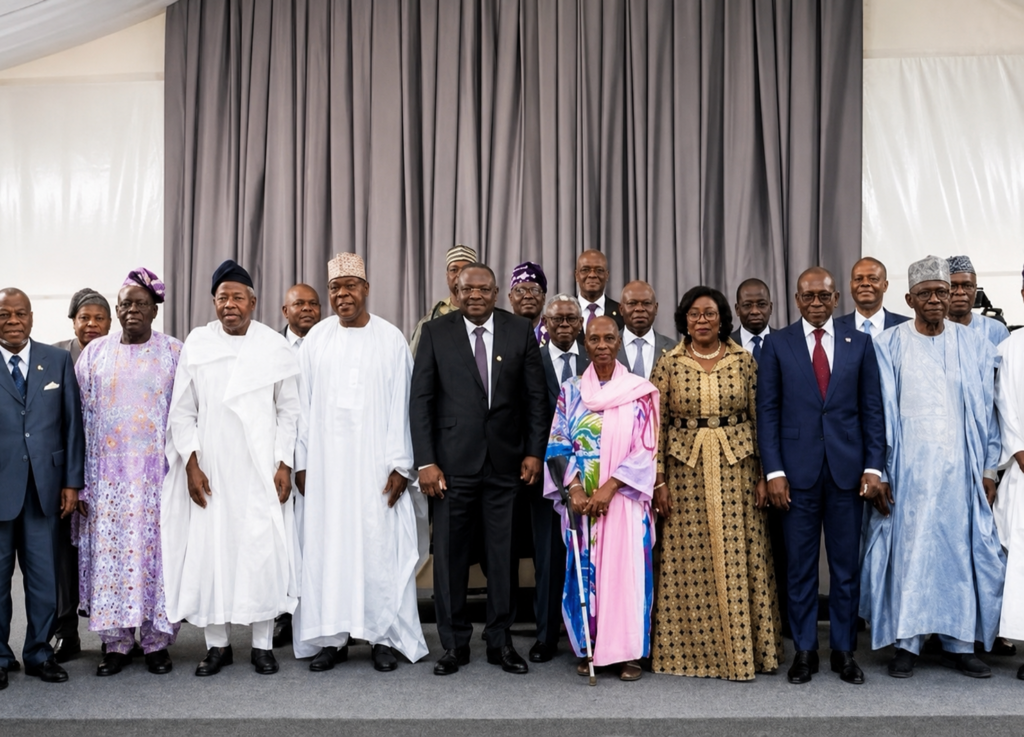
The official inauguration of Bénin’s first-ever Senate on July 30, 2026, followed by the election of former President Patrice Talon as its head on August 6, marked a pivotal moment in the country’s institutional evolution. Established through the constitutional revision of December 17, 2025, this second parliamentary chamber introduces a new dynamic into Bénin’s governance structure.
The Senate: a constitutional body, not a personal tool
Critics have framed the Senate as a potential “shadow government” or a mechanism allowing Patrice Talon to retain influence beyond his presidency. However, such interpretations overlook the legal framework governing the Senate’s creation and functions.
The Constitution explicitly outlines the Senate’s establishment, composition, and authority. It is not a structure tailored to an individual but an institutional body defined by constitutional law. The Senate’s existence is independent of its president’s identity, and its powers are strictly delineated by the revised Constitution.
Patrice Talon’s role: influence versus constitutional authority
The election of Patrice Talon as Senate President has intensified speculation about his potential sway over national affairs. As a former head of state, his political experience and networks naturally invite scrutiny. Yet, it is essential to distinguish between political influence and the constitutional exercise of presidential power.
Since Romuald Wadagni assumed the presidency on May 24, 2026, following the April elections, the transition of power has been formally completed. Talon’s new role does not grant him the prerogatives of the presidency. The Senate President does not command the executive branch, direct the government, or administer the state. The Constitution reserves these functions exclusively for the elected president and government.
Legislative power, not executive control
The Senate’s role is primarily legislative and regulatory. While it holds significant responsibilities such as reviewing constitutional amendments, electoral laws, and political party regulations these functions do not equate to governance. The chamber can delay or request reconsideration of certain laws, but it does not implement policy or manage state operations.
The Constitution clearly separates the Senate’s duties from those of the executive. Article 79 defines the Parliament as the legislative body responsible for overseeing government actions, while the presidency retains executive authority. The Senate’s mission is to foster stability, mediate political tensions, and ensure democratic continuity roles distinct from policymaking.
A chamber of experience and mediation
One of the Senate’s defining features is its composition, which includes former high-ranking officials, military leaders, and individuals with extensive institutional experience. This structure aims to create a space for dialogue and crisis prevention, where seasoned professionals can contribute to national stability.
In a democracy, institutions must balance majority rule with mechanisms for consensus-building. The Senate’s design reflects this need, positioning it as a potential mediator in political disputes rather than a rival to the executive branch.
The paradox of criticism: influence versus legal boundaries
While Patrice Talon’s political experience ensures he will wield influence, this reality does not translate into a constitutional breach. The Senate’s powers are real but strictly limited. Its ability to object to legislation, for instance, requires a two-thirds majority a threshold designed to prevent arbitrary use of authority.
The Constitution also imposes an obligation of political reserve on senators, prohibiting them from active partisan participation. This ensures the Senate remains an institution of reflection rather than one of political maneuvering.
Continuity versus institutional overreach
The election of Romuald Wadagni, a former finance minister under Talon’s administration, has fueled debates about political continuity. While his victory winning over 94% of the vote signals policy alignment with the previous government, it does not imply institutional capture. A smooth transition of leadership does not equate to power consolidation.
The true test for the Senate will lie in its daily functioning. Will it act as a rubber stamp, or will it engage in meaningful legislative review? Will it collaborate effectively with the Assembly and government, or remain isolated? Its ability to fulfill its constitutional mandate without overstepping will determine its legitimacy.
Separation of powers: the key to dispelling misconceptions
To clarify the Senate’s role, it is helpful to outline the division of responsibilities: the president leads the executive, the government implements policy, the Assembly and Senate form the Parliament, and the Constitutional Court ensures adherence to the Constitution. Within this framework, Patrice Talon’s Senate presidency does not grant him executive authority.
Political influence is not synonymous with institutional power. The Senate can shape legislation and foster stability, but it cannot govern. Its effectiveness will be measured not by the personality of its leader but by its adherence to constitutional limits and its contribution to Bénin’s democratic processes.
Beyond speculation: evaluating the Senate’s performance
The debate over the Senate’s creation is valid, but it must be grounded in facts rather than assumptions. The institution is not a constitutional anomaly; it is a product of the 2025 constitutional revision, with clearly defined roles. Its success will depend on its ability to regulate, mediate, and enhance legislative quality without encroaching on the executive’s domain.
For Bénin, the focus should shift from speculative fears to tangible outcomes. The Senate’s true value will be revealed in its actions whether it stabilizes institutions, improves governance, and upholds democratic principles. The era of conjecture must give way to an era of evaluation, where the Senate’s performance is judged by its contributions to the nation’s progress.
You may also like
What Luxembourg’s 9.8 billion FCFA port training pledge means for Benin’s workers and businesses
Burkina Faso: shrinking civil service payroll exacts a heavy toll on households and local economies
Libya-Cameroon air link plan: how Yaoundé and Tripoli are reacting, and what could follow
Silmossin fallout: Burkina Faso’s security debate moves beyond slogans
Chad’s UN warning on Ennedi-East strikes: global reactions and what happens next