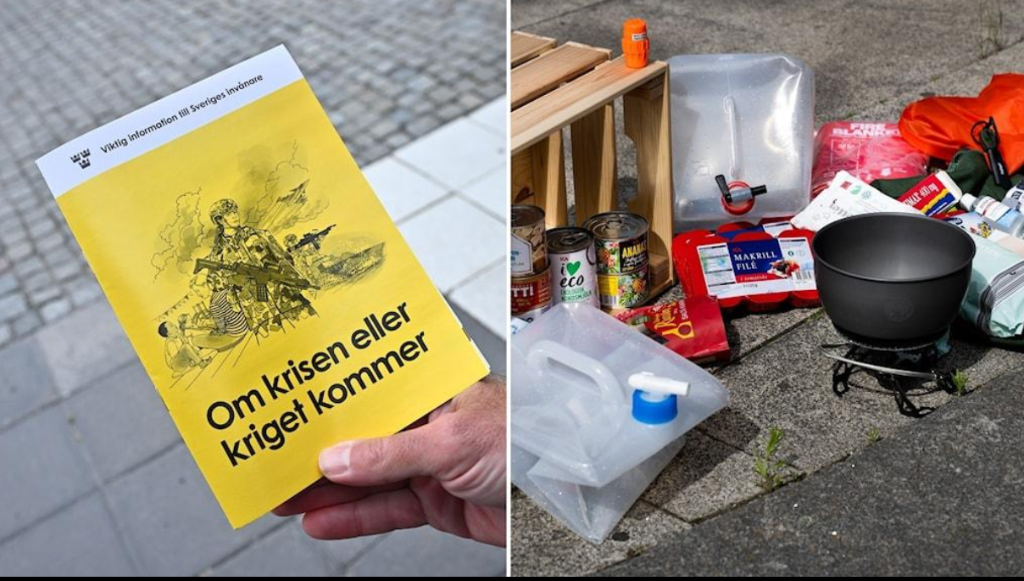
Why national stockpiles are no longer optional for household survival
Geopolitical tremors from Brussels to Beijing now force a critical question upon every family: if supply chains fracture, utilities fail and emergency services are overwhelmed, could your household endure the first 72 hours? Governments worldwide believe the answer must be yes — and they’re rewriting the rules of domestic preparedness to make it so.
The European Union’s silent civil-defense revolution
Northern Europe has already moved past theory. Sweden, Finland, Poland and the Baltic states have quietly normalised the idea that every home should anchor survival on three days of food, water and medical supplies. Stockholm now publicises detailed checklists: 9 litres of water per person, shelf-stable proteins, a manual can-opener, a wind-up radio and at least €150 in small bills. Authorities cite not only weather extremes and IT meltdowns but also “hostile actions against critical national infrastructure”. In Helsinki, the national grain reserve now covers nine months of consumption, a hedge once reserved for wartime scarcity.
This preparedness drive gained irreversible momentum after Russia’s 2022 invasion of Ukraine. Cross-border electricity flows, freight corridors and medical oxygen pipelines suddenly proved as vital as rifles on the front line. European intelligence services now warn that Moscow’s next gambit may stay below the threshold of war yet trigger nationwide blackouts or cyber sieges — exactly the kind of shocks that household reserves are designed to absorb.
Middle-East fault lines: how nearby conflicts become domestic shortages
A sudden shock to Gulf energy lifelines
In the early hours of 28 February 2026, combined strikes on Iranian nuclear and military sites escalated into retaliatory missile salvos that arched over the Gulf. Though the strikes were limited, the ripple effects were immediate: liquefied-natural-gas shipments to the United Arab Emirates were delayed for weeks, spot prices for gasoline in Dubai doubled overnight, and hospitals in Abu Dhabi activated emergency rationing protocols. Authorities later confirmed that families who had maintained two-week food stocks and portable water filters fared far better than those scrambling to empty supermarket shelves at the last minute.
Abu Dhabi’s quiet pivot to domestic resilience
The emirate’s civil-defence agency now distributes bilingual emergency cards that map every citizen to the nearest communal shelter and to designated water-distribution points. Public-service messages increasingly feature practical advice: “Store at least three litres of water per person per day; keep a battery-powered fan; ensure prescription medicines are topped up.” Behind the scenes, the government has quietly subsidised underground storage tanks so that petrol stations can function for 72 hours even if pipelines are severed.
China, North Korea and the calculus of simultaneous crises
On 15 October 2026, Beijing and Pyongyang inaugurated a new cross-border bridge, symbolising a deliberate deepening of economic and military coordination. Within days, North Korean state media broadcast footage of Kim Jong-un inspecting aid convoys destined for Chinese border towns — a rare public acknowledgement of interdependence. Intelligence channels indicate that these exchanges could complicate any future contingency involving Taiwan or the Korean Peninsula. The lesson for households is clear: a regional conflict in one theatre can disrupt shipping lanes, container traffic and rare-earth supplies halfway around the globe, turning a “distant” war into a local price surge.
What to store, where to store, and how to avoid panic buying
The NATO resilience directive renewed in September 2026 sets minimum standards that now trickle down to kitchen counters: water, food, medicine, light and cash. Experts recommend rotating staples every six months, choosing foods that require no refrigeration and packing them in cool, dark cupboards. A basic 72-hour kit for a family of four weighs roughly 12 kg and costs less than one month’s grocery budget. Crucially, every adult should practise a 24-hour “stay-home drill” once a year to confirm that lights, phones and first-aid supplies remain within reach during a simulated blackout.
Five items that pay unexpected dividends
- Portable water filter: removes 99.99% of pathogens without chemicals, doubling as insurance against water-main contamination.
- Crank radio: bypasses cell towers and Wi-Fi outages, delivering real-time guidance when digital channels collapse.
- Solar power bank: keeps phones operational for emergency calls and digital-payment apps during grid failures.
- Duct tape and plastic sheeting: turns any room into a temporary shelter, slowing airborne contaminants.
- Copies of IDs and prescriptions: speeds re-entry to pharmacies and shelters when official databases are down.
A new social contract: shared responsibility in an uncertain century
Governments no longer frame stockpiling as a fringe survivalist hobby; they present it as civic duty. The NATO directive explicitly balances military readiness with civilian resilience, recognising that hospitals, firefighters and police cannot respond everywhere at once. Social-media campaigns now avoid apocalyptic language and instead champion “practical readiness” — a phrase that registers 230 % more engagement than older terms like “doomsday prepping”.
The psychological dividend is equally important. Families who have already experienced regional blackouts or rationing report lower stress levels during subsequent alerts. In short, the three-day stock is becoming the new seatbelt: something you hope never to need, but that keeps you safe when everything else fails.
Your action plan, step by step
- Audit: check pantry contents today; identify gaps in calories, water and medications.
- Budget: allocate €40–€60 this month for the missing essentials, then replace items before they expire.
- Drill: once every six months, cook an entire meal using only kit ingredients while simulating a power cut.
- Neighbourhood: offer to share spare filters or radios with elderly households; resilience is contagious.
- Refresh: after six months, taste-test stored foods and update prescriptions.