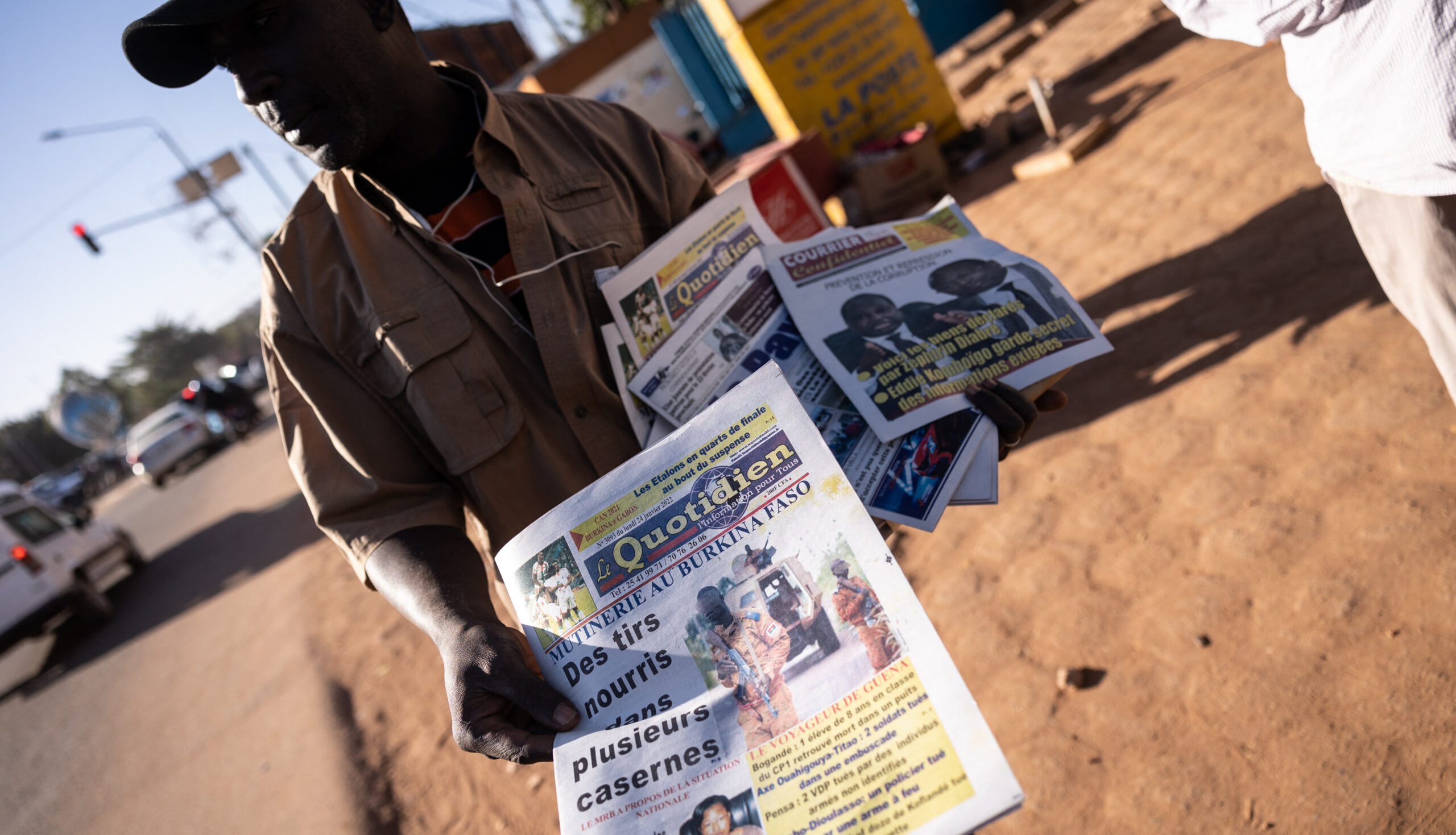
Global coalition urges Mali and Burkina Faso to end press freedom violations
Under the leadership of Reporters Without Borders (RSF), nearly 30 human rights organizations and media outlets have issued an open letter to authorities in Mali and Burkina Faso, demanding an immediate end to escalating press freedom violations in both nations.
RSF has coordinated this landmark initiative involving nearly 30 media organizations and human rights defenders to safeguard press freedom across Mali and Burkina Faso. In a powerful open letter addressed to national authorities, regional bodies, and the international community, the coalition urgently calls for an end to systematic harassment of local and foreign journalists while demanding strict compliance with international commitments regarding freedom of expression and press freedom—particularly the African Charter on Human and Peoples’ Rights.
“This solidarity initiative underscores the critical importance of upholding press freedom in Mali and Burkina Faso. As the world marks World Press Freedom Day, authorities in both countries must fully grasp its significance and take decisive action to enable journalists to work freely without fear of retaliation.”
The coalition’s signatories include prominent local media outlets such as Joliba TV News (Mali) and Lefaso.net (Burkina Faso), alongside esteemed press freedom organizations like the African Journalists Federation (FAJ), International Francophone Press Union (UPF), and the West African Media Foundation (MFWA). International media organizations have also joined this vital cause.
Recent World Press Freedom Index rankings confirm the deteriorating situation: Burkina Faso has plummeted to 58th place (from previous positions), while Mali now sits at a troubling 113th place out of 180 countries.
Open letter for the protection of journalists and defense of freedom of expression and press freedom in Mali and Burkina Faso
- His Excellency, President of the African Union
- His Excellency, President of the ECOWAS Authority
- His Excellency, President of the West African Economic and Monetary Union
- President of the African Union Commission
- President of the ECOWAS Commission
- President of the West African Economic and Monetary Union Commission
- President of the Pan-African Parliament
- UN Secretary-General
- President of the UN Human Rights Council
- UNESCO Director-General
- International Organisation of La Francophonie Secretary-General
- Presidents of Media Regulatory Authorities of ECOWAS member states
- President of the Francophone Media Regulators Network
- President of the Audiovisual Regulators Platform of WAEMU and Guinea
- ECOWAS Communication Ministers
- President of the African Broadcasting Union
Recent events paint a grim picture: death threats against journalists and opinion leaders, violent crackdowns on domestic media, fabricated smear campaigns, suspensions of international broadcasters RFI and France 24, deportations of French newspaper correspondents, and government bans on independent media in Burkina Faso. These measures directly undermine citizens’ fundamental right to information.
In Mali, the situation has deteriorated rapidly: the Bamako Press House was ransacked on February 20, 2023. On March 13, radio host Mohamed Youssouf Bathily (Ras Bath) was imprisoned for criticizing the alleged assassination of former Prime Minister Soumeylou Boubèye Maïga. On March 15, activist Rokia Doumbia was arrested for discussing price hikes and transitional failures. On April 6, journalist Aliou Touré was abducted by armed men and held for four days. International media have also faced severe restrictions: Jeune Afrique reporter was expelled in February 2022, and RFI and France 24 were banned nationwide in March 2022. In late 2022, Joliba TV was suspended by Mali’s High Authority of Communication for airing editorials critical of authorities.
Social media amplifies these attacks through coordinated disinformation campaigns by pro-regime influencers who routinely issue death threats against independent journalists. As L’Observateur Paalga warns, this has created a climate of terror where factual reporting is drowned out by deliberate misinformation, depriving Malian and Burkinabè citizens of meaningful democratic debate.
Despite grave security challenges, journalists continue their vital work to inform the public while navigating complex political and geopolitical landscapes. They, too, suffer the consequences of insecurity and desperately seek peace. However, counter-terrorism efforts must never justify restricting fundamental rights or stifling access to professional, independent media—rights clearly protected under international law.
The situation has become so dire in Burkina Faso that even the national media regulator has sounded the alarm. In a March 29, 2023 statement, the Superior Council of Communication “expressed regret over the recurrence of threats against media outlets and journalists”, urging authorities to “implement appropriate measures to ensure the safety of media professionals”. UN High Commissioner for Human Rights Volker Türk has also expressed deep concern, stating that “during this transition period, protecting independent voices is more critical than ever”.
In Mali, UN Independent Expert Alioune Tine has highlighted his “extreme concern over the shrinking civic space, freedom of expression, and association”. Against this backdrop, the signatories of this open letter:
- Urge authorities in both countries to immediately cease all measures violating press freedom
- Highlight the lack of protection from security forces and judicial silence regarding death threats and intimidation campaigns, calling for urgent action from prosecutors and judicial police
- Demand guarantees for the safety and security of all media professionals facing threats, intimidation, harassment, or physical attacks
- Call for impartial, thorough, and independent investigations into abuses against journalists to identify and prosecute perpetrators
- Urge compliance with international obligations on freedom of expression and press freedom, particularly the African Charter on Human and Peoples’ Rights and the International Covenant on Civil and Political Rights
- Call on national, regional, and international leaders to support this initiative, emphasizing that access to information is a fundamental human right that must be defended and protected
May 2, 2023
SIGNATORIES
- AfrikaJom Center
- Association des Journalistes du Burkina Faso (AJB)
- Association des Professionnels de la Presse en Ligne (APPEL Sénégal)
- Cellule Norbert Zongo pour le Journalisme d’Investigation (CENOZO)
- Centre National de la Presse Norbert Zongo (CNP-NZ Burkina Faso)
- Courrier confidentiel (Burkina Faso)
- Fédération des Journalistes Africains (FAJ)
- Fédération Internationale des Journalistes (FIJ)
- Fédération Internationale pour les Droits de l’Homme (FIDH)
- France 24 (France)
- Fondation des médias pour l’Afrique de l’Ouest (MFWA)
- Human Rights Watch (HRW)
- International Press Institute (IPI)
- Jeune Afrique (France)
- Joliba TV News (Mali)
- Le Pays (Burkina Faso)
- Le Monde (France)
- Lefaso.net (Burkina Faso)
- Le Reporter (Burkina Faso)
- L’Événement (Burkina Faso)
- Libération (France)
- L’Observateur Paalga (Burkina Faso)
- Radio France Internationale (France)
- Reporters sans frontières (RSF)
- Société des Editeurs de la Presse Privée du Burkina Faso (SEP)
- Omega Médias (Burkina Faso)
- Union Internationale de la Presse Francophone (UPF)
- Union des Journalistes d’Afrique de l’Ouest (UJAO)
- 24heures.bf (Burkina Faso)
- Wakat Sera (Burkina Faso)
Related Posts
Togo opens ENA entrance exams for advanced civil service training
The Minister of Public Service, Labour, and Social Dialogue has officially announced the launch of both internal and external entrance…
Gabon Tackles Child Labor Exploitation in Libreville
In Gabon, a clear legislative framework is in place: compulsory education for all children between the ages of 6 and…
N’Djamena’s national museum comes alive for inaugural night of museums
N’Djamena recently hosted the inaugural Night of Museums, a vibrant celebration of Chadian cultural heritage held at the National Museum…