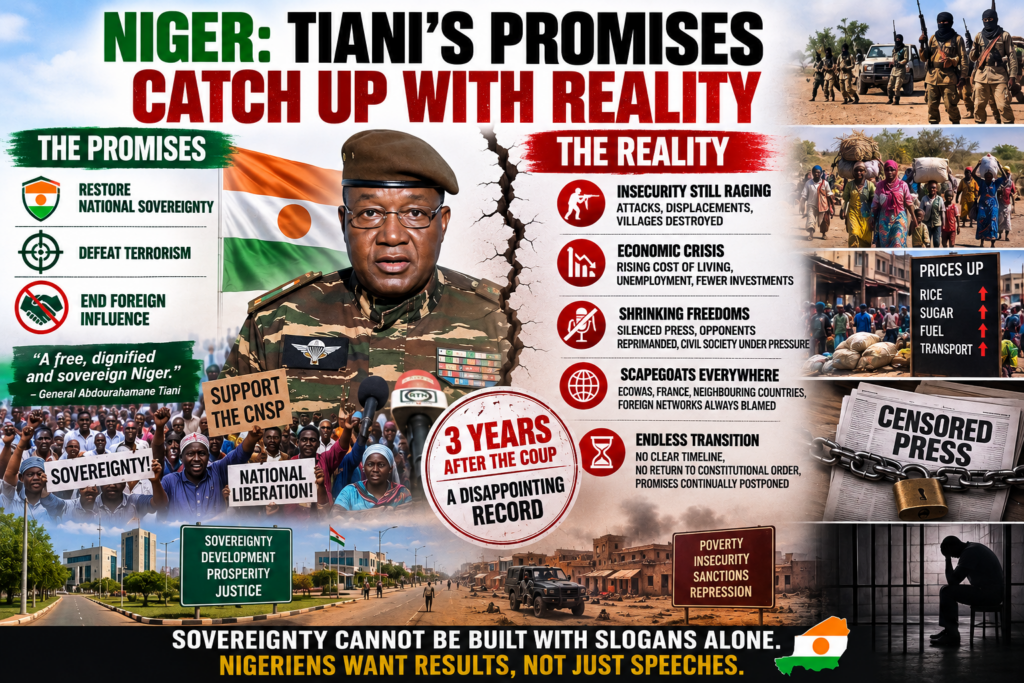
When General Abdourahamane Tiani overthrew President Mohamed Bazoum on July 26, 2023, his junta justified the coup with three key pledges: restoring national sovereignty, eradicating terrorism, and ending foreign interference in Niger’s affairs. This narrative, amplified by pro-regime media and sovereignist movements, resonated with many citizens weary of chronic insecurity and economic hardship.
Sovereignty as a political tool
The National Council for the Safeguard of the Homeland (CNSP) has built its legitimacy on a simple yet powerful story: Niger has regained its sovereignty by severing ties with former Western partners. This rhetoric frames the regime as patriotic while casting former allies as exploiters of national resources.
While this strategy has helped rally public support, sovereignty cannot be measured solely by diplomatic ruptures or the departure of foreign forces. True sovereignty demands tangible results: secure citizens, functional institutions, preserved freedoms, and improved living conditions. On these fronts, the verdict remains sharply debated.
A narrative rooted in public frustration
The junta has skillfully tapped into deep-seated disillusionment over insecurity, unemployment, inequality, and rising living costs. By framing the coup as a historic break, it positioned itself as the answer to decades of mismanagement. Yet over time, official communications have shifted from policy announcements to relentless displays of patriotic mobilization, while concrete achievements receive scant attention.
This shift has depoliticized public debate. Instead of evaluating governance, Nigeriens are increasingly divided between blind loyalty and opposition, with accountability taking a backseat to ideological allegiance.
Security: the unfulfilled promise
The junta’s primary justification for seizing power was to restore safety. Yet large swaths of Niger remain plagued by armed attacks, mass displacements, and pervasive insecurity. Civilians bear the brunt, facing disrupted livelihoods, restricted access to essential services, and fractured communities.
While the military continues operations on multiple fronts, repeated assaults on bases and villages reveal the resilience of armed groups. The conflict’s complexity cannot be resolved by regime change or shifting international alliances alone, and the lack of transparent progress reports fuels doubts about the current strategy’s effectiveness.
Blame-shifting over accountability
Faced with mounting challenges, the regime frequently frames domestic crises as foreign conspiracies. Sanctions from ECOWAS, former Western allies, neighboring states, and shadowy international networks are repeatedly cited as the root causes of Niger’s struggles.
While regional tensions and geopolitical rivalries undeniably shape the Sahel’s security landscape, they do not fully account for Niger’s internal woes. This approach risks turning every crisis into a diplomatic standoff, sidelining critical discussions on domestic reforms, institutional accountability, and governance improvements.
A struggling economy
Economic expectations following the coup have gone largely unmet. Regional sanctions, reduced investment, trade disruptions, and political uncertainty have crippled key sectors. Households continue to grapple with soaring living costs, supply shortages, and vanishing job opportunities. For many, the promised dividends of political rupture remain elusive.
Sovereignty in economic terms demands more than rhetoric it requires sustainable domestic production, robust infrastructure, stable public finances, and a business friendly environment. These are long term challenges that no coup can resolve overnight.
Shrinking civic freedoms
Observers warn of a growing erosion of public freedoms. Critics of the regime, journalists, civil society leaders, and opposition figures face heightened scrutiny, with dissent increasingly stifled by state vigilance. In many military-led systems, power centralization comes at the cost of institutional checks and balances a dilemma Niger now confronts.
With no clear political transition timeline, questions linger over the junta’s commitment to restoring constitutional order and preserving the pluralism essential for responsible governance.
Patriotism vs. results: the reckoning
Patriotism can unite a nation, but it cannot substitute for deliverables. Sovereignty is not declared in speeches; it is forged through resilient institutions, a thriving economy, credible justice, effective security, and transparent governance.
The Sahel’s recent history shows that no leader civilian or military can sustain legitimacy solely by rallying against external foes. As time passes, citizens judge their rulers less on slogans and more on their ability to improve daily lives.
For General Abdourahamane Tiani and the CNSP, the true test lies not in convincing Nigeriens of their sovereignty, but in proving that this sovereignty translates into tangible gains in security, development, justice, and liberty. Without such proof, anti-imperialist rhetoric risks appearing less a national project and more a tool for political survival.
You may also like
Benin’s CCI budget for 2027 sparks debate: what the 6.6 billion FCFA plan means for businesses
Bambali agro park: what the launch means for Sédhiou and Senegal
Senegal’s palm oil deal with Indonesia: reactions, debate and what happens next
Burkina Faso’s militarisation debate: what the fallout means for displaced citizens
Gabon’s EU fisheries talks: mixed reactions as a new chapter begins