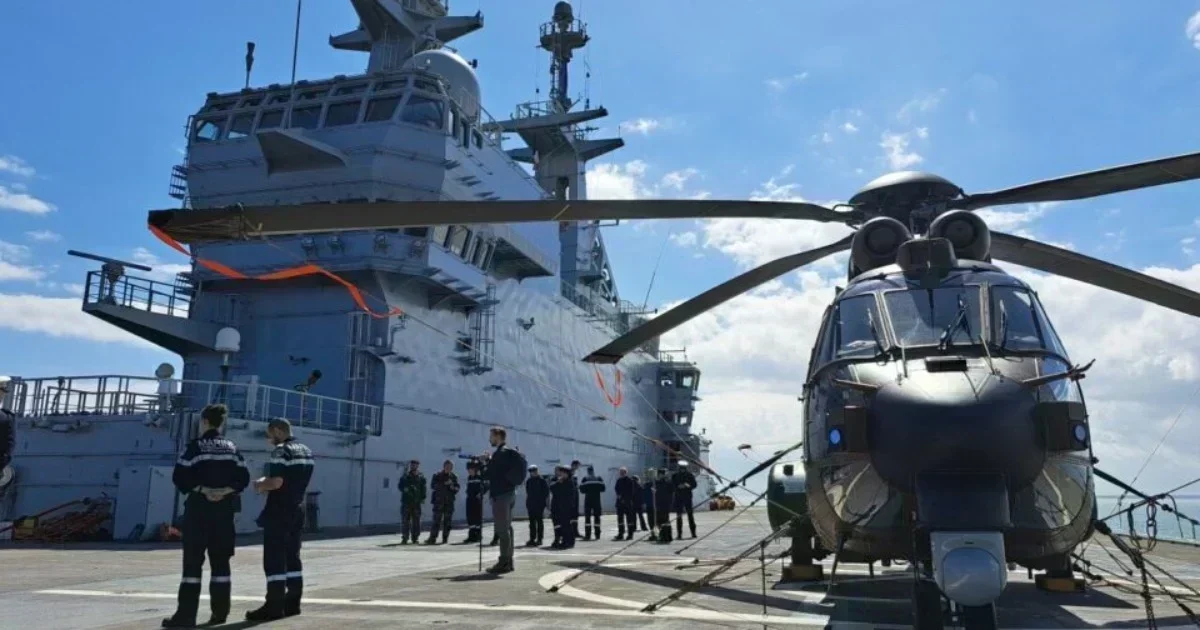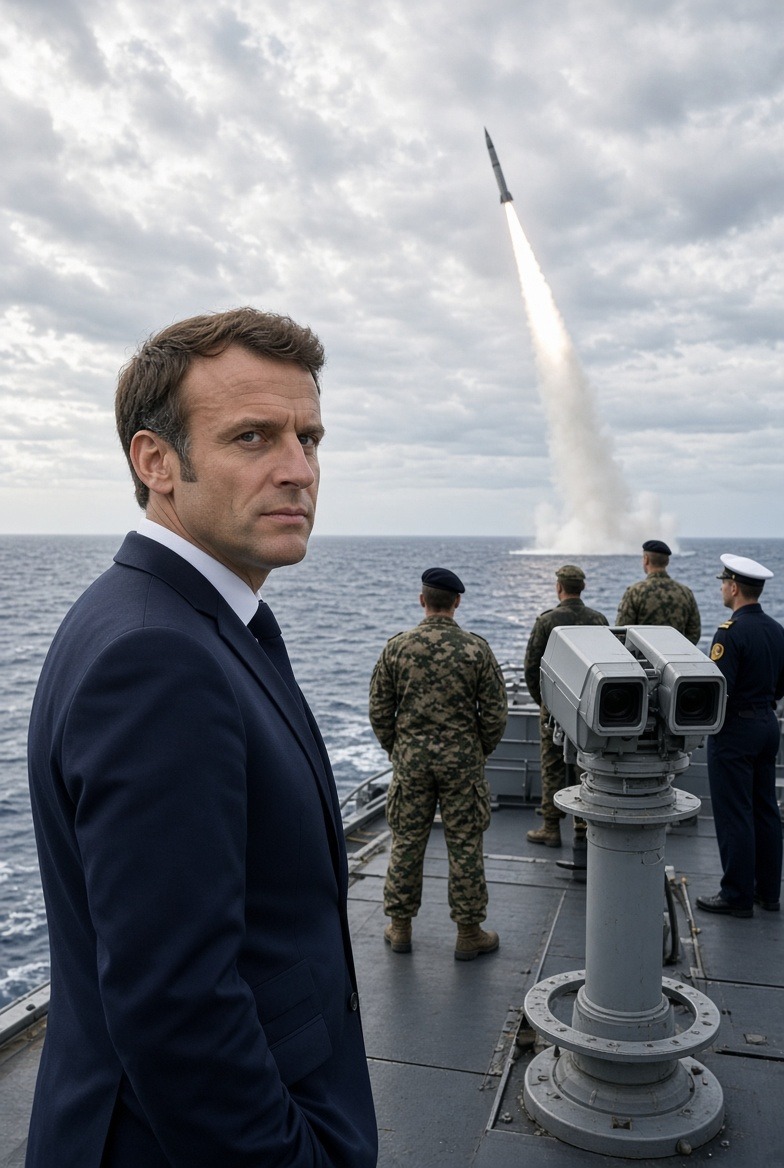
The first acceptance firing of the M51.3 strategic ballistic missile from the nuclear-powered submarine Le Vigilant has triggered a wave of reactions across Europe and opened a broader debate about the future of French deterrence. Conducted on 6 October 2026 off the coast of Finistère, the test took place against a backdrop of deepening security tensions, with airspace violations, drone incursions and friction between Russia and NATO member states multiplying. For Emmanuel Macron, who observed the launch from the multi-mission frigate Auvergne, the event is not merely a technical milestone but a political signal about the durability of France’s nuclear posture.
What the launch demonstrated — and why it matters now
The missile was carried without a nuclear warhead, and its trajectory was monitored by the Directorate General of Armaments using test assets including the vessel Monge. The primary goal was to confirm that Le Vigilant could operate this new version of the missile after its maintenance period. The M51.3 entered operational service in October 2025, and this third iteration is designed to improve the performance of France’s sea-based component against evolving adversary missile defences.
Beyond the industrial dimension, the test has become a focal point for public and political discussion. Analysts and officials are asking what the demonstration reveals about France’s readiness to sustain its deterrent over the long term, and how allies and potential adversaries may interpret it.
European reactions: between reassurance and unease
The immediate fallout has been felt across European capitals. NATO has repeatedly warned that Russia has durably transformed the strategic environment, pointing to hostile and destabilising actions such as airspace violations, cyberattacks and sabotage. Recent weeks have seen incidents involving Polish and Romanian airspace, as well as drone incursions that the Alliance has attributed to Russia. In September, an Italian fighter jet on a NATO mission shot down a drone identified as probably Russian-made after it entered Lithuanian airspace from Belarus.
In the Baltic region, Swedish and Finnish fighter jets recently intercepted Russian military aircraft operating in international airspace over the Gulf of Finland — a joint operation that underscores the heightened vigilance of Nordic countries since they moved closer to NATO following the large-scale invasion of Ukraine in February 2022.
These episodes have fuelled a wider debate about how far Europe should go in reinforcing its defences. NATO launched Operation Eastern Sentry in 2025 to bolster airspace surveillance and defence, and in 2026 it has moved toward a more integrated air-defence architecture capable of addressing a broader range of threats, from drones to ballistic missiles.
Yet the multiplication of incidents does not mean a direct Russia-NATO confrontation is considered imminent. NATO Secretary General Mark Rutte stated in late September that there was no immediate threat to NATO territory, while stressing that any aggressive Russian action against a member state would be preceded by visible military preparations. That nuance is central to the current debate: Europe is preparing more, but preparation does not automatically mean war.
France’s strategic bet and the arguments shaping the outlook
It is in this climate that Macron’s message has taken on its full meaning. He has insisted on a core tenet of French doctrine: the ability to deter an adversary rests on the credibility of military means and on the capacity to sustain them over time. “To be free, one must be feared. And to be feared, one must be powerful,” he wrote, summarising a classic conception of deterrence — preventing a major attack by making clear that aggression against France’s vital interests would bring consequences an adversary could not accept.
France’s deterrent is organised around two components: oceanic and airborne. The first relies on nuclear-powered ballistic missile submarines, whose stealth is a key element. From the depths, these vessels must guarantee a retaliatory capability that could survive a first strike. The M51.3 modernisation fits precisely into this logic, with the Ministry of the Armed Forces indicating that the new version is intended to strengthen range, precision and penetration capacity against evolving missile defences.
Macron has also pointed out that modernisation is not limited to missiles. According to him, the defence budget will have doubled in ten years. Future French ballistic missile submarines are already under construction, and Paris has launched a programme for a hypersonic, manoeuvring strategic missile for the airborne component. In March, he had already presented the modernisation of the entire French nuclear force as a necessity in light of the changing international environment, highlighting progress on future submarines and new strategic missiles.
This policy reflects a French willingness not to depend solely on conventional capabilities or on guarantees offered by alliances. Paris maintains a national nuclear capability, conceived as an ultimate insurance policy for the Republic’s vital interests.
Beyond nuclear weapons: a transformed threat landscape
The current context goes beyond the nuclear question alone. Contemporary conflicts show the growing importance of drones, missiles, electronic warfare, cyberattacks and so-called hybrid operations. In the Black Sea, tensions have recently reached the maritime domain. On 6 October, a merchant ship flying the Togolese flag sank after a drone attack off Bulgaria, leaving several people missing. Another vessel had been hit the previous day in the region. Authorities have not definitively attributed these incidents to Russia, although initial security assessments pointed to a probable Russian origin for the attack off Bulgaria.
These events illustrate a transformation of the strategic landscape: the threat is no longer measured only by the number of tanks or missiles held by major powers. It also manifests through inexpensive drones, attacks on infrastructure, clandestine operations and incidents liable to cross borders.
By highlighting the M51.3 test, Macron seeks to place nuclear modernisation in a much broader perspective. For Paris, deterrence is not merely a Cold War legacy: it must remain adapted to the technologies and power balances of the 21st century. The Vigilant launch comes at a moment when Europe is reinforcing its defences, NATO is monitoring its eastern flank more closely, and Russia continues its war against Ukraine.
The political scope of the presidential message is clear: in a world where European borders are more exposed to drones, missiles and hybrid actions, France wants to retain an autonomous capacity to protect its vital interests. The M51.3 is therefore not just an industrial feat — it is one element of a broader strategy based on the permanence of deterrence, the modernisation of the armed forces and the will to maintain a national decision-making capability.
In a Europe where the risk of the Ukrainian conflict spilling over remains a major concern, Paris is seeking to combine conventional power, European cooperation and strategic autonomy. The Vigilant test ultimately recalls a reality: in the new European security environment, the question is no longer only whether states must prepare for crisis, but how far they must go to prevent it from becoming open war.