The prohibition of state-run RTB broadcasts across Guinea has thrust a critical dilemma into public discourse: when a public broadcaster prioritizes political alignment over journalistic integrity, what remains of its mandate to serve citizens rather than power?
An unprecedented ban with far-reaching implications
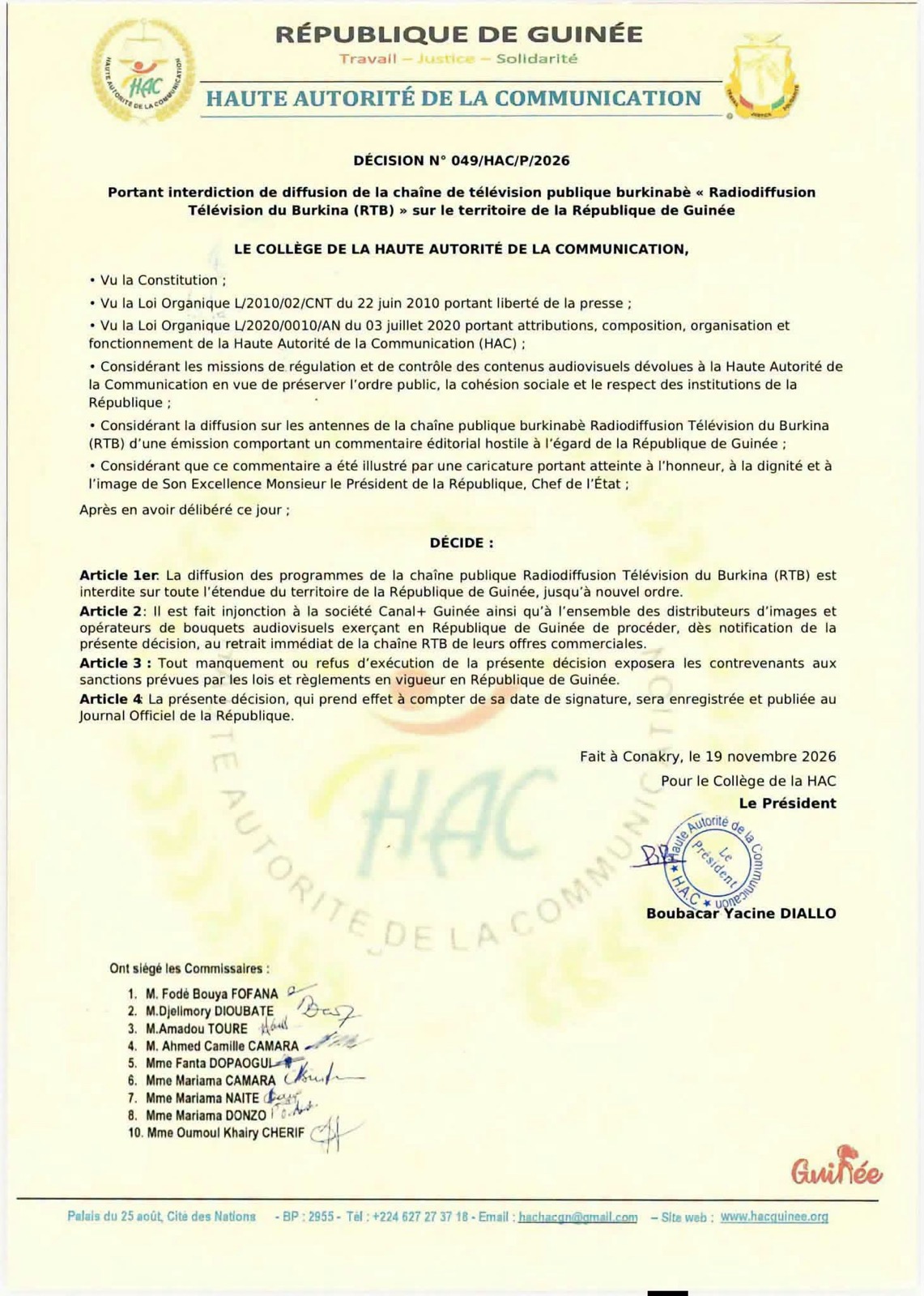
Guinea’s High Authority for Communication (HAC) made a historic decision by suspending the Radiodiffusion Télévision du Burkina (RTB) across the entire national territory, pending further review. While the decree itself may appear administrative, its underlying implications challenge the very core of Africa’s public broadcasting systems. When a state-funded television network abandons its duty to inform in favor of advancing political narratives, the foundations of media credibility crumble.
The HAC’s intervention underscores a growing regional concern: the erosion of public broadcasting’s independence under pressures from national governments. The RTB, despite its mandate to deliver balanced reporting, has faced criticism for aligning its editorial stance with the political objectives of Burkina Faso’s transitional authorities. Such alignment blurs the essential distinction between journalism and propaganda, undermining the trust citizens place in state-funded media.
The anatomy of a broadcaster losing its way
A public television network should act as a mirror of society reflecting diverse perspectives, scrutinizing power, and empowering citizens. However, when its coverage shifts from fact-based reporting to partisan commentary, the result is neither informative nor impartial. This was the crux of Guinea’s decision to enforce the broadcasting ban.
The RTB’s editorial drift reflects a troubling trend across West Africa, where public broadcasters are increasingly pressured into serving as mouthpieces for ruling elites. Systematic denigration of political opponents, omission of dissenting voices, and the framing of news to favor government narratives are clear deviations from professional journalism. These practices do not merely weaken individual outlets; they erode public trust in all state-run media, with long-term consequences for democratic discourse.
Does sovereignty justify propaganda?
The HAC’s move compels African nations to confront a pressing question: can media serve as instruments of state policy without betraying their foundational purpose? Public broadcasting is not the patrimony of any administration it belongs to the people. Its legitimacy is derived from its commitment to truth, fairness, and accountability, not from allegiance to any political figure or regime.
The current controversy goes beyond a bilateral dispute. It calls into question the sustainability of public broadcasting models that prioritize regime maintenance over civic duty. The RTB suspension serves as a cautionary tale for other African countries where editorial independence is increasingly fragile. If public broadcasters are weaponized to manipulate narratives, they forfeit their role as pillars of democracy.
Restoring the pillar: what must change?
To reclaim their credibility, public broadcasters must reclaim their editorial autonomy. This requires structural safeguards, transparent governance, and unwavering commitment to journalistic ethics. Governments must recognize that national media sovereignty does not equate to unchecked influence over content. Citizens deserve truth, not propaganda masquerading as news.
The path forward demands a return to first principles: public broadcasting must serve the public interest not the interests of those in power. Until then, the RTB ban stands as a stark reminder of the dangers of conflating journalism with political messaging.
By Daniel Mbami — Journalist