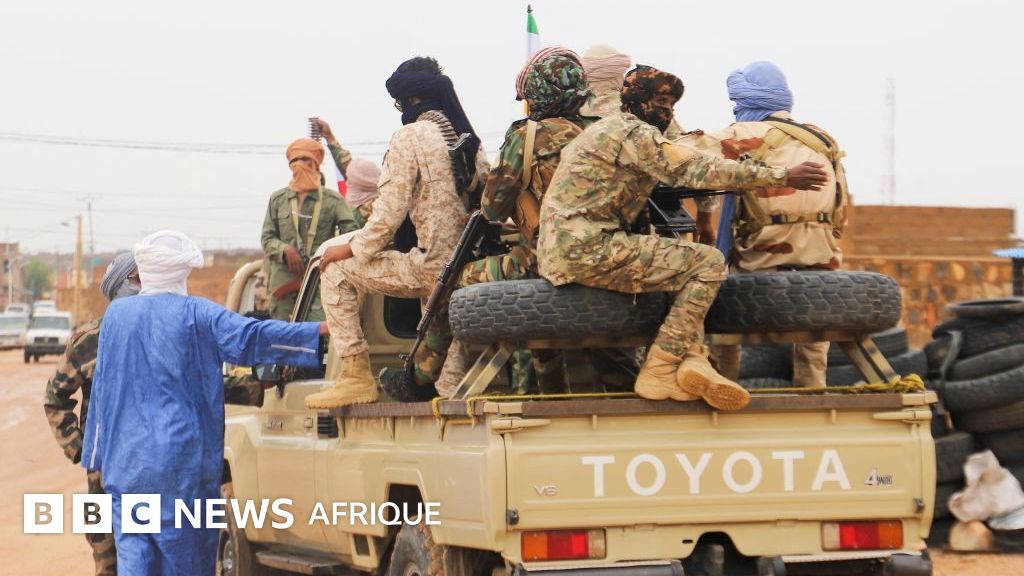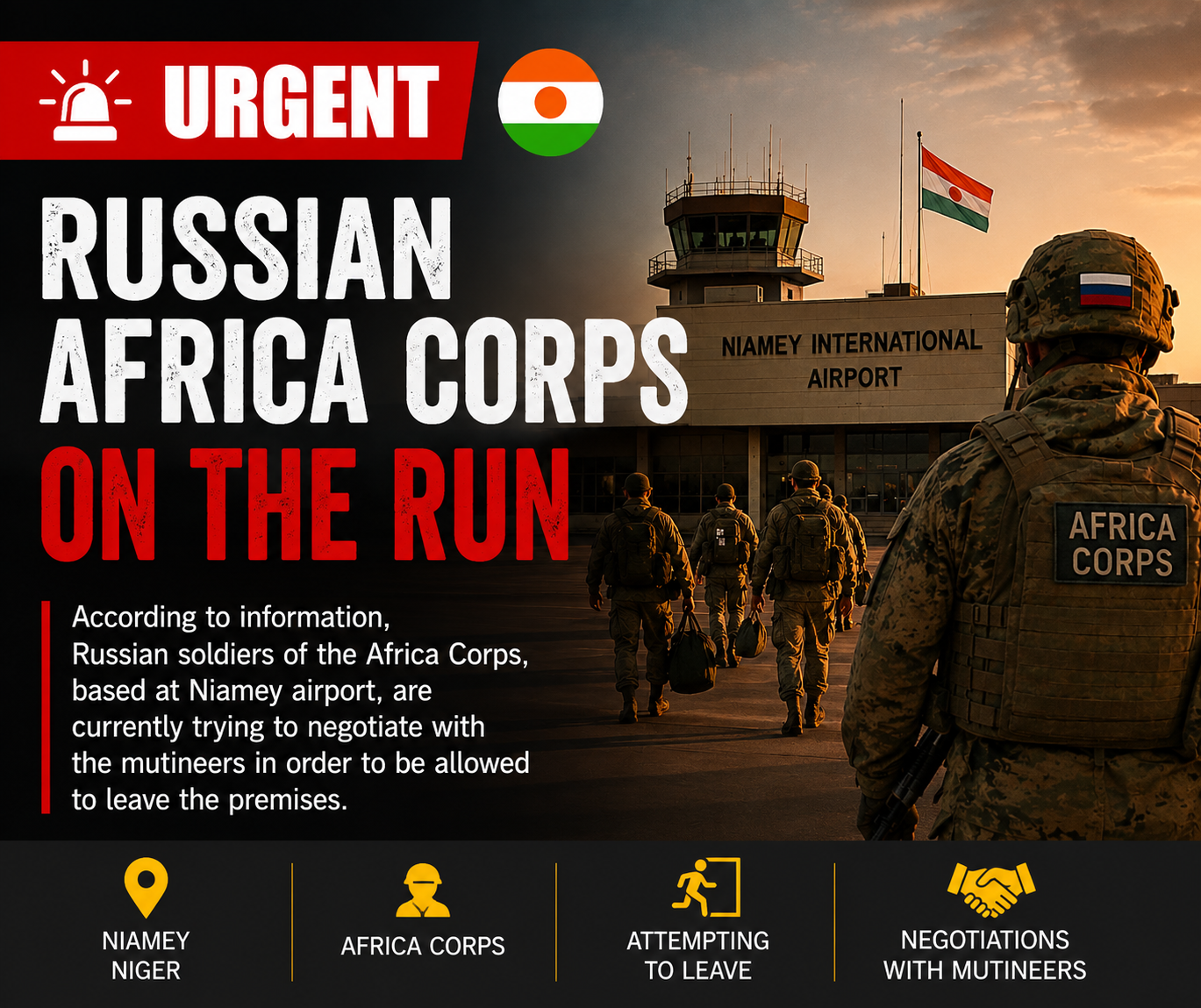
Reports of gunfire and significant unrest around Diori-Hamani International Airport in Niamey have brought to light a particularly revealing situation: according to reliable information, Russian elements of the Africa Corps are reportedly engaged in urgent negotiations with Nigerien military forces controlling the premises, seeking to secure their departure.
Should these details be substantiated, this episode would transcend a mere security incident at an airport. It would serve as a stark indicator of the inherent fragilities within the security paradigm upon which several Sahelian military administrations have chosen to stake their stability.
The illusion of the ‘infallible partner’
Breaking from their long-standing traditional allies, a number of military juntas across the Sahel have opted to cultivate closer ties with Moscow, entrusting a segment of their national security strategy to Russian forces. The Africa Corps, which has progressively assumed the role of the Wagner Group in various African operational zones, was initially presented as an instrument designed to bolster military regimes, safeguard leadership, and effectively counter jihadist factions.
However, the unfolding situation in Niamey compels a fundamental inquiry: what is the genuine efficacy of a security partnership when confronted by an internal crisis, a mutiny, or circumstances where the foreign partner’s interests diverge from those of the local authority? This crucial Niger Report raises pressing questions about the future of Niger security.
1. An engagement primarily guided by Russian interests
In contrast to a national army, a foreign military contingent does not hold the primary mandate of enduringly defending the populace or the institutions of the host nation. Its involvement is instead driven by political, military, and strategic objectives specific to its country of origin.
This creates a foundational contradiction: while a regime might perceive the Russian presence as indispensable for its survival, Moscow retains the prerogative to determine that a given situation no longer justifies further exposure for its own personnel. The Niamey incident, if confirmed, would precisely illustrate this limitation: when the operational risk escalates significantly, the protection of one’s own forces can swiftly become the overriding priority.
2. The trap of security dependence
By investing heavily in an external partner, military regimes incur the risk of cultivating a new form of reliance. The initial promise often espouses the reclamation of sovereignty: a reduction in dependence on Western powers, greater strategic latitude, and enhanced territorial command. Yet, a critical question persists: can genuine sovereignty truly exist when the security apparatus of a state is substantially reliant on a foreign entity?
The paradox is undeniable. To mitigate one form of dependence may simply mean substituting it with another. Furthermore, when foreign forces are positioned in strategic locations—such as airports, military installations, logistical corridors, or command centers—their abrupt withdrawal could instantaneously generate a profound security void. This is a key concern for Niger politics and stability.
3. A foreign presence is not enough to win a war
The deployment of foreign combatants or instructors can, on occasion, temporarily augment specific military capabilities. Nevertheless, it does not fundamentally resolve the deep-seated causes of a security crisis. The struggle against jihadist groups also mandates:
- Reliable intelligence;
- An effective chain of command;
- A national army that is adequately trained and equipped;
- A sustained state presence within rural territories;
- Active cooperation with local communities;
- Substantial logistical assets;
- And, critically, a comprehensive political strategy capable of diminishing the underlying factors that facilitate the recruitment into armed organizations.
No foreign force, regardless of its superior equipment, can provide a sustainable substitute for these essential elements. Niamey news today underscores the complexity of this challenge.
4. Results that remain difficult to measure
The Russian presence is frequently presented as a strategic inflection point, enabling a renewed initiative against jihadist groups. However, the definitive metric remains the prevailing situation for both the civilian population and national forces on the ground. When attacks persist, certain regions remain challenging to control, and military casualties accumulate, an unavoidable query emerges: what is the correlation between the substantial cost of this cooperation and its demonstrable outcomes? This is precisely where political rhetoric is prone to collide with operational realities.
Niamey: a military, but also political problem
The significance of this incident extends beyond the immediate circumstances surrounding the airport; its true weight lies in its symbolic implications. If Russian military personnel, purportedly involved in the regime’s protection, were to find themselves negotiating their departure with elements of local forces, it would unveil a reality often obscured: the external partner does not necessarily dictate the internal power dynamics of the country where it operates. In essence, the presence of a foreign power guarantees neither the cohesion of the national army nor the political stability of the ruling regime.
5. The myth of invincibility can shatter
For several years, Russia has actively sought to project an image across Africa as a military partner capable of succeeding where Western powers have ostensibly faltered. This narrative is partly predicated on an aura of power, resolve, and operational effectiveness. However, this very image can morph into a vulnerability when a dramatic incident directly contradicts it.
A force portrayed as indispensable and formidable suddenly seeking negotiated evacuation would transmit a particularly potent political signal. Opponents of the regime might interpret this as a clear indication of weakness. Military personnel themselves could begin to question the true depth of their Russian partner’s commitment. And the general populace might start to scrutinize the tangible benefits of this alliance, as highlighted in recent Niger news English reports.
What should juntas allied with Moscow now expect?
If the information concerning Niamey is verified, several significant consequences could begin to materialize for these regimes.
6. A risk of strategic isolation
Regimes that have severed ties with various Western and regional partners have progressively curtailed their diplomatic maneuverability. If, simultaneously, their primary foreign military partner demonstrates an inability or reluctance to intervene during a major internal crisis, these regimes could find themselves profoundly isolated in confronting their own security and political challenges. The question, therefore, no longer simply asks: “Who will combat the jihadist groups?” It also becomes: “Who will genuinely come to the regime’s rescue in a significant crisis?”
7. Increased vulnerability to internal challenges
A military government’s authority is also contingent upon the loyalty of its own armed forces. Should foreign soldiers appear incapable of managing a crisis situation or seek to hastily withdraw from the operational theater, it could significantly erode their deterrent capability. The ensuing risk is a psychological effect: the perception that the governing power may not be as robust as it claims. In an environment characterized by internal tensions, mutinies, or rivalries among military factions, this type of perception can become exceedingly dangerous, particularly for Niger security.
8. The economic cost of the strategy
Foreign military cooperation also imposes a substantial financial burden on states whose resources are inherently limited. However, a security strategy cannot be assessed solely on the basis of the number of military partners present on the ground. It must be rigorously evaluated based on its tangible outcomes: territory controlled, populations protected, attacks thwarted, military losses minimized, and the national armies’ capacity to operate autonomously. If expenditures escalate while insecurity stubbornly persists, the underlying model will inevitably face intense scrutiny regarding its overall effectiveness.
The real challenge: building a lasting national defense
The Niamey incident ultimately underscores a fundamental truth that shifts in alliances cannot erase. Replacing one foreign partner with another is insufficient to construct a durable national defense policy. The security of a state primarily hinges on the cohesion of its institutions, the professionalization of its military, the caliber of its intelligence services, the cultivation of trust between military personnel and the populace, and the state’s inherent capacity to exercise its authority across its entire territory. External support can complement this foundational architecture; it cannot, however, serve as a substitute.
Niamey, a warning?
If the alleged attempt by the Africa Corps to negotiate its departure is indeed confirmed, Niamey could evolve into something far more significant than a mere episode of tension around an airport. It would stand as a profound warning addressed to all regimes that have anchored a portion of their survival strategy on a foreign military partner. An external power can furnish armaments, instructors, combatants, and political backing. Yet, it cannot, by itself, guarantee a regime’s stability, an army’s cohesion, or ultimate victory against an insurgency.
The deeper question now confronting the Sahelian juntas is therefore much more profound: What transpires when the partner, presented as absolutely indispensable, also opts to prioritize its own interests? The Niamey episode could then expose the principal flaw of this model: having merely replaced one strategic dependency with another, without fundamentally addressing the internal fragilities that continue to fuel the pervasive security crisis in West Africa Niger.