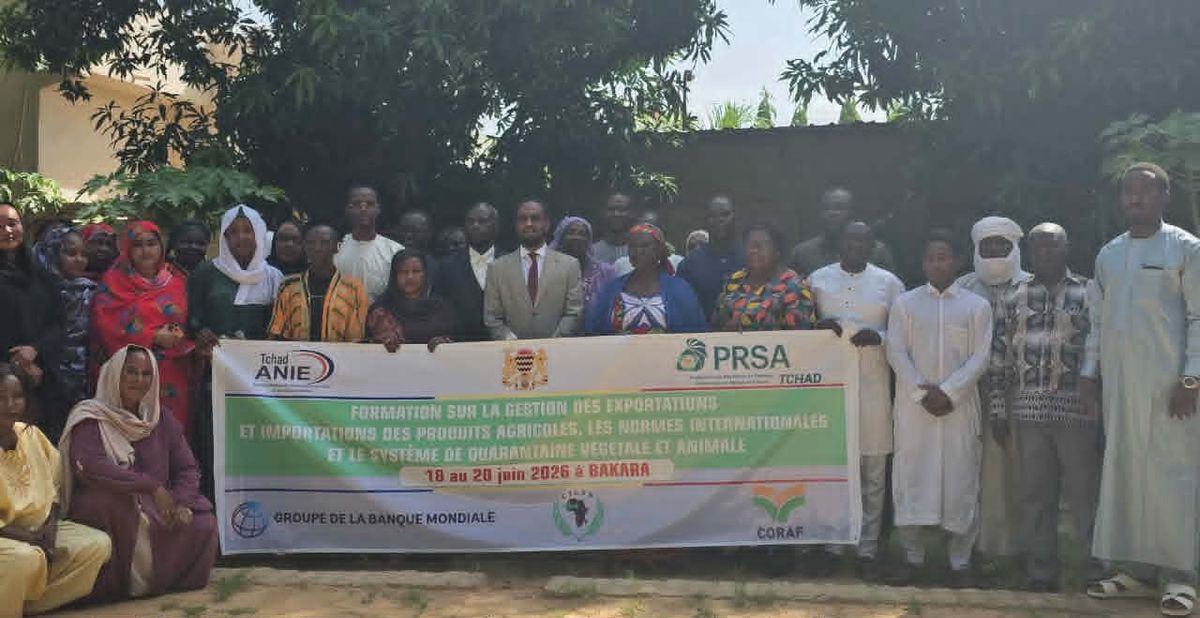
In a bid to overcome persistent obstacles in international agricultural trade, the World Bank and Chad’s National Agency for Investment and Exports (ANIE) have partnered to deliver a targeted training program in Bakara. Focused on streamlining export and import processes for agricultural goods, the initiative addresses critical challenges such as compliance with global quality standards, sanitary and phytosanitary regulations, and complex customs procedures.
Building export readiness in Chad’s agricultural sector
The session, held on June 18, 2026, under the Agricultural Sector Resilience Program (PRSA), brought together stakeholders from public institutions, private enterprises, and regulatory bodies involved in agricultural production, processing, and trade facilitation. The training aimed to equip participants with the technical know-how required to navigate international markets effectively.
Overcoming trade barriers through targeted training
Gotoraye Arnaud, Coordinator of the PRSA Trade and Agricultural Market Dashboard, highlighted the persistent difficulties faced by Chadian producers in accessing foreign markets. He noted that producers struggle with stringent certification requirements, intricate logistics, and adherence to health and safety protocols. “Strengthening export capabilities is not just about selling more—it’s about selling smarter,” Arnaud emphasized. The program focused on practical skills, including international certification protocols, supply chain optimization, and risk mitigation in customs clearance.
National strategy aligns with regional economic ambitions
Dadi Adoum Arsin, Deputy Director-General of ANIE, underscored the strategic importance of the initiative within Chad’s broader economic development agenda. He explained that the government’s “Chad Connexion 2030” National Development Plan prioritizes economic diversification, local value addition, private sector growth, and export promotion. “Our goal is to build an economy that not only produces more but also sells more beyond our borders,” Arsin stated. The training aligns with Chad’s ambition to become a key player in the African Continental Free Trade Area (AfCFTA), which offers access to a market of over 1.4 billion consumers.
“Only countries that invest in quality assurance, standardization, and the professionalization of their operators will fully benefit from AfCFTA’s opportunities,” he added. “Chad cannot afford to be left behind in this transformative movement.”
ANIE’s role in fostering a competitive export ecosystem
ANIE’s vision extends beyond mere regulation—it seeks to create a dynamic ecosystem where businesses gain access to market intelligence, technical support, strategic partnerships, and export opportunities. By serving as a facilitator, the agency aims to empower local enterprises, enhance their competitiveness, and position Chadian products as trusted brands across Africa and beyond. The training in Bakara is a tangible step toward this vision, bringing together a diverse group of stakeholders to foster collaboration and shared expertise.
Looking ahead: A more integrated and resilient agricultural sector
The initiative reflects a growing recognition that agricultural transformation is central to Chad’s economic future. By equipping producers, processors, and traders with the tools they need to meet global standards, Chad is positioning itself to capitalize on regional integration while ensuring food safety and economic sovereignty. As the country strengthens its export capabilities, the agricultural sector stands to play a pivotal role in driving growth, employment, and sustainable development.
You may also like
Nanga armoured vehicles: Burkina Faso’s ‘made in Burkina’ claim sparks national debate as questions mount
Sévaré attack aftermath: Mali’s security debate and the road ahead
Mali’s JNIM attacks: mounting toll, rising debate, uncertain path forward
What the first Sèmè crude cargo means for Benin — and the debate it has sparked
After Dioura: how the AES security gamble became the Sahel’s biggest open question