- Sécurité
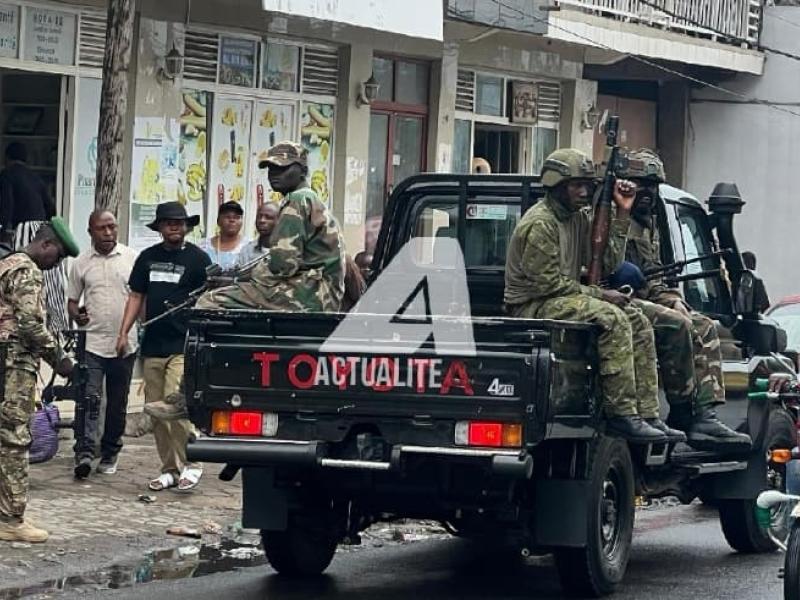
While the United Nations and the Democratic Republic of Congo (DRC) attribute military backing for the AFC/M23 rebellion, which controls significant territories across Nord-Kivu and Sud-Kivu provinces, primarily to Rwanda, this politico-military movement now faces fresh allegations of support from Ukraine. These accusations were voiced by Sergueï Viktorovitch Lavrov, Russia’s Minister of Foreign Affairs, during a working visit to Bujumbura, Burundi.
Speaking at a joint press conference with his Burundian counterpart, Édouard Bizimana, Minister of Foreign Affairs, Regional Integration, and Development Cooperation, on Friday, July 10, 2026, the head of Russian diplomacy condemned what he described as foreign interference in African affairs, specifically targeting the Democratic Republic of Congo. He asserted that Kinshasa, with Burundi’s backing, is confronting aggression led by the M23, which benefits from foreign support.
“We observe blatant attempts at interference in African matters, particularly in the Democratic Republic of Congo. The legitimate authorities of this Republic, with Burundi’s assistance, are currently striving to counter the aggression orchestrated by the M23 group, which is supported by foreign entities, including Ukrainians. We are aware of this, and our Burundian friends are equally aware,” stated Sergueï Viktorovitch Lavrov.
According to the Russian minister, Ukraine’s objective is to bolster forces opposing legitimate governments on the African continent. This strategy, he suggested, aims to destabilize countries perceived as allied with Moscow and to enhance Ukraine’s influence across Africa.
“Ukrainians are involved in far too many conflicts in Africa. Their goal is to support factions hostile to legitimate governments, solely to establish themselves as a key player on the African continent and to create challenges for Russia’s friendly nations,” affirmed the Russian foreign policy chief.
The escalating deployment of armed drones in the ongoing conflict in Eastern DRC continues to raise serious concerns within the international community. Russia is among the nations that have reacted, denouncing this evolution in combat tactics and its severe implications for civilian populations.
Addressing the United Nations Security Council during a session focused on the security situation in Eastern DRC, Anna Evstigneeva, Chargé d’affaires for the Russian Federation to the UN, contended that the increasing use of combat drones exacerbates the humanitarian and security crisis.
The Russian diplomat specifically referenced a drone strike on March 11 in Goma, which tragically claimed the life of a UNICEF staff member. She also conveyed Moscow’s apprehension regarding reports of foreign mercenaries participating in the conflict.
Evstigneeva, speaking before the Security Council on Friday, June 26, 2026, indicated that some of these mercenaries reportedly gained military experience in Ukraine before being recruited as instructors or drone operators.
“We are also concerned by information regarding the deployment of foreign mercenaries, some of whom possess experience acquired in the Ukrainian theater of operations and are reportedly employed as instructors or drone operators,” she had declared.
These concerns emerge as diplomatic initiatives aimed at resolving the conflict continue to yield limited tangible results. Despite the signing of the Washington Accord and subsequent follow-up meetings, the security and humanitarian conditions in Eastern DRC remain critical. Divergent interpretations of the agreement between Kinshasa and Kigali further complicate its implementation.
The Doha process, mediated by Qatar, also faces considerable hurdles. Multiple rounds of negotiations between the Congolese government and the Alliance Fleuve Congo (AFC/M23) rebellion, reportedly backed by Rwanda, have yet to bridge the fundamental disagreements between the parties. A meeting in Montreux, Switzerland, intended to inject new momentum into discussions, failed to achieve the anticipated breakthroughs.
Against this backdrop, calls for adherence to commitments made under various peace processes persist at national, regional, and international levels. However, these appeals have, to date, been insufficient to reverse the deteriorating trend. Diplomatic progress lags behind the grim realities on the ground, with each side maintaining its own interpretation of the accords, perpetuating impasses and delaying effective resolution.
Dans la même catégorie
Related Posts
New political movement ‘alternative credible’ launches in Côte d’Ivoire
Abidjan, July 5, 2026 – A new political force, Alternative crédible (ACR), has been officially introduced to the press, aiming…
Paris FC vs Lyon: kick-off time and TV channel for the Ligue 1 clash
Sports,Football,Ligue 1 Paris FC vs Lyon: kick-off time and TV channel for the Ligue 1 clash Ajouter Le Parisien en…
Colonel otoulou’s testimony in the zogo case shakes Cameroun
The testimony of Colonel Otoulou in the Martinez Zogo case has sent shockwaves through Cameroun. During the hearing, the senior…