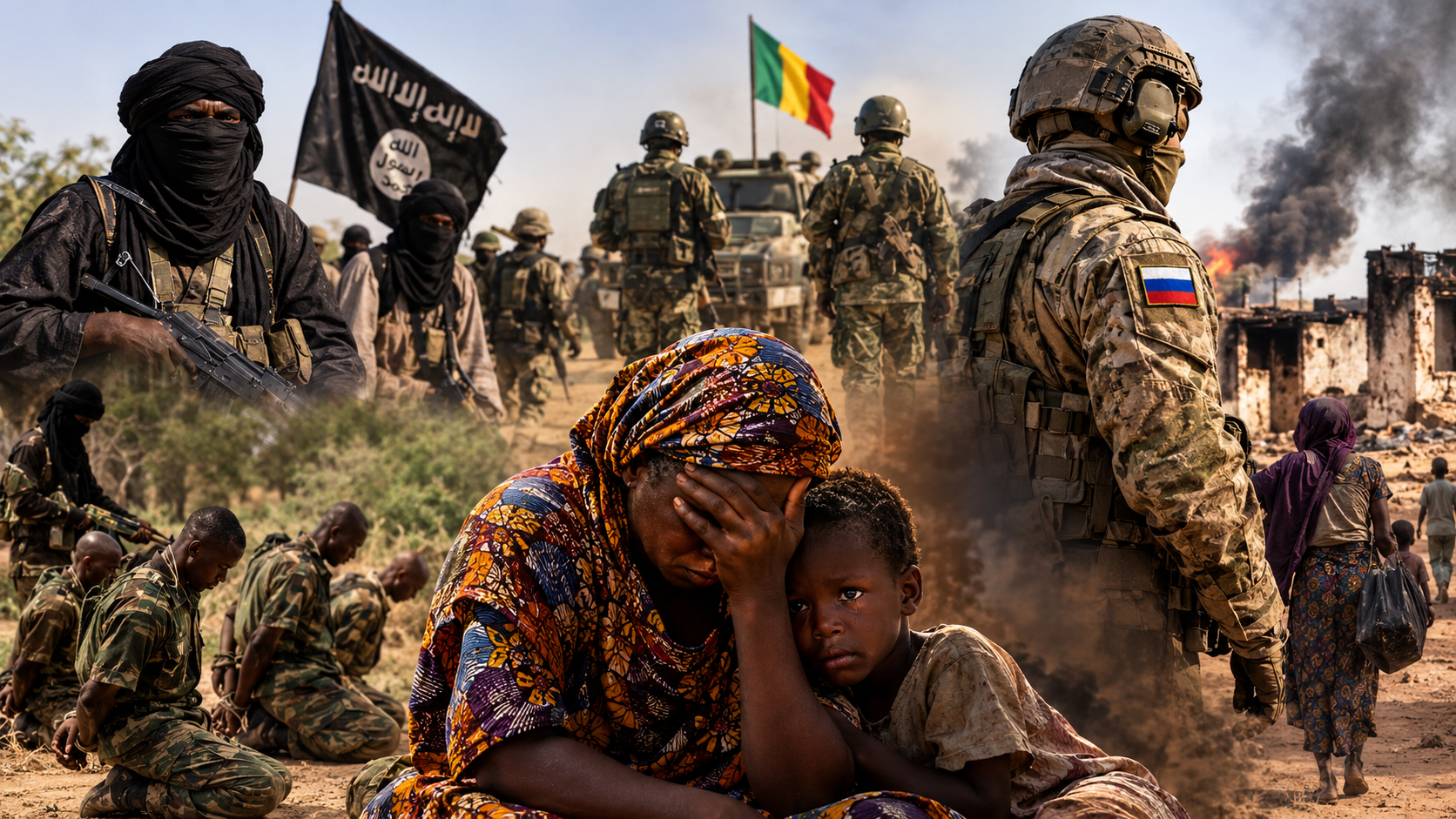
In the heart of Mali’s prolonged security crisis, a disturbing paradox has emerged: while government forces endure relentless attacks from the Group for the Support of Islam and Muslims (JNIM), reports indicate that civilians are increasingly caught in the crossfire not by jihadist bullets, but through alleged abuses by the Malian army and its allies, including Africa Corps personnel.
Is military force failing to shield the very communities it aims to protect?
Human rights observers have documented a grim pattern in Mali’s conflict zones. On one side, JNIM’s brazen attacks on military outposts leave soldiers dead and morale shaken. On the other, civilian populations face arbitrary detentions, extrajudicial killings, and destruction of property often attributed to Malian security forces operating with Russian-backed support.
This dual threat has left many communities stranded between the hammer of armed groups and the anvil of state security operations. For families caught in the middle, the promise of protection rings hollow when safety comes at the cost of life itself.
Why civilian casualties persist amid counterterrorism operations
At the core of the problem lies a fundamental contradiction. The Malian government’s military partnerships especially with Africa Corps were framed as a solution to the jihadist insurgency. Yet, instead of quelling violence, these operations have contributed to a surge in civilian harm.
Misidentification risks: Heavy-handed military tactics often conflate civilian settlements with jihadist hideouts, leading to devastating collateral damage.
Lack of accountability: Reports of abuses rarely result in transparent investigations or disciplinary action, fostering a culture of impunity.
Distrust in institutions: Civilians, already wary of armed groups, now view state forces with growing suspicion, further complicating peacebuilding efforts.
Can Mali’s security strategy ever prioritize human rights over military gains?
The JNIM’s tactics are undeniably brutal, but they do not excuse the state’s obligation to uphold international humanitarian law. International observers argue that a truly effective counterterrorism strategy must prioritize civilian protection as fiercely as it confronts armed threats.
Key steps forward could include:
Independent oversight of military operations, with mechanisms to address civilian complaints swiftly.
Clear protocols to distinguish between combatants and non-combatants during raids and patrols.
Cultural sensitivity training for allied forces to reduce the risk of misunderstood orders or indiscriminate force.
The human cost: families shattered by a war they didn’t choose
Behind every statistic is a story of loss. In villages like Ménaka, Gao, and Timbuktu, families recount how soldiers vanished after raids, homes were burned in reprisals, and children were left orphaned. These incidents, when documented, paint a picture of a nation where security operations have become as destabilizing as the insurgency itself.
The international community’s role is also under scrutiny. Allies providing military support must balance tactical effectiveness with ethical imperatives. Africa Corps’ involvement, while framed as a stabilizing force, now faces scrutiny over whether its tactics align with Mali’s humanitarian obligations.
A way forward: redefining success in Mali’s fight for stability
Mali stands at a crossroads. It can continue down a path where security is measured in bodies and territory reclaimed, or it can shift toward a model where civilian safety and accountability are the true benchmarks of progress.
The choice is stark: Will the government confront its failures in protecting civilians, or will history remember this chapter as one defined by preventable tragedy?
For the people of Mali, the answer cannot come soon enough.
By Daniel Mbami — Journalist