
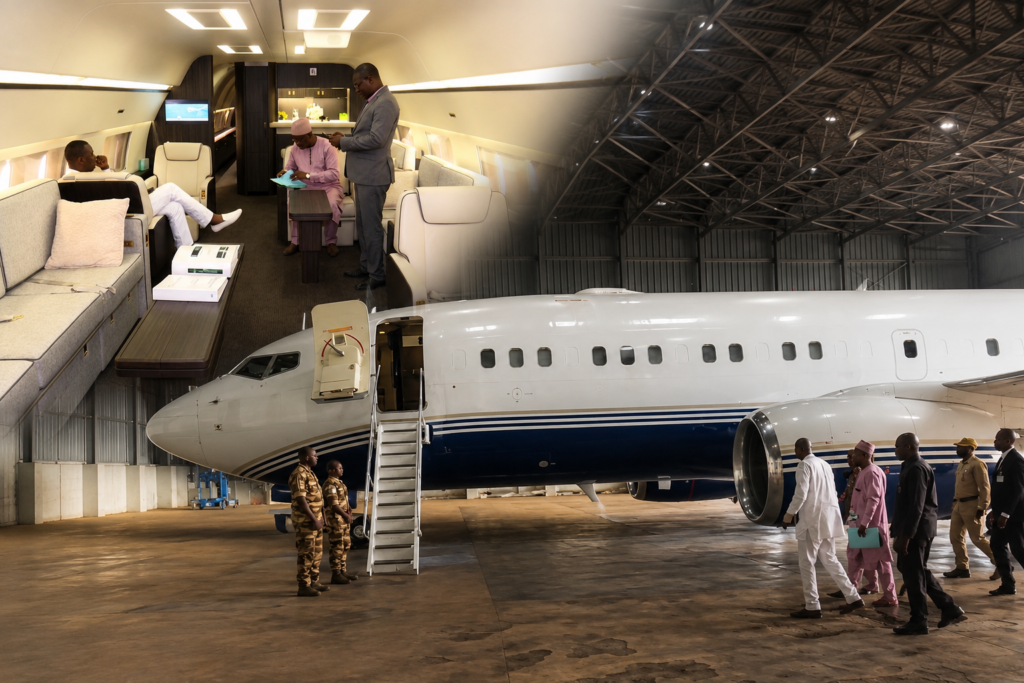
The unveiling of Mali’s latest presidential aircraft a Boeing 737 has ignited widespread discussion days after its presentation on national television. The government framed the acquisition as a financially sound decision, claiming the 15.6 billion CFA franc purchase price would be reduced to 6 billion after insurance payouts and the resale of components from the previous aircraft.
An acquisition at odds with Mali’s security realities
Yet beyond the financial justification, the timing and nature of this investment raise critical questions about national priorities. Mali continues to grapple with severe security challenges, economic strain, and public finance constraints, making this sizable expenditure a focal point of contention.
The announcement followed repeated appeals for national resilience and collective sacrifice, creating a stark contrast between the government’s rhetoric and its actions. In numerous regions, insecurity remains a daily reality: military outposts are under siege, civilians face targeted violence, and vital roadways are plagued by ambushes. Many communities remain cut off from state protection, with administration struggling to restore control over vast areas.
Ongoing security threats overshadow the new aircraft
Three years into the Transition’s stated priority of territorial recovery, the challenges remain daunting. In the north, the Cadre stratégique permanent, including the Front de Libération de l’Azawad (FLA), maintains significant operational capacity and contests control over key zones. Meanwhile, in central and southern Mali, the Jama’at Nusrat ul-Islam wal Muslimin (JNIM) continues expanding its influence through relentless attacks on military positions, infrastructure, and state representatives. Critical supply routes remain hazardous, crippling commerce and local economies.
Budget allocation scrutinized amid urgent needs
While officials maintain the deal’s financial prudence, critics argue that billions could have been redirected to pressing priorities, such as:
Enhancing the operational capacity of the Malian Armed Forces;
Acquiring armored vehicles, communication systems, and protective equipment;
Strengthening intelligence and aerial surveillance capabilities;
Supporting wounded soldiers and families of fallen troops;
Assisting internally displaced persons and funding reconstruction in conflict-affected areas.
The expenditure’s symbolic weight carries as much weight as its financial implications, challenging the Transition’s professed commitment to governance rooted in national service.
A departure from the promise of austerity
The current administration positioned itself on a platform of transparency and frugality, vowing to break from past regimes’ practices. Yet the procurement of a high-capacity executive jet undermines this narrative for many observers. To a significant portion of the public, the move signals a return to the very culture of extravagance it pledged to reject.
The contrast is further sharpened by persistent economic hardships: surging living costs, strained public finances, and unmet social needs across sectors.
Diplomatic utility versus domestic expectations
Proponents argue that a modern presidential aircraft enhances Mali’s diplomatic footprint, facilitating official missions and international representation. However, critics counter that a state’s credibility rests not on its fleet, but on its ability to secure its territory, protect its people, and restore functional governance.
For many Malians, sovereignty is measured not by the modernity of an executive jet, but by the state’s tangible capacity to fulfill its most basic obligations.
The deeper implications for transitional governance
This acquisition transcends a mere procurement decision—it reflects broader questions about the Transition’s strategic choices. As security threats persist, attacks continue unabated, and economic hardship deepens, every high-profile expenditure is met with heightened scrutiny.
To regain trust, the government must demonstrate that its actions align with the urgent needs of the population. Until then, investments perceived as symbolic may increasingly be seen as emblematic of a widening gap between official priorities and public expectations.
You may also like
Why Niger’s soldiers are walking away from Tiani’s army
Behind the sovereignty talk, AES states owe 7,727 billion CFA francs on the regional market
Benin back to school: classes reopen nationwide on 14 september 2026
Sonidep’s 2026 loss: how Niger’s cheap fuel policy is draining the state oil company
Texforces-BF: a textile plant built on Burkina Faso’s retirement savings