
The gap between the message and the market
For three years, Burkina Faso, Mali and Niger have told their citizens that they are cutting loose from old dependencies. Self-reliance, home-grown financing, refusal of arrangements designed elsewhere — the vocabulary is familiar. The balance sheets of the regional securities market, though, tell a more tangled story.
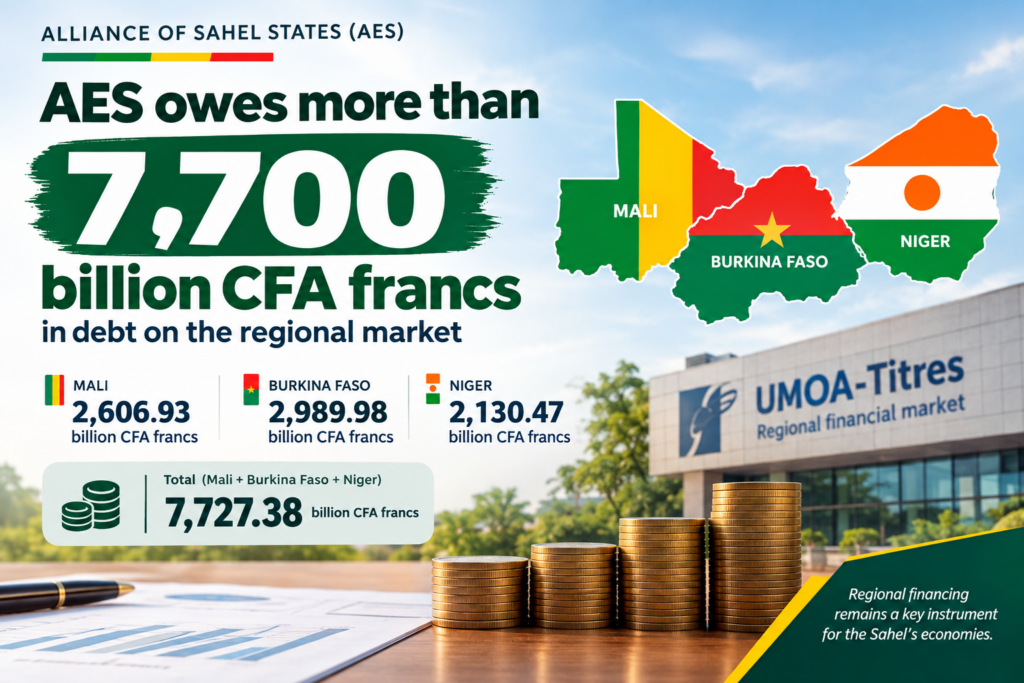
By 31 July 2026, the three members of the Alliance of Sahel States were still among the busiest borrowers on the public securities market of the West African Economic and Monetary Union. Their combined outstanding instruments came to about 7,727 billion CFA francs.
One distinction matters before anything else: this is not money owed to the union as an institution. It is money owed to investors — banks, funds, insurers — that bought the treasury bills and bonds these governments issued. UMOA-Titres exists precisely to organise that market and channel regional savings toward sovereign borrowers.
Three treasuries, three figures
At 31 July 2026, the stock of public securities still in circulation broke down as follows:
- Burkina Faso: 2,989.98 billion CFA francs
- Mali: 2,606.93 billion CFA francs
- Niger: 2,130.47 billion CFA francs
Add them together and the total reaches 7,727.38 billion CFA francs. Across the entire union, outstanding public securities stood at 24,073.53 billion CFA francs the same day. The three Sahel states therefore accounted for roughly 32.1 percent of the whole regional market — a third of it, held by countries that present themselves as charting a separate course.
Burkina Faso closes in on 3,000 billion
Ouagadougou’s outstanding stock reached 2,989.98 billion CFA francs at the end of July, or about 12.4 percent of the union-wide total. The figure was still rising, up 2.46 percent over a single month.
Activity during the early months of 2026 shows a treasury operating on both sides of the ledger at once. In May alone, Burkina Faso raised 99.50 billion CFA francs through Treasury bonds while paying back 72.04 billion. Borrowing on the regional market did not vanish when the sovereignty speeches started; it remains an ordinary instrument for managing cash flow and covering state spending.
Mali holds a little over 2,600 billion
Mali’s outstanding stock stood at 2,606.93 billion CFA francs on 31 July, close to 10.8 percent of the regional total.
This is not a one-off spike. By the end of May 2026, the Malian balance had already reached 2,637.64 billion CFA francs. During that month, Bamako raised 93.50 billion CFA francs while repayments swallowed 110.07 billion — paying back more than it took in. The country keeps borrowing and repaying simultaneously, which is standard practice for any debt manager.
The interesting question is not whether Bamako borrows. It is at what pace, at what price, and to finance which expenditures.
Niger: a 388 billion leap in a single month
Niger’s outstanding stock amounted to 2,130.47 billion CFA francs at the end of July, roughly 8.9 percent of the union total. It is the trajectory rather than the level that deserves attention.
Between April and May 2026, the Nigerien balance jumped from 1,732.05 billion to 2,120.45 billion CFA francs — an increase of nearly 388.4 billion in one month, according to market data compiled by UMOA-Titres. Large financing operations and a debt reprofiling exercise explain much of that surge.
In May 2026, Niamey raised 567.49 billion CFA francs, including 519.51 billion in Treasury bonds and 47.97 billion in bills, while repaying 191.31 billion. Days earlier, a broader operation had handled 446.386 billion CFA francs of securities, of which about 59.710 billion in short-term paper was bought back to ease immediate pressure on the treasury. Net resources generated by that transaction were estimated at around 327 billion CFA francs.
Do the numbers contradict the sovereignty project?
This is where the real reporting begins. It would be wrong to claim these three states are wholly dependent on the regional market. It would be just as wrong to claim they have walked away from it. The data point to heavy, sustained use.
The market is also not some external mechanism forced upon governments. For years it has been a normal channel for financing national budgets across the West African monetary area. What remains an open political and economic question is whether a policy can be described as fully autonomous when thousands of billions of francs are still raised from regional investors to fund state needs.
Answering that requires looking past slogans.
The paradox sharpens after the ECOWAS exit
Politically, the three countries say they want to build an independent path. Financially, they keep tapping the union’s regional market — a market that runs largely on the balance sheets of West African banks and investors.
An analysis published in late 2025 noted that investors in the other union states had trimmed their exposure to AES sovereign debt, from 3,174 billion to 2,801 billion CFA francs — a decline of 373 billion between the fourth quarter of 2024 and the third quarter of 2025. Over the same period, cross-holdings of securities among the three AES states fell by 622 billion CFA francs, to about 3,160 billion.
That trend is worth monitoring. When lenders grow more cautious, financing tends to become costlier and harder to secure.
The indicator that counts: price, not volume
An outstanding balance on its own proves little. Judging whether a debt is sustainable means examining:
- interest rates;
- maturity schedules;
- the annual volume of repayments;
- the capacity to raise tax revenue;
- economic growth;
- the share of spending devoted to security;
- the ability to roll over maturing securities.
This is where the danger sits. A state can carry a large balance comfortably if it collects enough revenue and grows steadily. A state can also stumble badly with a smaller debt if a large slice of its securities matures all at once, or if interest rates climb too high.
Why headline issuance numbers flatter
Niger’s May 2026 operation illustrates the mechanism neatly. The country raised 567.49 billion CFA francs and repaid 191.31 billion. Another transaction covered 446.386 billion, part of which was used to buy back securities reaching maturity.
The consequence is simple: a portion of newly raised money is not fresh cash available for projects. It refinances existing obligations. That is normal on bond markets, but it needs to be said plainly — raising several hundred billion francs does not automatically mean those hundreds of billions add to the resources available for development.
So when a government announces a 500 billion CFA franc issue, several questions follow. How much of it is genuinely new? How much retires older paper? What interest rate applies? What is the duration? And what will the final bill cost the taxpayer?
In Niger’s case, the gap between the 446.386 billion CFA francs handled and the roughly 327 billion in net resources generated is not an accounting footnote. It changes how the political headline should be read.
Sovereignty does not wipe out a liability
The debate over the alliance should not be reduced to a contest between sovereignty and dependency. The figures describe something more layered.
At 31 July 2026, Burkina Faso, Mali and Niger together carried 7,727.38 billion CFA francs of outstanding public securities on the regional market. This is not a debt owed directly to the monetary union as an organisation; it is a debt owed to the investors who subscribed to the securities these states issued.
The observation stands regardless. Three countries that claim greater financial autonomy keep leaning heavily on regional bond financing to cover their needs.
The question is no longer whether the alliance borrows. It is how far these states can keep borrowing before the price of that financial sovereignty starts weighing heavily on the budgets of tomorrow.
You may also like
Why Niger’s soldiers are walking away from Tiani’s army
Benin back to school: classes reopen nationwide on 14 september 2026
Sonidep’s 2026 loss: how Niger’s cheap fuel policy is draining the state oil company
Texforces-BF: a textile plant built on Burkina Faso’s retirement savings
Niger’s external liabilities reach 12,900 billion CFA francs as dependence deepens