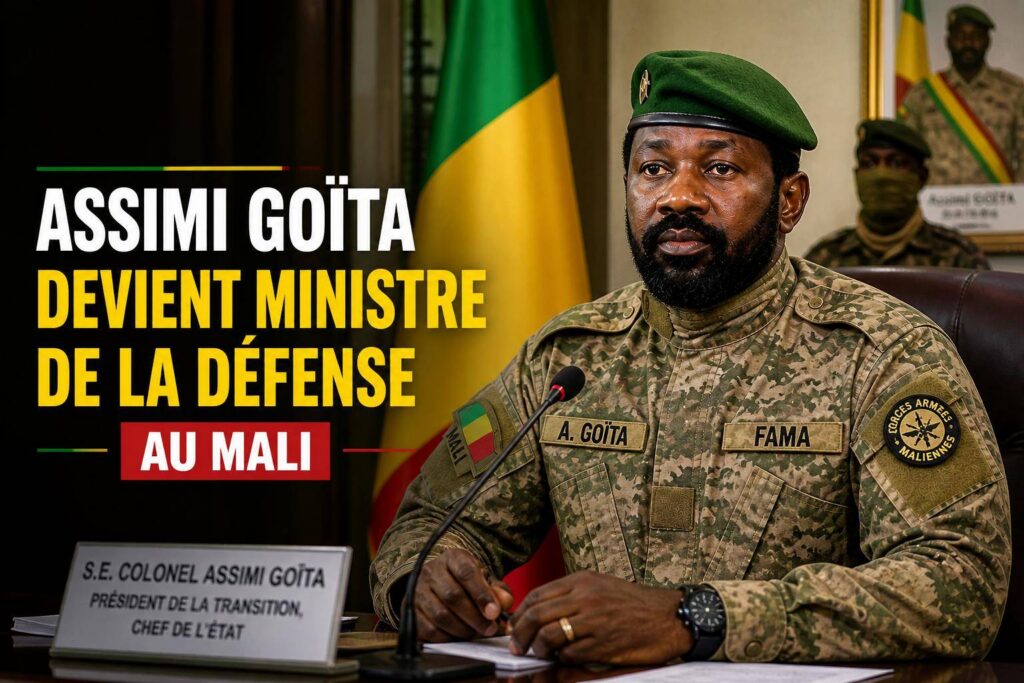
By officially assuming the role of Defence Minister in addition to his presidency, Colonel Assimi Goïta has solidified his grip on power in Bamako. This move, far from a routine administrative shift, signals a desperate attempt to address a crumbling command structure and a faltering military strategy. The fall of Kidal to the JNIM and FLA forces has exposed glaring weaknesses, while the much-touted Russian partnership under Wagner (now Africa Corps) has failed to deliver tangible security gains.
power centralisation in Bamako: a high-stakes gamble
In Mali’s capital, every decision now originates from Koulouba Palace. By merging the roles of Head of State and Defence Minister, Assimi Goïta has taken direct control of both political vision and battlefield operations. Regional analysts interpret this as a sign of growing distrust within the inner circle. With the transition dragging on, the question looms: can one leader effectively manage state affairs, regional diplomacy, and the intricacies of asymmetric warfare? This concentration of power resembles a reckless dash toward uncertainty. By removing ministerial buffers, Goïta now shoulders full responsibility—every setback will be seen as his failure, not that of a subordinate.
kidals fall: from liberation to humiliation
Just months ago, official narratives celebrated Kidal’s “liberation” as a triumph of Mali’s sovereignty. Today, the city lies in ruins, retaken by armed groups like the Group for the Support of Islam and Muslims (JNIM) and the Coordination of Azawad Movements (CMA/FLA). This defeat is both symbolic and tactical. Despite claims of military progress, Malian forces struggle to hold ground. The absence of civilian administration and lingering security vacuums have enabled jihadist and rebel factions to reclaim territory swiftly. The JNIM, in particular, has refined its tactics, isolating garrisons and severing supply lines, turning Bamako’s proclaimed victories into fleeting illusions.
Wagner’s fading promise: a flawed security pillar
The Russian paramilitary group Wagner—now rebranded as Africa Corps—was touted as a sovereign alternative to France’s former influence. Yet, their impact on Mali’s security landscape remains dubious. Reports of scorched-earth tactics and widespread human rights abuses have fueled local radicalisation rather than stabilising the region. Worse still, Malian military columns continue to fall victim to ambushes with alarming ease, exposing gaps in Wagner’s operational effectiveness. With Russia embroiled in its own conflict in Europe, can Moscow truly provide the aerial and technological support Mali desperately needs? The evidence suggests otherwise.
regional isolation: the cost of autarky
Mali’s pivot away from ECOWAS in favour of the Alliance of Sahel States (AES) was meant to assert independence. However, porous borders and transnational terrorism render such isolation counterproductive. By severing regional cooperation channels, Bamako has stripped itself of critical intelligence-sharing and logistical support. Neighbouring capitals view Goïta’s power consolidation as an authoritarian overreach, further complicating diplomatic efforts. The paradox is stark: Mali seeks sovereignty through force yet remains dangerously dependent on opaque foreign actors and a command chain concentrated in one man’s hands.
a nation at the precipice: what lies ahead for Mali?
The Central and Northern regions of Mali face an escalating security crisis. Daily attacks on civilian and military convoys have become the norm. Assimi Goïta’s dual role as President and Defence Minister represents his last major gamble. Should the situation deteriorate further, simmering public discontent—currently suppressed by heavy-handed security measures—could erupt violently. History warns that excessive power centralisation often precedes large-scale instability.
To break this cycle, Mali must reassess its approach. Reliance on brute force and mercenary alliances has proven ineffective. Without inclusive governance and a robust strategy for reasserting state authority over territory, Goïta’s military campaigns risk collapse. The time for wartime rhetoric is over; urgent political realism is the only path forward. Behind the uniforms and titles, the very survival of the Malian state hangs in the balance on the shifting sands of the North.
You may also like
Burkina Faso: shrinking civil service payroll exacts a heavy toll on households and local economies
Simporé’s TV admission: Burkina Faso reacts as the security narrative crumbles
Gabon’s ghost payroll purge: public reaction, union pushback and what happens next
After Burkina Faso’s imam crackdown: the fallout, the anger, and the road ahead
Benin’s disability card rollout: reactions, scrutiny and what happens next