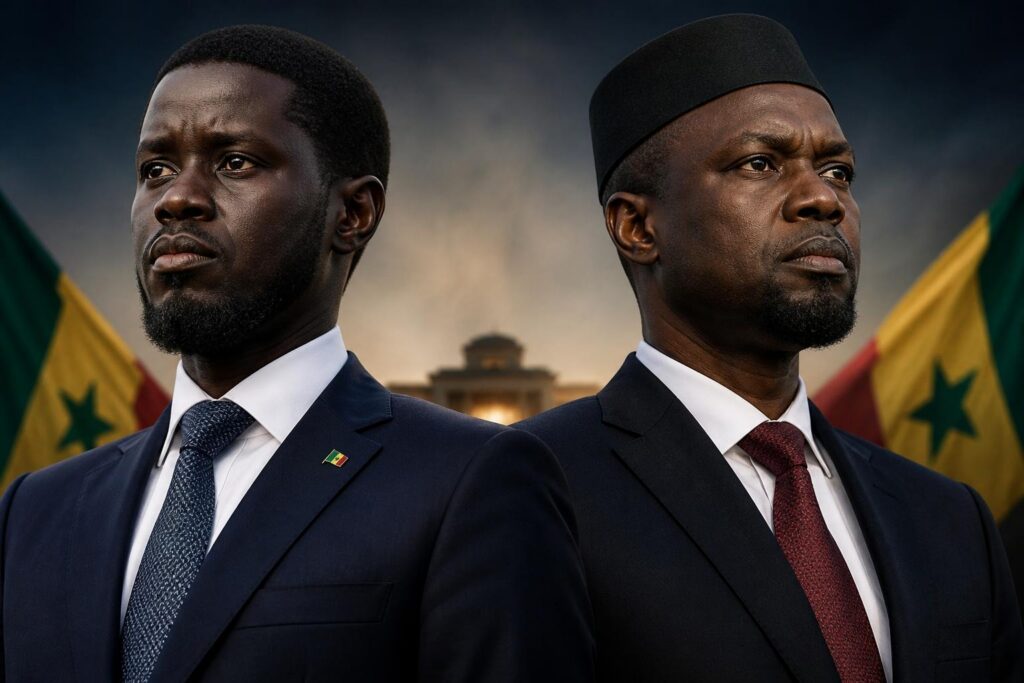
In Senegal, the honeymoon period at the highest levels of government appears to be giving way to a more pragmatic and assertive political reality. The weekend of May 2-3, 2026, marked a significant turning point in the relationship between President Bassirou Diomaye Faye and his Prime Minister, Ousmane Sonko. By openly addressing their growing differences with the Pastef party and declaring himself « ready for a separation » should national interests demand it, the president shattered the illusion of an unbreakable alliance. As Senegal watches on, the unfolding dynamics between presidential emancipation and partisan loyalty hint at an unprecedented political reshuffle.
a weekend of unmistakable clarity
The catalyst for this shift came in the form of a single statement during a national press interview. Up until then, the official narrative had painted a picture of an inseparable duo, a « pair » where mentor and protégé marched in lockstep toward their shared vision of change. That narrative has now shifted dramatically.
When questioned about escalating tensions between government policy and the sometimes outspoken rhetoric of Pastef officials, President Faye adopted an unexpectedly firm stance. He reiterated his formal disengagement from the party to assume the role of president for all Senegalese citizens. His words carried the weight of a thunderclap across the political landscape of Dakar when he declared that while his loyalty to the national project remains unwavering, his ultimate responsibility is to the people. By stating he would not hesitate to dissolve the alliance if partisan interests clashed with his vision for the State, he staked an irreversible claim to executive autonomy.
the shadow of Ousmane Sonko: a prime minister overshadowing the presidency
To grasp the depth of this tension, it’s essential to revisit the origins of this administration. Elected on a platform that positioned a vote for Diomaye as a vote for Sonko, the president has long navigated the shadow of a Prime Minister whose media presence often eclipsed official government communication. The charismatic leader of Pastef never fully shed his partisan mantle, frequently taking to the stage at rallies and public forums—sometimes in ways that seemed to bypass or contradict the administration’s official messaging.
Over recent months, strategic disagreements have surfaced on critical issues. Debt management and relations with international institutions highlight this divide, with the Prime Minister advocating for a radical break, while the president favors a more diplomatic and pragmatic approach. The appointment process has also sparked controversy, caught between the president’s preference for technocratic expertise and the party’s push to install loyalists from its earliest ranks. The contrast between Sonko’s fiery rhetoric and Faye’s measured, statesmanlike demeanor has grown increasingly stark.
is separation now inevitable?
While an immediate split may still be premature, it is now an openly acknowledged political possibility. The president seems to have reached a pivotal realization: to leave a lasting legacy, he must define his leadership independently. Within the Prime Minister’s inner circle, attempts are being made to downplay these remarks by framing them as a division of roles. Yet the president’s messaging suggests a far more consequential shift. By signaling openness to a break, he sends a clear message to his base: the presidency will not be held hostage by any pressure group.
This development leaves Senegal in a state of institutional uncertainty. The country has a history of volatile executive partnerships, and many now fear a potential paralysis of the state apparatus. Should a rupture occur, the president would face the challenge of governing without the full support of the Pastef’s activist machinery, forcing him to seek new alliances or govern through decree.
the stakes of presidential autonomy
President Bassirou Diomaye Faye’s central challenge is twofold: reassuring international partners of the country’s stability while proving to citizens that he is firmly in command. Public opinion is deeply divided. A segment of the youth, fiercely loyal to Sonko’s charisma, may interpret this emancipation as a betrayal. Conversely, a more legalistic faction of the population welcomes the emergence of a president who is finally embracing his constitutional prerogatives.
The president now faces a high-stakes chess match. He must assert his authority without triggering a social crisis that opponents could exploit. The question is no longer about personal rapport—it’s about whether the architecture of the State can sustain two competing centers of power indefinitely.
Observers of Senegalese politics are witnessing the end of a certain political innocence. Governance is not about camaraderie—it’s about the management of power. President Faye has reminded the nation that the Constitution grants him authority he is now resolved to wield independently. What once served as a vehicle for victory appears to now hinder effective governance. Senegal is entering a phase of maturity where the State must take precedence over the party, and the president has just drawn that line in the sand.
You may also like
Burkina Faso: shrinking civil service payroll exacts a heavy toll on households and local economies
Simporé’s TV admission: Burkina Faso reacts as the security narrative crumbles
Gabon’s ghost payroll purge: public reaction, union pushback and what happens next
After Burkina Faso’s imam crackdown: the fallout, the anger, and the road ahead
Benin’s disability card rollout: reactions, scrutiny and what happens next