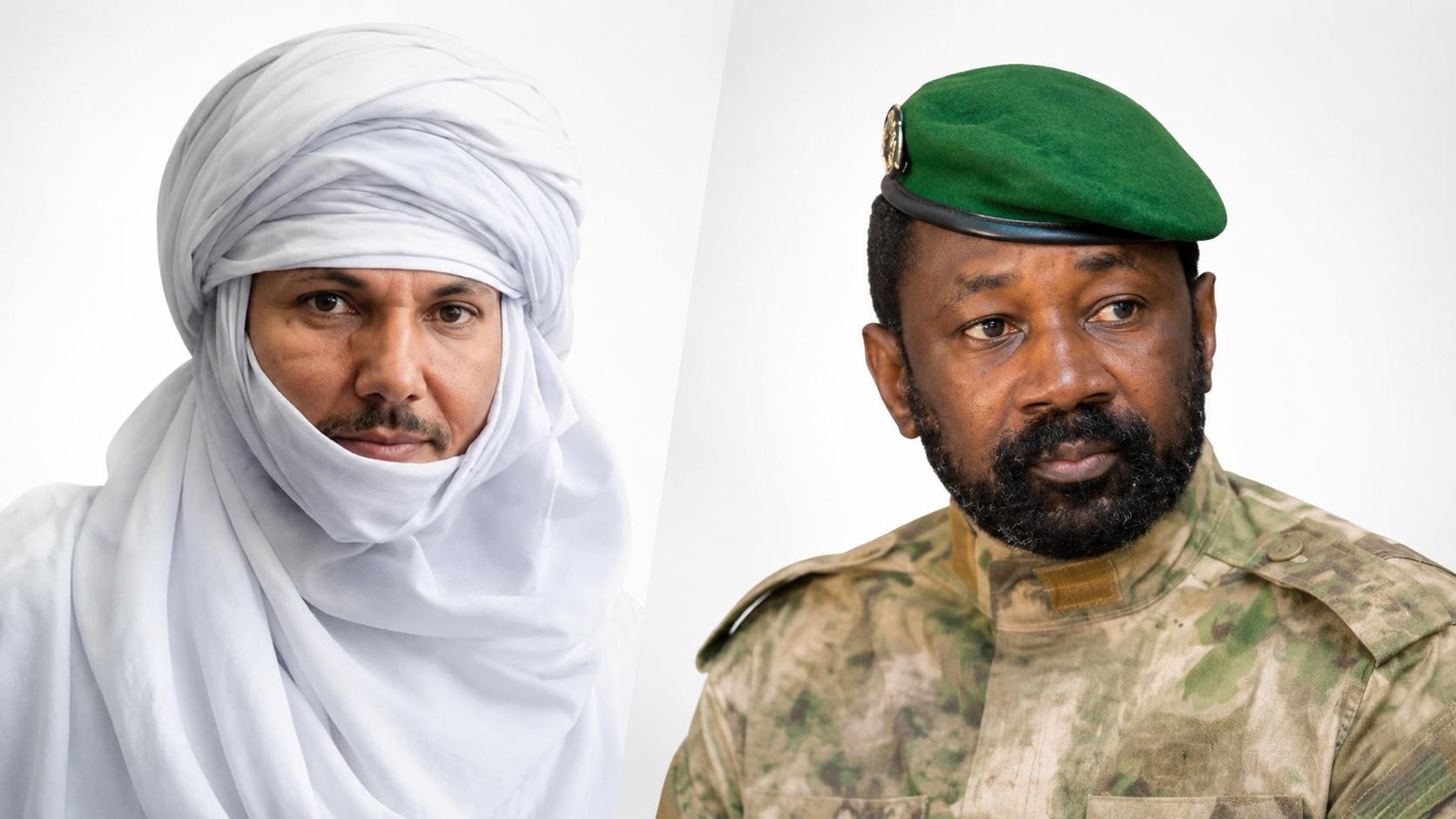
Mali’s leadership trapped in a spiral of denial amid worsening conflict
BAMAKO / ANEFIF — The Malian junta’s official narrative of a strong, sovereign state crumbles under the weight of ground realities. Reports of renewed large-scale fighting in the North, the growing military influence of Azawad rebels, and the devastating human cost of the junta’s alliance with Russian mercenaries paint a starkly different picture. These challenges are dissected in unfiltered detail by Nigerien writer and commentator Issouf Ag MAHA, now living in exile.
The junta’s grip on power overshadows peace prospects
Since the August 2020 coup, the military leadership vowed to restore national unity and end insecurity. Yet six years later, the results speak for themselves. By unilaterally withdrawing from the 2015 Algiers Peace Accords in early 2024, the transitional authorities closed the last meaningful channel for political dialogue with northern armed groups—pushing the country back toward armed confrontation.
In a blunt assessment, Ag MAHA condemns what he describes as the junta’s « power addiction »—a fixation on short-term political survival rather than resolving the conflict. As the regime tightens its grip in Bamako through media censorship, repression of dissent, and curbs on public freedoms, its authority is rapidly eroding beyond the capital. The harder it clings to control, the more fragile its legitimacy becomes.
Military setbacks expose cracks in Bamako’s façade
On July 4, 2026, heavy fighting erupted near Anefif, a key northern outpost where Malian troops and Russian-backed forces are entrenched. A military convoy dispatched from Gao was ambushed, resulting in significant casualties and forcing government forces to retreat. This defeat follows a string of strategic losses, including the fall of Tinzawatène and the recapture of Kidal by the Azawad Liberation Front (FLA).
Contrary to official claims of control, the military balance remains precarious. Ag MAHA highlights a deliberate shift by the FLA: after seizing key positions, the movement allowed the withdrawal of some Malian and Russian troops, signaling an attempt to differentiate itself from the junta’s brutal tactics and demonstrate adherence to international humanitarian standards.
Russian mercenaries deepen suffering in northern Mali
The junta’s pivot toward Moscow, embodied by the deployment of Africa Corps (formerly Wagner Group), has come at a terrible human cost. While this alliance frees the regime from Western democratic pressures, it has unleashed a wave of violence against civilians in the North.
Ag MAHA’s report outlines a pattern of systematic abuse:
- Widespread arbitrary arrests and enforced disappearances.
- Extrajudicial executions targeting unarmed civilians.
- A deliberate strategy of intimidation aimed at eroding local trust in the state.
Despite mounting evidence, Bamako continues to deny allegations, retreating into denialism that Ag MAHA warns threatens the very fabric of Malian society.
Mali drifting toward irreversible collapse
The international community’s waning attention has left Mali in a dangerous vacuum. Ag MAHA criticizes the « deafening silence » from global actors, regional blocs, and foreign media. He questions whether the world will only act after a decisive military outcome—or if Mali has already faded from global concern.
For the analyst, Mali is hurtling toward a point of no return. By prioritizing the illusion of total military victory over justice, inclusivity, and national unity, the junta risks not rebuilding the country—but accelerating its fragmentation.