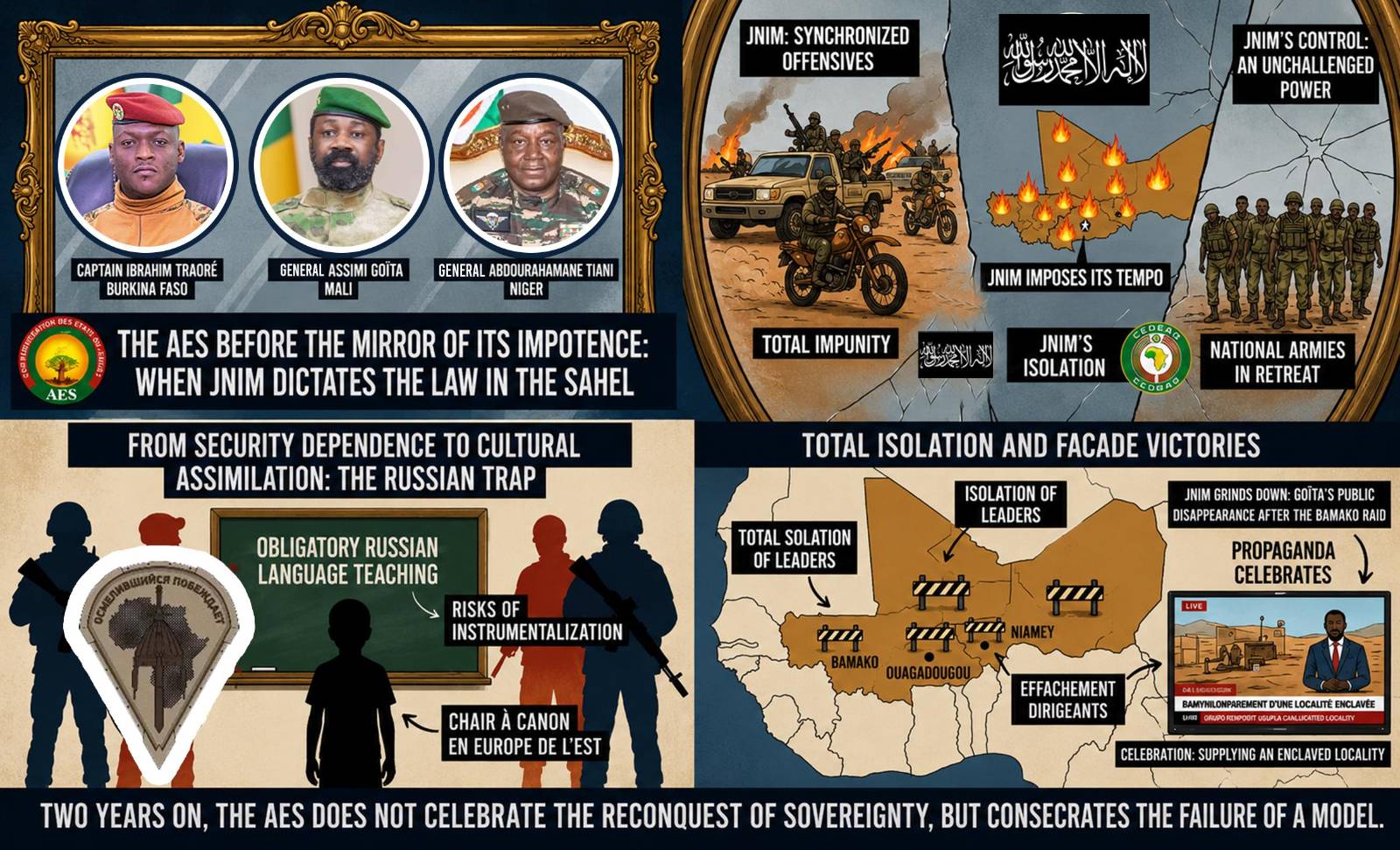
The Alliance of Sahel States (AES) is grappling with a harsh reality two years after its much-touted formation. Behind the bold declarations of sovereignty from the juntas in Bamako, Ouagadougou, and Niamey, the situation on the ground tells a different story. The only force capable of coordinated action, dictating the pace of conflict, and striking with impunity remains the Group for the Support of Islam and Muslims (JNIM).
The illusion of strength crumbles against tactical supremacy
The political amateurism and grandstanding of the military regimes have collided head-on with the JNIM’s devastating efficiency. The armed group orchestrates large-scale, synchronized offensives, striking multiple key regions simultaneously and overpowering national armies that boast superior equipment. Neither the theoretical pooling of AES intelligence services nor the full geopolitical alignment with Moscow has managed to stem the tide of losses.
From security dependence to cultural assimilation: the Russian gambit
Facing this void, leaders like Captain Ibrahim Traoré have forged an alliance with Russia that extends far beyond mere military cooperation or the presence of mercenaries from the former Wagner Group, now rebranded as Africa Corps. The decision to introduce Russian language instruction in Burkinabè schools starting next term signals a profound ideological shift. Presented as an act of cultural decolonization, this move is better understood as a psychological and structural preparation of the youth for a deeper integration into Moscow’s sphere of influence.
Analysts warn that this linguistic shift is not just an educational reform but a precursor to a more insidious long-term strategy. By embedding Russian into the curriculum from an early age, the regime is laying the groundwork for future generations to be drawn into Moscow’s orbit. The risk is clear: young Sahelians, sent to Russia under the guise of education or training, could be exploited as cannon fodder or human shields in conflicts unrelated to their homeland, all to repay Moscow for its military support to the juntas.
Isolation and hollow victories
As the cultural transition unfolds, the JNIM continues its relentless campaign of attrition. By crippling the three juntas, the armed group has succeeded in isolating their leaders almost entirely from public view. In Mali, the prolonged absence of Assimi Goïta from the public eye following a deadly raid in Bamako—allegedly claiming the life of the Defense Minister—has become a glaring symbol of this isolation.
The bitter truth is evident: while terrorist groups carve out territory, military command centers are drowning in political absurdity. State propaganda now celebrates trivial achievements, such as the resupply of a remote village or a minor defensive response, as major triumphs. This admission of powerlessness underscores the depth of the crisis.
Two years into the AES experiment, the narrative of regained sovereignty has given way to the stark reality of a failed model. By mistaking war propaganda for military strategy and swapping Western dependence for cultural and military submission to Moscow, the juntas have allowed the JNIM to dictate the terms of engagement. The Sahel has not liberated itself; it has merely exchanged one master for another, with its youth bearing the heaviest burden.