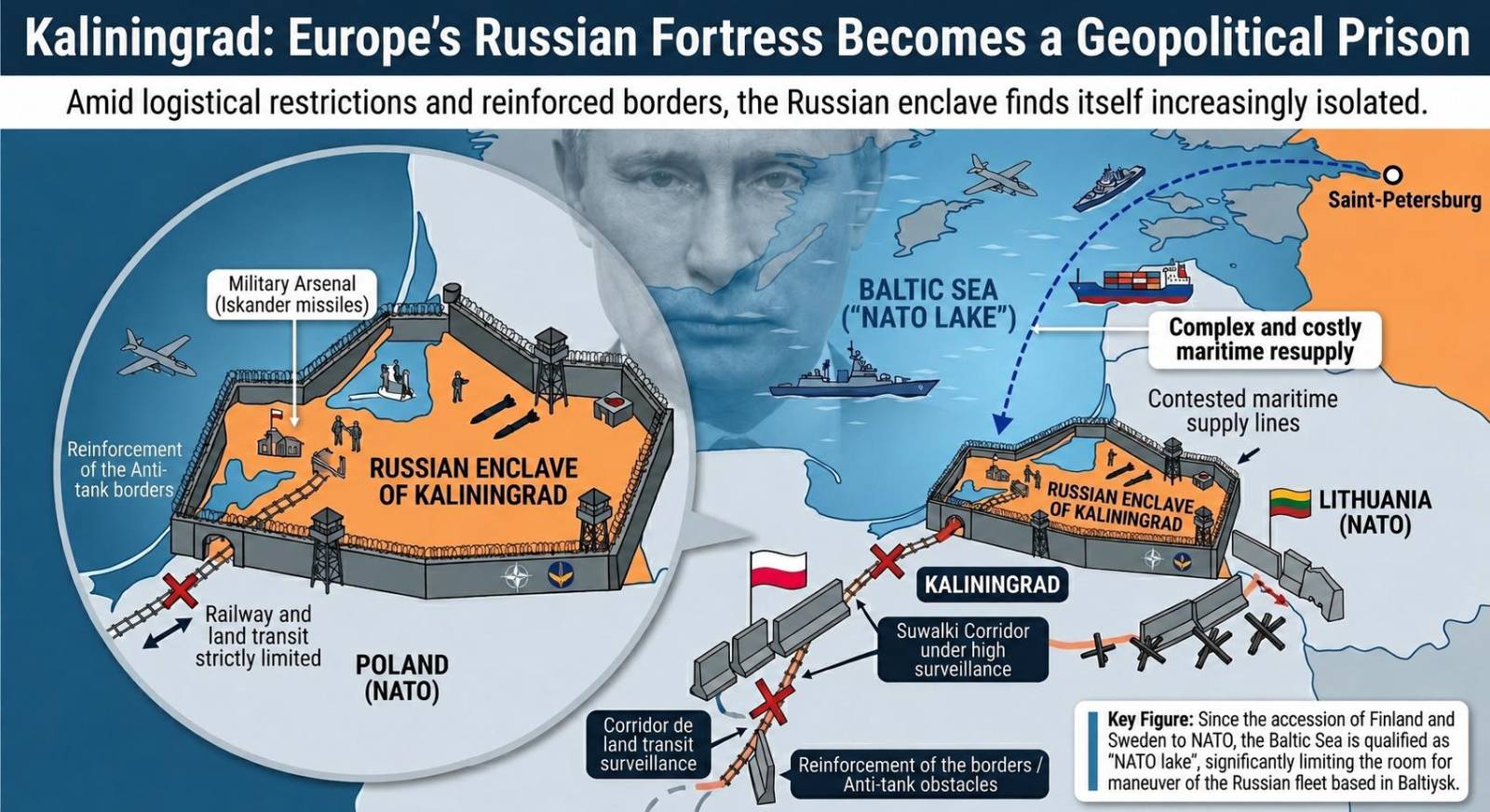
Once Moscow’s military stronghold in the heart of Europe, the Russian territory of Kaliningrad now faces an unprecedented tightening of controls by its NATO neighbors. Restrictions on logistics and reinforced borders are isolating this enclave more than ever.
The strategic shift reshaping Europe’s eastern flank
What was once perceived by the Kremlin as an invincible military bastion—capable of projecting firepower across Europe, particularly through its Iskander missiles—has become a fortress cut off from the world. Kaliningrad, a heavily militarized Russian enclave wedged between Poland and Lithuania, is now experiencing an unprecedented connectivity crisis.
Under the initiative of Warsaw, Vilnius, and Riga, NATO’s eastern flank is tightening its grip on the region. The geographic vulnerability that once fueled Moscow’s deterrence strategy has now become a liability, forcing the Alliance to turn the tables.
Railways, energy lines, and borders: the suffocating grip
The current blockade is not sudden but the result of a deliberate, incremental squeeze. Poland, Lithuania, and Latvia have progressively tightened transit conditions into the enclave:
- Rail infrastructure: The Suwałki corridor, the critical land bridge connecting Belarus to Kaliningrad, is under heightened scrutiny. Rail transit of goods, relying on Soviet-era networks, has been slashed to the bare minimum permitted under European sanctions.
- Energy supplies: Land-based fuel and energy flows have plummeted, prompting Moscow to resort to costly and complex maritime resupply via the Baltic Sea to prevent paralysis.
- Physical barriers: On the ground, access has been nearly halted by the construction of fortification lines. From anti-tank ditches to barbed-wire fences, Poland and Lithuania have effectively sealed their borders with the Russian territory.
A critical factor further complicates Moscow’s position: since Finland and Sweden joined NATO, the Baltic Sea has become what analysts call a “NATO lake”, severely limiting the maneuverability of Russia’s Baltic Fleet based in Baltiysk.
Is Kaliningrad becoming a logistical trap for the Kremlin?
For Vladimir Putin, the situation in Kaliningrad represents a top-tier strategic challenge. Though the enclave remains heavily armed, its resilience in a prolonged conflict is increasingly questioned by military experts. With no smooth land links to the rest of Russia, its armed forces now rely entirely on contested maritime and aerial supply lines.
Some analysts suggest that what Moscow once viewed as its “sharpest sword” against the West has turned into a liability. In the event of open confrontation, the territory could find itself immediately encircled and isolated by NATO forces on high alert.
Diplomatic deadlock looms
In response to this de facto blockade, Moscow has repeatedly accused its neighbors of breaching international treaties on free transit to its peripheral regions. The Kremlin has also hinted at retaliatory measures, though it has not specified their nature.
Poland, Lithuania, and Latvia, backed by their Western allies, defend their actions as necessary security measures in response to Russia’s aggressive posture in Ukraine. The question now is how far this logistical tug-of-war can escalate before igniting a military spark in one of the world’s most heavily militarized regions.