Senegal’s political landscape shaken by the collapse of the Sonko-Diomaye tandem
The Senegalese political arena has always been a battleground of shifting alliances, where alliances are forged and broken based on ever-changing interests. This principle, long recognized in political science, has once again taken center stage in the country’s executive leadership.
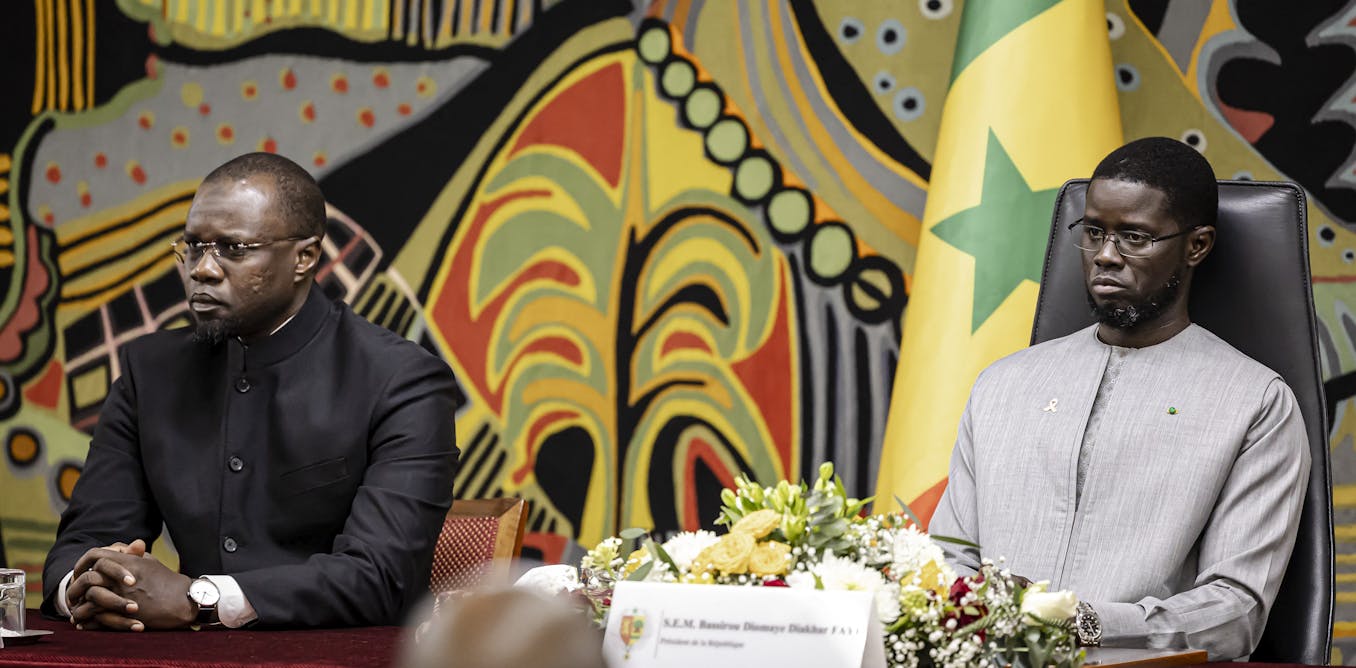
The once-united front of President Bassirou Diomaye Faye and Prime Minister Ousmane Sonko, who shared a unified vision, has fractured under the weight of internal disagreements. These tensions culminated in the dismissal of the Prime Minister by the President on May 22, followed by the dissolution of the government.
The first cracks in their partnership became visible during the November 8, 2025 rally, where signs of discord emerged. However, it was during a May 2 meeting in 2026 that the rift became undeniable. President Faye openly criticized what he described as the Prime Minister’s “excessive personalization of power,” signaling the definitive end of their collaboration.
How a symbolic partnership crumbled into rivalry
Their alliance was born from necessity: Sonko backed Diomaye’s presidential bid after his own candidacy was disqualified. Initially, the duo appeared complementary—Sonko brought grassroots political strength, while Diomaye provided institutional stability. However, the November 8, 2025 gathering revealed the fragility of their partnership.
The slogan “Sonko mooy Diomaye” (Sonko is Diomaye), once a unifying rallying cry for PASTEF supporters, has lost its luster. In its place, individual ambitions have surfaced, with slogans like “Sonko is Sonko” and “Ousmane is Ousmane” now dominating public discourse. The initial fusion of their political identities has given way to a visible duality, where roles are redefined and ambitions clash.
Their political symbiosis had created an “habitus partisan unique”, blurring the lines between the two leaders in the eyes of their supporters. However, Senegal’s presidential system, where executive authority cannot be shared, has exposed the irreconcilable differences between their roles. The Constitution (Articles 42-52) clearly distinguishes the President’s prerogatives from those of the Prime Minister, transforming their initial harmony into a “soft rivalry.”
Diomaye embodies the institutional reserve expected of a head of state, while Sonko retains his combative, mobilizing persona. As sociologist Pierre Bourdieu noted, “the role shapes the individual rather than the reverse.” This institutional tension has forced Diomaye to step down from his leadership roles within PASTEF, further distancing the two figures.
Public communication has also shifted from the grassroots “Diomaye is Sonko” narrative to a protocol-driven emphasis on the President’s primacy. Once the driving force behind Diomaye’s rise, Sonko now finds himself in a subordinate position, creating a clear divide between pro-Diomaye and pro-Sonko factions within the party.
The unsustainable balance of power
Drawing from fluid dynamics, where unequal masses within a shared space lead to compression, the Sonko-Diomaye partnership has become a study in power asymmetry. Sonko’s populist legitimacy fuels Diomaye’s authority, while Diomaye’s decrees and state decisions give tangible form to their shared political project.
Yet this interdependence is inherently unstable. If Sonko overreaches, he encroaches on Diomaye’s institutional domain. If Diomaye isolates himself, he risks losing the popular mandate embodied by Sonko. Their power is a delicate equilibrium, oscillating between the presidential palace and the Prime Minister’s office, sustaining a rivalry that grows increasingly bitter with each passing day.
Their rivalry reflects a classic political paradox: the closer they become in ambition, the deeper their divisions grow. Both men covet the same ultimate prize—the presidency—and their mirrored desires have turned them into antagonistic doubles. Sonko, once the loyal lieutenant, now seeks the top role, while Diomaye, secure in his position, views Sonko’s growing influence with suspicion.
This dynamic harks back to the age-old “number two syndrome,” where loyalty erodes as ambition takes hold. The once-trusted ally becomes a potential threat, breeding mutual paranoia. The result? A political landscape fraught with instability, where social and institutional turbulence looms large.