
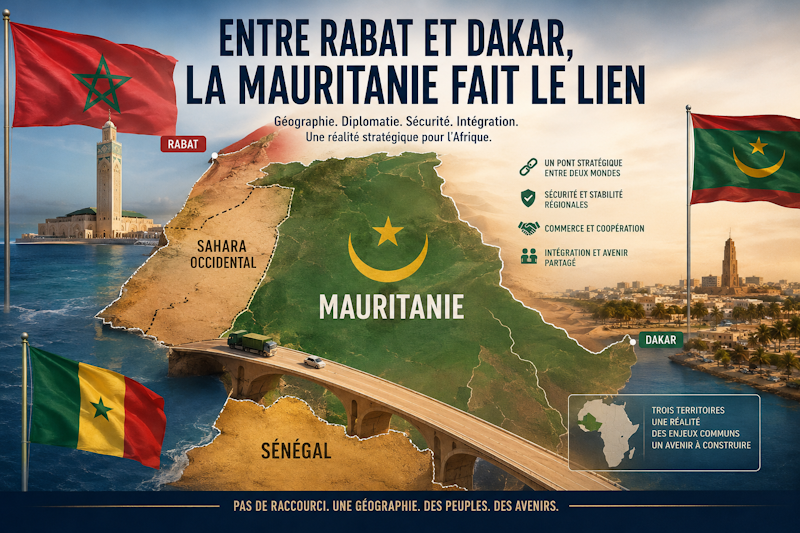

The vast stretches between Morocco and Senegal are not merely empty spaces on a map—they are territories shaped by history, sovereignty, and strategic interests. Journalist Ahmed Ould Bettar emphasizes a critical geographic reality: between these two nations lies the Western Sahara, but more importantly, the Mauritania.
The temptation to bypass Mauritania in discussions about regional dynamics often stems from oversimplification, yet this oversight ignores a nation that serves as a vital link between the Maghreb and West Africa. Mauritania is far more than a desert expanse or a mere transit zone; it is a sovereign state, a diplomatic powerhouse, and a cornerstone of security, trade, and regional cohesion.
Geopolitical analysis cannot afford to disregard the tangible realities of borders and nations. Ignoring Mauritania—whether intentionally or not—reduces a complex interplay of interests to a misleading oversimplification. The truth is that between Rabat and Dakar, thousands of kilometers stretch across lands rich with cultures, histories, and unresolved challenges.
Why Mauritania Matters in Regional Geopolitics
Mauritania’s strategic position makes it indispensable in understanding the broader dynamics of North and West Africa. Its role extends beyond physical geography:
- Diplomatic bridge: Acting as a mediator between conflicting regional interests, Mauritania fosters dialogue where direct communication falters.
- Security guarantor: With porous borders and transnational threats, Mauritania’s stability is key to preventing spillover conflicts.
- Economic connector: Trade routes and resource flows depend on Mauritania’s infrastructure and policies.
- Sovereign entity: Its recognition as an independent state is non-negotiable, regardless of attempts to bypass its role.
The Western Sahara Factor
The unresolved status of the Western Sahara adds another layer of complexity. While discussions often focus on Morocco’s stance or international reactions, Mauritania’s position—whether active or neutral—shapes the outcome. Its proximity and historical ties demand a seat at the table in any negotiation involving regional stability.
Geographic shortcuts may work in casual conversation, but in geopolitics, they lead to dangerous miscalculations. The omission of Mauritania from strategic assessments does not simplify the equation—it distorts it.
A Call for Precision in Regional Analysis
For analysts, policymakers, and observers, the lesson is clear: Africa’s geopolitical landscape cannot be reduced to linear connections. The space between Morocco and Senegal is not a blank canvas but a mosaic of nations, each with its own agency and influence. Recognizing Mauritania’s role is not an academic exercise—it is a necessity for accurate, responsible analysis.
You may also like
Bénin: le Sénat tient sa séance inaugurale sous la conduite de Patrice Talon
Gabon : la participation citoyenne au cœur de la Ve République
Is Chad truly experiencing a political easing of tensions?
Accord FMI-Sénégal : Thierno Bocoum exige la transparence sur les conditionnalités
Ousmane Sonko demands full transparency on Senegal’s new FMI agreement