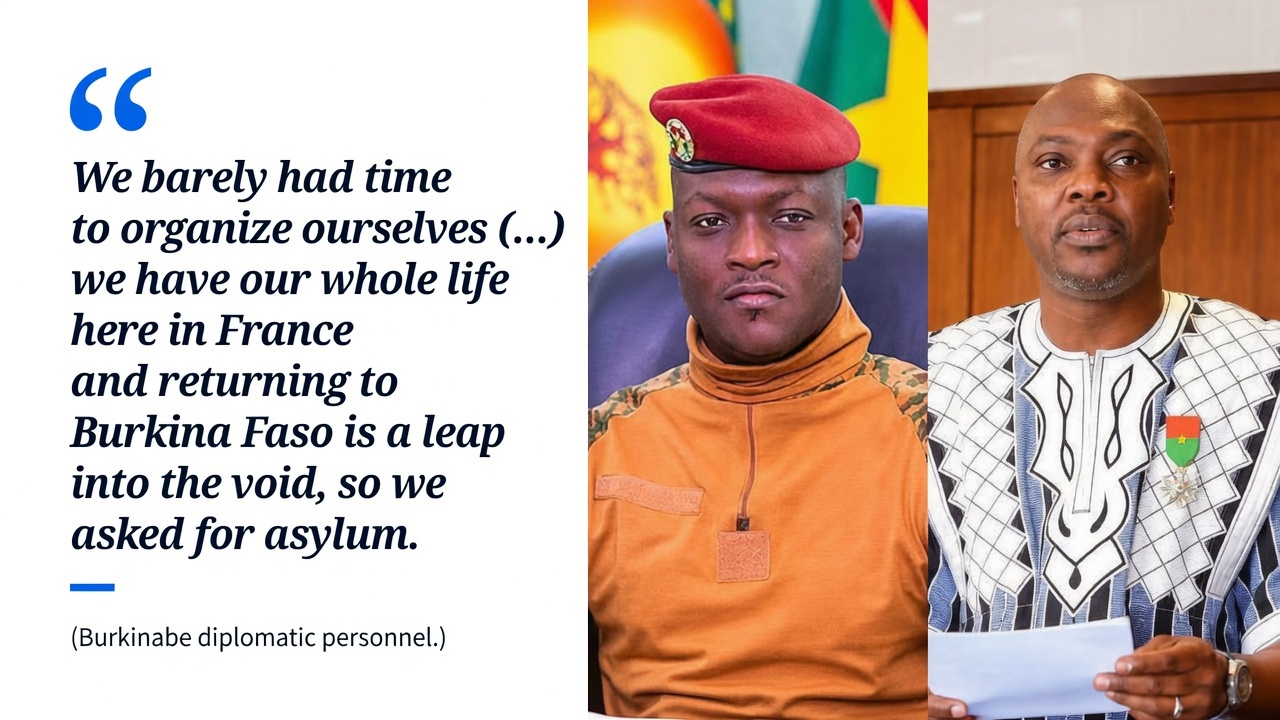
The recent decision by several diplomatic staff from the Burkinabè embassy in Paris to request political asylum in France has sent ripples through the transitional government’s ranks. This unprecedented move among embassy personnel underscores broader concerns within the state apparatus, reflecting dissatisfaction and uncertainty among officials stationed abroad.
The personnel’s request follows a series of administrative reshuffles within Burkina Faso’s diplomatic corps, as announced by authorities in Ouagadougou. While framed as a routine restructuring, the recall of diplomats has left many in a precarious position, particularly those who have spent years building their lives in France. For these individuals, returning to Burkina Faso is not merely an administrative obligation—it represents a leap into the unknown.
In a widely circulated statement, the diplomats articulated their reasons for seeking asylum, emphasizing the abruptness of the situation and the personal stakes involved:
« We had no time to prepare. Our entire lives are here in France. Going back to Burkina Faso feels like stepping into the void. That’s why we applied for asylum. »
Their words reveal deep-seated fears about the future, compounded by the challenges of uprooting established lives. Many have enrolled their children in French schools and secured stable careers, making the prospect of relocation daunting. Beyond personal disruption, concerns about security in Burkina Faso further complicate their decision. The ongoing security crisis in the country has heightened anxieties, particularly regarding the risks associated with recent government mobilizations against armed groups.
Reports and testimonies from civil society organizations have highlighted troubling allegations surrounding the requisitioning of civilians. Critics claim that individuals, including those who have criticized authorities or been targeted for mobilizations, have been dispatched to operational zones with inadequate preparation—a claim denied by government officials. These concerns have further fueled the diplomats’ apprehensions about returning to a country where stability remains fragile.
Observers point to the centralized nature of governance as a contributing factor. The rapid-fire administrative decisions, including the recall of diplomats, have been criticized for failing to account for the human consequences on families and careers. For critics of the transitional leadership, these actions reflect a lack of foresight and empathy, with life-altering decisions made without adequate transition periods or support.
This episode carries significant symbolic weight. When diplomatic staff—whose role is to represent their nation abroad—opt to seek asylum rather than return home, it signals a profound erosion of trust in the institutions they serve. Such requests are rare in international relations and often serve as a barometer of political and security climates within a country.
For Burkina Faso’s transitional government, the fallout presents a challenge to its international image. Since assuming power, authorities have pledged to restore national sovereignty and rebuild public trust in state institutions. Yet the spectacle of diplomats choosing asylum over repatriation raises questions about the prevailing climate within the country and the protections afforded to its officials.
Beyond political discourse, this affair underscores the human toll of administrative decisions. The diplomats’ statement reveals a reality often overlooked in official communications: behind every recall order are families, careers, and futures at stake. The choice to pursue asylum, in their view, is not an act of defiance but a calculated response to perceived risks. This episode serves as a reminder that decisions made at the highest levels of government can have far-reaching, unintended consequences for those tasked with representing the nation overseas.