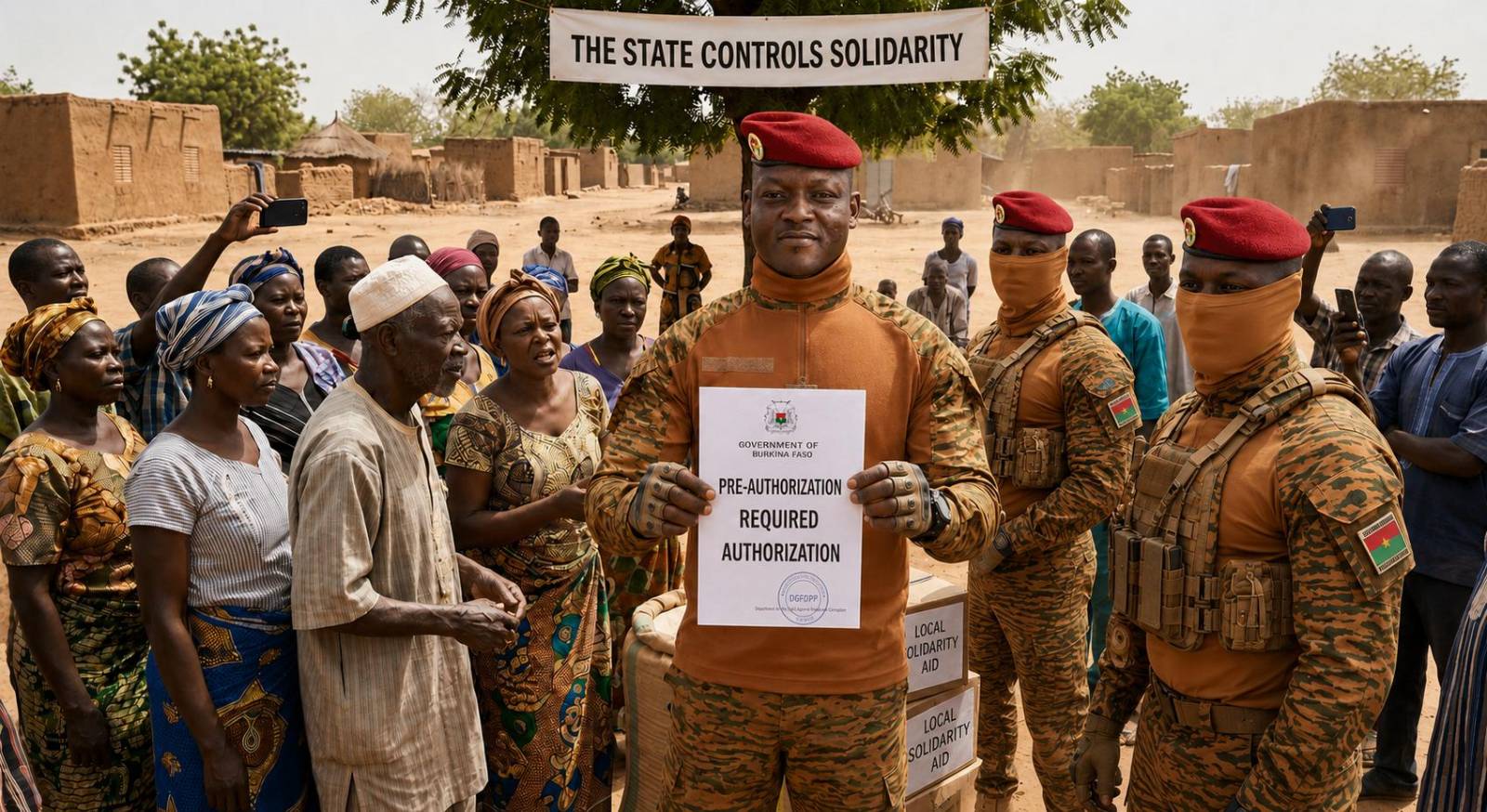
The era of unregulated charitable initiatives, marked by spontaneous social media appeals, appears to be drawing to a close in Burkina Faso. The Ministry of Solidarity has introduced stringent new measures requiring all humanitarian actions to secure prior authorization under the threat of penalties. While authorities justify this move as a necessary step to preserve human dignity and combat the exploitation of suffering for public attention, the policy raises profound questions about the erosion of individual freedoms and the role of civil society in times of crisis.
From spontaneous aid to administrative oversight
The new regulations mark a significant shift in how humanitarian efforts are perceived and managed. Previously, citizens, associations, and religious groups could mobilize rapidly in response to urgent needs without bureaucratic constraints. This autonomy has long served as a lifeline for communities grappling with the country’s escalating security and economic challenges. By imposing mandatory approvals, the government risks stifling the very initiatives that have historically filled gaps left by public institutions.
The paradox of state-controlled benevolence
Critics argue that the policy reflects a deeper trend: the state’s growing suspicion toward any form of independent civic engagement. Under the leadership of Captain Ibrahim Traoré, the transitional government appears to view unregulated solidarity as a challenge to its authority rather than a complementary force. This centralizing approach transforms even the most altruistic acts into potential infractions, fostering an environment of mutual distrust between citizens and authorities.
Historically, societies that thrive are those where state and civil society collaborate as equals, not as adversaries. When governments monopolize compassion, they not only discourage spontaneous aid but also undermine grassroots networks that have sustained communities through decades of instability. The risk is clear: a Burkina Faso where generosity is treated as a privilege requiring state approval is a Burkina Faso where resilience weakens.
Consequences of a disconnected policy
The decree’s implementation reveals a stark disconnect between policy and reality. While officials tout the benefits of streamlined humanitarian efforts, the truth remains: public institutions lack the financial, logistical, and human resources to replace the rapid, localized responses that have long defined Burkina Faso’s social fabric. By criminalizing unapproved aid, the government abandons vulnerable populations to bureaucratic delays, leaving families to fend for themselves in crises that demand immediate action.
Consider the case of a displaced community in need of emergency shelter or medical supplies. Under the new rules, every intervention—no matter how urgent—must first navigate a labyrinth of administrative approvals. Meanwhile, the suffering continues unabated. This Kafkaesque process does not protect dignity; it erodes the very foundations of social cohesion. The so-called “solidarity of the bush”—the deep, unmediated ties between diaspora communities, urban centers, and rural areas—risks being suffocated by red tape.
Dignity as justification, invisibility as outcome
Proponents of the regulation claim it safeguards the dignity of vulnerable individuals by preventing the public shaming of their struggles. Yet this argument overlooks a critical point: dignity is not preserved by silence enforced through decrees. A family denied food assistance because an aid worker’s paperwork is delayed does not experience dignity; they experience abandonment disguised as regulation.
The path forward lies not in blanket restrictions but in ethical frameworks that balance transparency, consent, and urgency. A policy that prioritizes administrative control over human need is one that prioritizes the state’s authority over the survival of its people. When generosity becomes a crime, the state does not protect its citizens—it abandons them.
The fragility of state-led humanitarianism
Burkina Faso’s current trajectory raises troubling questions about the limits of state capacity. History shows that no government can single-handedly meet the needs of a population facing chronic insecurity, economic collapse, and mass displacement. The reliance on civil society has never been optional; it has been essential. By dismantling the autonomy of grassroots initiatives, the authorities risk dismantling the social safety nets that have kept communities afloat. The result is not order—it is vulnerability magnified by bureaucracy.
In a country where every day brings new hardships, the message from Ouagadougou is unsettling: the state does not trust its people to do good without permission. This is not governance; it is control. And in the end, it is the most vulnerable who will pay the price.