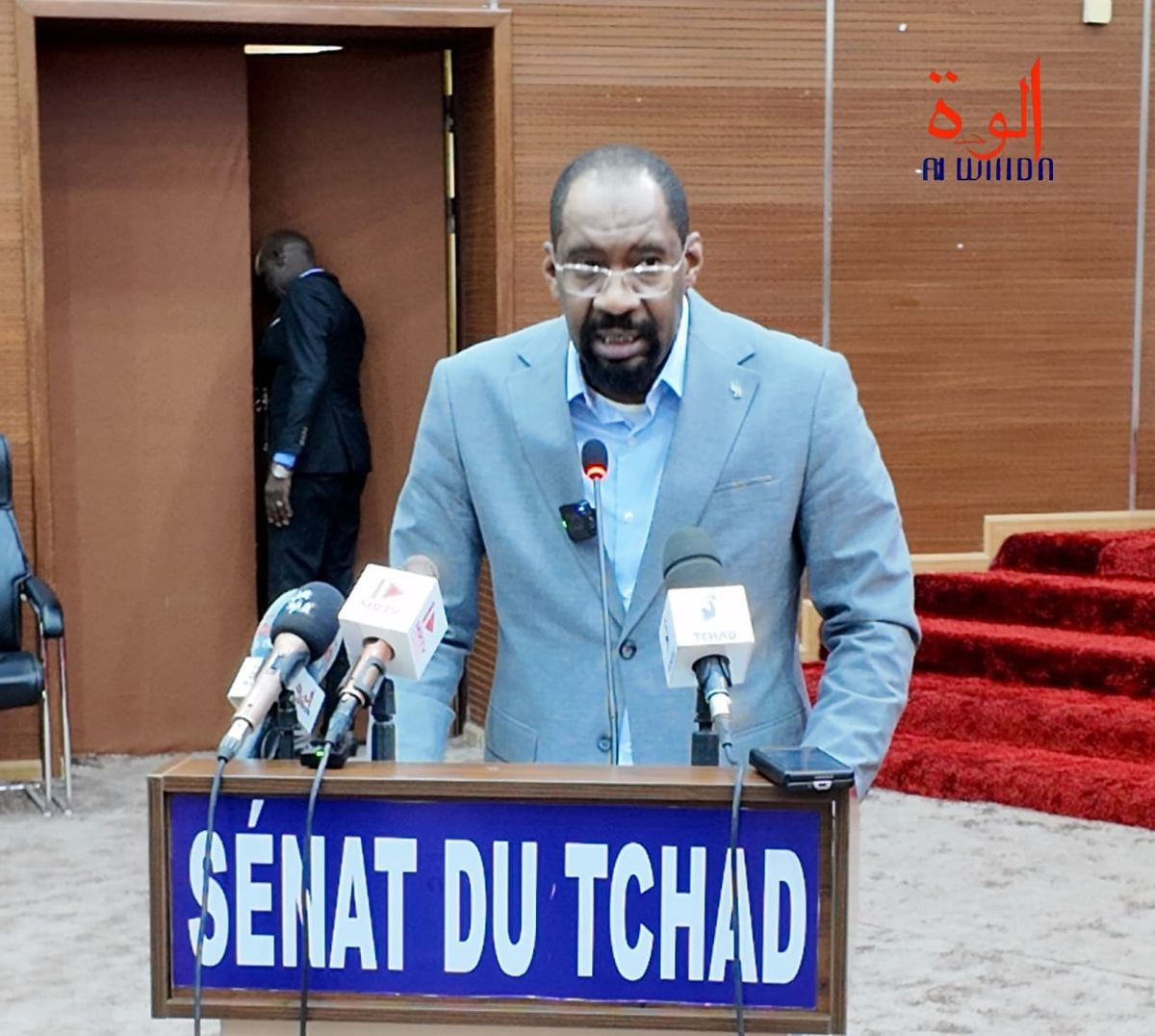
On June 1, 2026, General Ali Ahmat Aghabache, Chad’s Minister of Public Security and Immigration, addressed senators regarding the persistent issues of violence and insecurity across the nation. This crucial discussion, presided over by Dr. Haroun Kabadi, President of the Senate, was prompted by an oral question from Senator M. Mbaigolmen Sébastien.
Dr. Haroun Kabadi opened the session by acknowledging the deployment of defense and security forces in various provinces. Despite these efforts, he highlighted ongoing conflict incidents, citing examples such as events in Mayo-Kebbi Ouest and Salamat in June 2025, and a serious confrontation in Hadjar-Lamis on November 4, 2025, which tragically resulted in multiple fatalities. He also recalled a specific farmer-herder conflict in Mandakao, Logone Occidental province, on May 14, 2025, which was later followed by a peace agreement signed on July 5, 2025.
In his response to Senator Mbaigolmen Sébastien, Minister Aghabache clarified that intercommunal disputes frequently stem from competition over vital resources like water points and land, as well as clashes between agricultural communities and livestock herders. Before delving into specifics, the Minister offered his deepest condolences and observed a moment of silence for those who lost their lives or suffered temporary or permanent disabilities due to the various community conflicts plaguing several Chadian provinces. He expressed a preference for Senator Sébastien’s inquiry to encompass the broader scope of community conflict challenges, not only in Dougui, Logone Occidental, but also in regions such as Mayo-Kebbi, Wadi, Sila, Bahr El-Ghazal, Salamat, and more recently, Wadi Fira. “We share the grief of the bereaved families and extend our sincere compassion to all victims of these acts of violence,” he stated unequivocally.
The Minister reaffirmed his department’s unwavering commitment to providing clear answers and implementing concrete solutions to the significant security challenges facing Chad.
While assuring the Senate that overall national security remains largely intact, the Minister acknowledged the existence of specific areas experiencing insecurity. “Indeed, no place in the world enjoys a state of perfectly absolute security or a complete absence of insecurity,” Minister Aghabache emphasized. He stressed that these tensions, often locally exploited or manipulated, cannot be resolved solely through security presence, which primarily serves to contain violence and establish conditions conducive to lasting political and social solutions.
Despite isolated incidents, strategies focused on preventing and resolving community conflicts at their source are deemed most effective. The Minister outlined several key factors contributing to the rise and persistence of violent acts across Chad’s provinces:
- Natural Resource Conflicts: During the rainy season, particularly in eastern, southern, and central Chad, tensions escalate due to livestock damaging agricultural crops. These disputes frequently devolve into violent acts of revenge rather than peaceful resolution.
- Land and Water Scarcity: Climate change and drought in northern regions have diminished pastoral resources, compelling herders to migrate southward. Concurrently, population growth and expanding cultivated areas intensify pressure on agricultural and pastoral lands, fueling conflicts among local communities.
- Absence of Clear Resource Regulation and Legal Gaps: The lack of precise maps delineating transhumance corridors, land rights, and agricultural zones creates a legal vacuum that exacerbates disputes between groups.
- Demographic Growth: An increasing population drives higher demand for pastures, water, food, and land, further straining fragile ecosystems and local communities.
- Political Exploitation of Tribal Affiliations: Certain political actors manipulate tribal identities to garner support, enhance their influence, or secure personal or political advantages, thereby intensifying local tensions and conflicts.
- Ethnic Diversity and Tribal Structure: Chadian society is remarkably complex, comprising over 200 ethnic groups. The strong emphasis on tribal identity over national identity has weakened the sense of belonging to the state and the concept of citizenship.
- Influence of Neighboring Countries’ Security Situations and Regional Conflicts: The proliferation of light weapons across borders has provided local communities with access to deadly automatic firearms, escalating the intensity of traditional conflicts and increasing their human cost.
- Land Ownership Disputes and Historical Inter-Social Borders: The cumulative human cost of these conflicts in 2025 reached 318 fatalities and 315 injuries.
Senators posed numerous questions to the Minister, inquiring about the provinces most affected by violence, the measures and mechanisms implemented to reduce violence in specific Chadian provinces and villages, and the critical issue of light weapon proliferation.
Despite ongoing concerns, the senators acknowledged and commended the Minister’s department for its efforts in combating insecurity nationwide, though they underscored that considerable work remains.
Addressing the issue of intercommunal conflicts, the Minister urged local leaders, traditional chiefs, and elected representatives to prioritize raising awareness about the importance of peaceful coexistence and social cohesion to prevent such disputes. He also provided an overview of police and gendarmerie operations conducted between 2024 and 2025, which resulted in the seizure of over 4,000 weapons, the arrest of more than 1,300 brigands, and the confiscation of substantial quantities of illicit drugs.
Further questions were raised and answered, including those concerning kidnappings for ransom, particularly prevalent in Mayo-Kebbi Ouest, and child abductions carried out by the Boko Haram sect in the Lac province. Senator Mariam Ahmat Djamil also voiced concerns about the alarming presence of unidentified foreigners in Chad, identifying it as a significant source of insecurity.
Regarding the establishment of new police stations to enhance security, the Minister affirmed his department’s commitment to this initiative. He noted that the recent creation of several commissariats and companies in Abéché, Ouaddaï province, has demonstrably led to a reduction in insecurity in that region.