
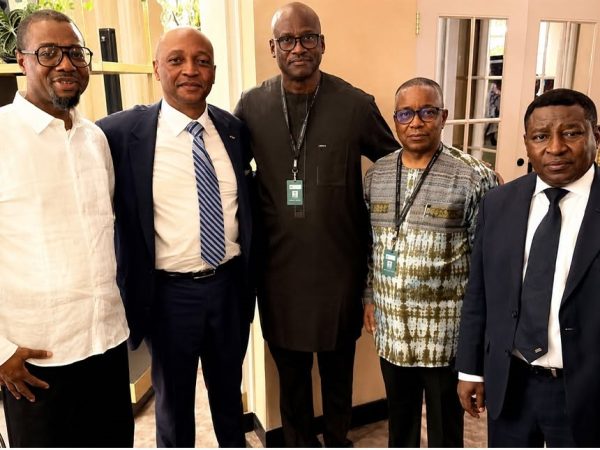
The African Football Confederation (CAF) has officially recognised the joint interest declaration submitted by Burkina Faso, Mali, and Niger to host the 2032 Africa Cup of Nations (AFCON). This milestone, though symbolic, marks the beginning of a rigorous journey where the three Sahelian nations must now prove their readiness in infrastructure and security.
On 18 July, in New York, a pivotal meeting took place between CAF President Patrice Motsepe and the presidents of the three national football federations—Colonel Oumarou Sawadogo of Burkina Faso, Mahamadou Cissé of Mali, and Issaka Adamou of Niger. Their joint candidacy received formal validation, with the announcement made public on 20 July by the Nigerien Football Federation (FENIFOOT) and widely echoed across the region.
First hurdle cleared, but not the race won
Under CAF’s bid regulations, this approval only confirms that the trio has met the administrative requirement of submitting a declaration of interest—a necessary step to remain in contention. It does not guarantee final hosting rights. According to FENIFOOT, this validation simply allows their bid to proceed to the next phase of the official evaluation process.
Why the CAF is looking three editions ahead
In early July 2026, the CAF simultaneously launched calls for bids for AFCON 2028, 2032, and 2036, giving member associations ample time to prepare competitive proposals. This long-term planning approach aims to ensure robust bids that meet the highest standards.
While no final decision date has been set for 2032, the CAF will conduct a thorough technical assessment. This review will focus on the condition of sports facilities, accommodation, transport networks, and overall logistical capacity in the three candidate countries.
A proven model: co-hosting in East Africa
The concept of a three-nation joint bid is not unprecedented. Kenya, Uganda, and Tanzania are set to co-host AFCON 2027, setting a precedent that could guide the Sahelian evaluation. This collaborative model enables countries to share existing infrastructure, reducing the burden of meeting international hosting standards alone.
The CAF President praised the initiative as a demonstration of regional cooperation, while emphasising the importance of adhering to established procedures, as noted in a FENIFOOT communiqué released on 20 July 2026.
Football as a tool for Sahel unity
This bid is more than a sporting ambition—it reflects a broader geopolitical shift. Since breaking ties with ECOWAS, the military-led governments in Ouagadougou, Bamako, and Niamey have intensified joint initiatives to assert the autonomy of the Sahel bloc, spanning monetary policy to diplomacy. A successful co-hosting bid would provide the Alliance of Sahel States with a rare international platform at a time when the region faces persistent security challenges. Just days before the CAF’s approval, the African Union condemned deadly attacks in Niger and Mali on 17 and 18 July.
The coming months will test not only the security landscape but also the development of sports venues, hospitality, and transport systems. These are the pillars on which the CAF will base its final decision for AFCON 2032.
What to watch next
The 18 July approval is merely the first administrative step in a long process whose 2032 timeline remains undefined. It does not confirm technical feasibility—whether in infrastructure, accommodation, or security—or determine the bid’s success against potential competitors.
Football federations in Burkina Faso, Mali, and Niger, in collaboration with their governments, are now working to compile a technical dossier that aligns with CAF’s stringent requirements. The real challenge lies not in New York, but on the ground: demonstrating the ability to sustainably meet the demands of hosting a continental tournament.
If successful, AFCON 2032 could transcend sport, becoming a testament to the Sahel’s capacity to turn political unity into a global showcase.
You may also like
-
Burkina Faso, Mali and Niger secure joint bid for CAN 2032
-
Niger and South Africa bolster security ties with high-level talks
-
Ivorian governance praised by African peer review mechanism
-
Tragic death of Togo dancer in France sparks investigation
-
Justice à deux vitesses en Centrafrique : la CPS ouvre une enquête sur Am-Dafock mais reste silencieuse sur les crimes commis par les mercenaires russes du groupe Wagner