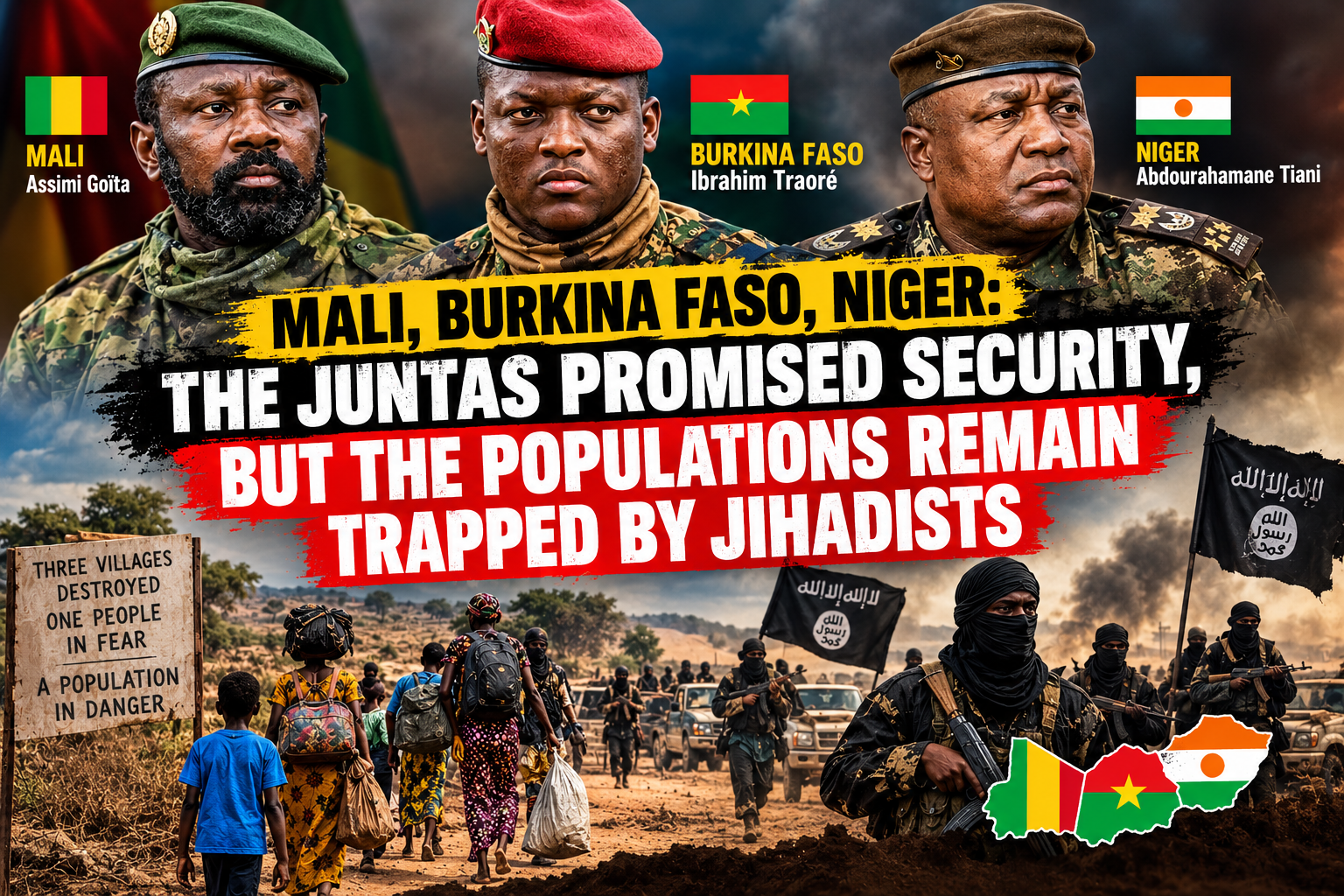
Why are civilians still trapped in the crossfire of Sahel’s jihadist rivalry?
The battle between the Islamic State in the Sahel and the Group for Support of Islam and Muslims (JNIM) has reached a dangerous new intensity in the volatile tri-border region of Mali, Burkina Faso, and Niger. What began as isolated skirmishes has exploded into a full-blown power struggle, with both armed factions claiming territory, trade routes, and local allegiances. But while the jihadists fight for dominance, the true cost is being paid by the region’s most vulnerable populations.
From political promises to deadly reality: the limits of juntas’ security strategies
The military regimes in Bamako, Ouagadougou, and Niamey rose to power promising a decisive break from past failures. Cutting ties with former allies, reorganizing security partnerships, and emphasizing national sovereignty were framed as the keys to restoring safety. Yet, in the same breath, communities in the tri-border zone continue to face relentless violence. Roads remain unsafe, markets are deserted, and families live in fear of displacement or worse. The question is no longer whether these governments can criticize past approaches but whether they can deliver on their core pledge to protect their people.
How jihadist clashes deepen civilian suffering
Contrary to the assumption that infighting weakens armed groups, the rivalry between the Islamic State in the Sahel and JNIM may be driving deeper instability. As the factions compete for control, civilians caught in the middle face new waves of violence. Reports of forced displacements, arbitrary restrictions on movement, and economic paralysis have become routine in affected areas. The true human toll remains difficult to verify, as both groups manipulate casualty figures to serve their narratives. Yet one fact is undeniable: the more these organizations fight among themselves, the harder it becomes for local populations to find refuge, feed their families, or access essential services.
This dynamic raises a critical issue: what does sovereignty mean when citizens cannot safely farm their land, send their children to school, or travel to neighboring towns? For the residents of rural communities along the Mali-Burkina Faso-Niger border, the answer is increasingly clear. The promises of the juntas are being tested and found wanting by a conflict that shows no signs of ending.
The erosion of state authority in the hinterlands
Security crises are not confined to battlefield losses. In areas where state presence has weakened, the vacuum is often filled by jihadist factions that impose their own rules. Public services collapse. Schools close. Healthcare becomes inaccessible. The withdrawal of government forces, combined with the constant threat of raids, forces entire communities to abandon their livelihoods. For farmers, traders, and civil servants alike, the choice is stark: flee to improvised camps or endure a life of siege.
It is important to acknowledge the operational challenges faced by Mali, Burkina Faso, and Niger’s militaries. Operating across vast, poorly connected terrain with limited resources makes sustained protection difficult. However, the persistence of such conditions demands more than acknowledgment it requires action. Authorities must explain how their strategies are translating into tangible improvements for the most exposed populations. Have attacks decreased? Have displaced families returned home? Have trade routes reopened? Without concrete answers, sovereignty remains a hollow claim.
Can the Alliance of Sahel States succeed where others failed?
The formation of the Alliance of Sahel States was presented as a bold step toward reclaiming regional security. Built on shared resolve and a rejection of foreign partnerships, the alliance signals a desire to chart a new course. Yet, its success will ultimately depend on outcomes, not declarations. The tri-border region is a testing ground for this new approach and so far, the results are mixed.
To end the cycle of violence, more is required than coordinated military operations. Effective strategies must include reliable intelligence-sharing, cross-border intelligence units, and a commitment to restoring civilian protection as the top priority. Justice systems must begin to function again. Humanitarian corridors need to be secured. And communities must see tangible improvements in their daily lives not just in the halls of power.
Sovereignty in name only: what do citizens expect from their leaders?
The men and women of the Sahel do not measure their governments by rhetoric alone. They judge by results. Can a farmer in northern Mali tend his fields without fear? Can a mother in eastern Burkina Faso send her son to school? Can a trader in western Niger transport goods to market safely? When the answer to these questions is ‘no,’ the legitimacy of any regime begins to erode not because of foreign interference, but because of a fundamental failure to protect its own people.
The jihadist power struggle unfolding across the tri-border zone has laid bare a harsh truth: security is not something that can be declared it must be delivered. Until the populations of Mali, Burkina Faso, and Niger can live without constant fear, the juntas’ claims to sovereignty will remain unconvincing, and the cycle of violence will continue.
By Élise Ntamag — Journalist