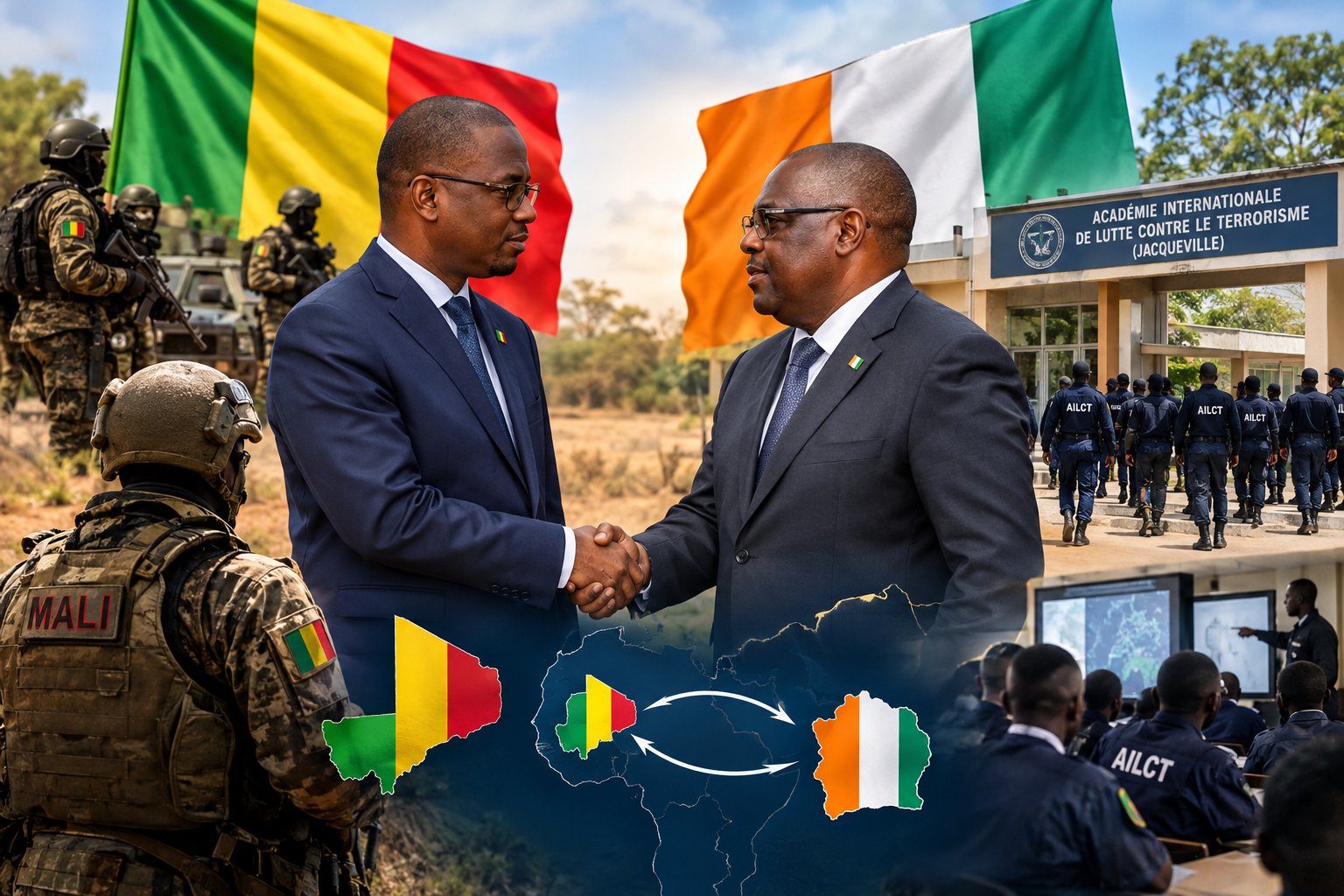
As Mali grapples with mounting insurgencies and cross-border terrorism threats, Bamako is now looking south for answers. The upcoming visit of Côte d’Ivoire’s intelligence chief, Vassiriki Traoré, to Malian capital Bamako on October 15, 2026, signals a potential strategic shift in how Mali confronts its security crisis. Invited by General Modibo Koné, Director of Mali’s National State Security Agency (ANSE), the Ivorian official’s trip underscores a critical interrogation for Malian authorities: Can Bamako leverage Côte d’Ivoire’s proven counterterrorism framework to secure its vulnerable borders and restore stability?
Why Abidjan’s experience could be Mali’s game-changer
The question is not hypothetical. Côte d’Ivoire has emerged as a regional leader in counterterrorism preparedness, having developed a comprehensive security response that extends beyond military operations. Over the past five years, Abidjan has invested in intelligence-driven prevention, inter-agency coordination, and specialized training areas where Mali continues to face critical gaps. The timing of Traoré’s visit aligns with rising concerns that traditional security approaches may no longer suffice against increasingly sophisticated armed groups spreading across the Sahel.
Central to Côte d’Ivoire’s model is the International Academy for Counter-Terrorism (AILCT) in Jacqueville, operational since June 2021. This state-of-the-art facility trains military, police, and judicial personnel at strategic, operational, and tactical levels. It also serves as a hub for regional knowledge exchange, offering a framework that Mali could closely examine especially given the shared regional threat environment.
Operational synergies: From intelligence to inter-agency collaboration
Mali’s security challenges are well-documented: fragmented intelligence networks, delayed response times, and the lack of a unified operational doctrine. Côte d’Ivoire’s counterterrorism ecosystem addresses these pain points through:
Proactive intelligence gathering: Emphasizing human and signal intelligence integration to detect threats before attacks occur.
Unified command models: Clearer chains of command between military, law enforcement, and judicial entities.
Specialized unit training: Evidence-based curricula focused on threat neutralization, hostage rescue, and border surveillance.
Judicial integration: Strengthened legal frameworks to ensure captured militants face prosecution, dismantling cycles of impunity.
These components form a cohesive system that Mali’s authorities could adapt without surrendering sovereignty. The goal is not imitation, but integration: selectively adopting proven methods that align with Mali’s operational realities and constitutional framework.
Beyond diplomacy: turning talk into tangible security gains
This is not the first time Mali and Côte d’Ivoire have explored cooperation. Past initiatives, however, often stalled due to mutual distrust and divergent security priorities. Yet the current regional climate marked by the expansion of Jama’at Nusrat al-Islam wal Muslimin (JNIM) and the Islamic State in the Greater Sahara (ISGS) demands pragmatic partnerships. The upcoming meeting could mark a turning point, but only if it yields actionable outcomes.
Key deliverables could include:
Joint threat assessments and shared early-warning systems.
Exchange programs for military and police officers, including rotations at the AILCT.
Harmonized protocols for cross-border pursuit and neutralization of armed groups.
Technical support in cyber-intelligence and digital forensics for tracking financing networks.
The absence of immediate, visible results could erode public confidence and embolden insurgent groups. Bamako must therefore ensure that Traoré’s visit translates into a roadmap with benchmarks, timelines, and accountable implementation teams.
Sovereignty vs. effectiveness: the strategic balancing act
Critics may argue that leaning on foreign models risks undermining national autonomy. However, Mali’s current trajectory suggests that inaction carries greater long-term costs. The country has lost vast territories to militant control, displaced millions, and seen its economy suffer from insecurity. In this context, pragmatic adaptation isn’t a compromise of sovereignty it’s a strategic imperative.
Côte d’Ivoire’s journey offers a compelling case study. Once a target of cross-border attacks, Abidjan has managed to reduce major incidents through disciplined intelligence sharing and coordinated security operations. While its geopolitical context differs, the underlying principles prevention over reaction, regional solidarity over isolation remain universally relevant.
For Mali, the path forward may lie in selective borrowing: taking what works, adapting it, and embedding it within a Malian-led framework. The visit of Côte d’Ivoire’s intelligence chief is not a sign of weakness, but a recognition that no nation can secure its future alone in an era of transnational terror.
The real test lies not in the meeting room, but on the battlefield and in the streets. Will Bamako act with the urgency its citizens demand? And can Côte d’Ivoire’s lessons translate from paper to practice? The answers will define the security landscape of the Sahel for years to come.
By Daniel Mbami — Journalist