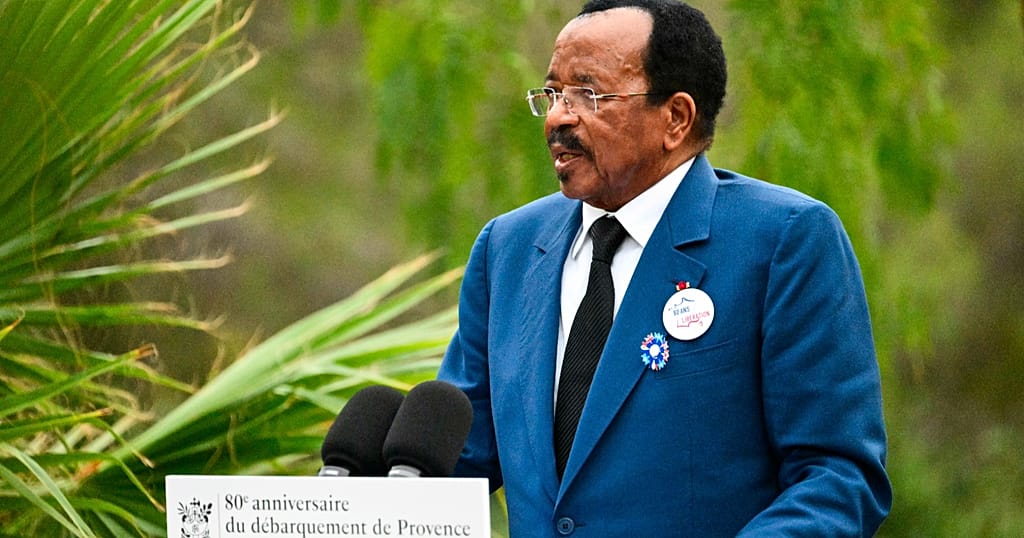
In the face of mounting accusations of power vacuum during his extended absence, Cameroon’s president Paul Biya has intensified the issuance of presidential decrees to reassert his governing presence.
The 93-year-old leader departed Cameroon with his spouse on June 7, described at the time as a “brief private European visit.” Yet, nearly two months later, he remains out of the public eye, fueling persistent speculation about his health.
To counter the growing doubts, President Biya has adopted a proactive approach by leveraging executive actions to maintain political visibility. In late July, he signed a decree authorizing the Minister of Economy to finalize a funding agreement with the Islamic Development Bank, totaling approximately 28 billion CFA francs.
On August 3, he further solidified his influence by reshaping the military hierarchy. Five colonels were elevated to the rank of brigadier general, while General Ebaka Hypolite was appointed as the new Chief of the Defense Staff. These strategic military appointments not only reinforce his decision-making authority but also strengthen the security apparatus under his control.
The government has dismissed reports of a decline in the president’s health, affirming his imminent return to Cameroon. However, the prolonged absence has drawn sharp criticism from opposition figures, who warn of an institutional void and a nation drifting in “autopilot mode.” Calls for the formation of a new government and the appointment of a vice president—long overdue—have intensified amid the uncertainty.
You may also like
Niger’s August mutiny: the fallout, the unanswered questions, and what lies ahead
Benin’s CCI budget for 2027 sparks debate: what the 6.6 billion FCFA plan means for businesses
Bambali agro park: what the launch means for Sédhiou and Senegal
Senegal’s palm oil deal with Indonesia: reactions, debate and what happens next
Burkina Faso’s militarisation debate: what the fallout means for displaced citizens