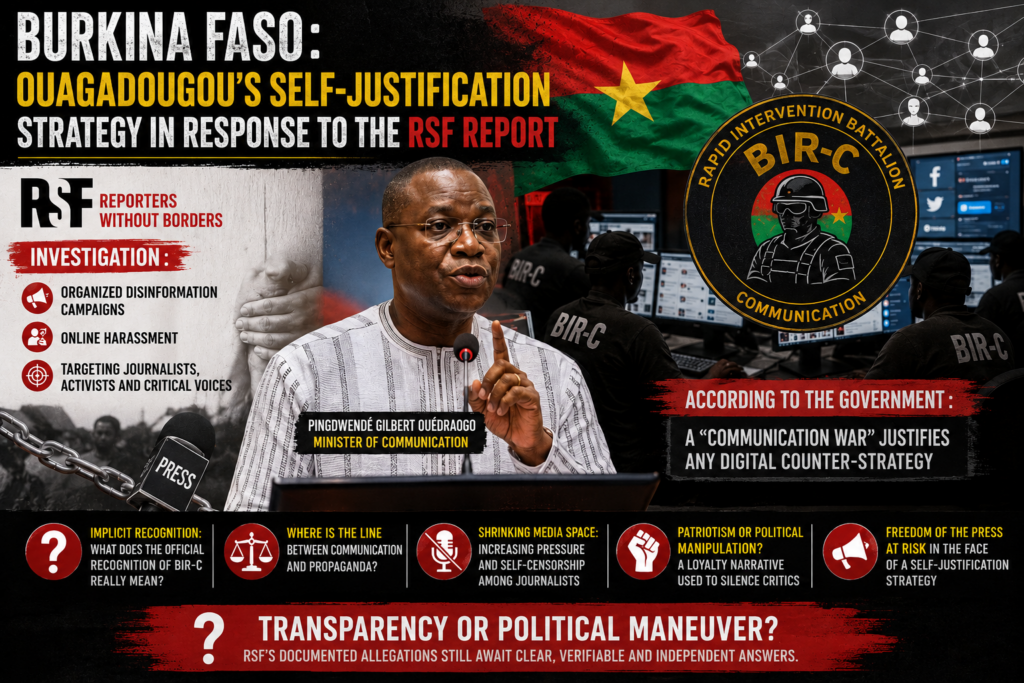
Ouagadougou’s response to RSF accusations lacks transparency
On August 3, during a public ceremony, Burkina Faso’s Minister of Communication, Pingdwendé Gilbert Ouédraogo, addressed recent allegations leveled by Reporters Without Borders (RSF). Rather than offering a detailed rebuttal or announcing an independent investigation, his remarks centered on praising the Rapid Communication Intervention Battalion (BIR-C), a structure now officially acknowledged as part of the country’s digital communications ecosystem. This public endorsement, however, has only deepened concerns about the BIR-C’s actual functions and its potential involvement in coordinated online campaigns.
The minister’s speech coincided with an RSF investigation revealing a network of coordinated digital actors allegedly engaged in disinformation, harassment, and systematic targeting of journalists, activists, and critics of the military-led transition. Instead of dismantling these claims, the government’s decision to publicly champion the BIR-C has fueled speculation about its true objectives and oversight mechanisms.
Digital warfare or suppression of dissent?
The RSF report outlines a systematic approach where coordinated social media accounts amplify specific narratives, discredit opposing views, and exert relentless pressure on media professionals. While authorities dismiss these findings, their refusal to engage with the documented evidence—opted instead for defending the BIR-C—has intensified debates over the line separating institutional communication from political propaganda.
The official narrative frames Burkina Faso as the target of an external ‘communication war,’ framing all digital strategies aimed at bolstering government narratives as patriotic acts. Yet, this justification raises critical questions: where does crisis communication end, and where does the suppression of pluralistic debate begin?
In a climate of intense political and security polarization, combating manipulation campaigns is undeniably a legitimate concern for any state. However, international freedom of expression standards emphasize that such efforts must never serve as a pretext for targeted harassment, smear campaigns, or intimidation tactics against journalists. When dissent is systematically equated with national betrayal, public discourse risks shrinking into a monologue rather than a dialogue.
Media freedom under strain in Burkina Faso
This controversy unfolds against a backdrop of suspended international media outlets, mounting pressure on journalists, and a steadily contracting local press environment. For many observers, these developments foster an atmosphere where self-censorship becomes a survival strategy for information professionals. Against this backdrop, the existence of an organized digital communication structure—if its operations extend beyond mere government messaging—raises pressing concerns about the balance between national security imperatives and fundamental freedoms.
The minister’s discourse appears less like an effort to clarify facts and more like a political counteroffensive, shifting the debate from documented evidence to blind allegiance. By framing critics as enemies of the nation, the government risks entrenching a binary where dissent is not scrutinized but vilified. This approach not only fails to address the allegations but may inadvertently validate the BIR-C’s perceived role within the state’s communication apparatus.
Transparency must guide digital communication strategies
The current controversy transcends the BIR-C case, spotlighting Burkina Faso’s broader approach to information management in the digital age. Social media platforms have emerged as arenas of political confrontation, but their use by state-affiliated structures must adhere to principles of transparency, respect for human rights, and alignment with press freedom standards.
Rather than responding to criticism with nationalist rhetoric, the government would do well to embrace a culture of accountability. Until allegations are met with precise, verifiable, and independent responses, official statements risk being dismissed not as refutations, but as attempts to justify a communication system shrouded in opacity. The true test of Burkina Faso’s commitment to democratic norms will lie in its willingness to engage with uncomfortable truths rather than suppress them.
You may also like
Niger’s August mutiny: the fallout, the unanswered questions, and what lies ahead
What Benin’s AirBadminton gold over Mauritius really changes for the sport
Benin’s CCI budget for 2027 sparks debate: what the 6.6 billion FCFA plan means for businesses
Bambali agro park: what the launch means for Sédhiou and Senegal
Senegal’s palm oil deal with Indonesia: reactions, debate and what happens next