
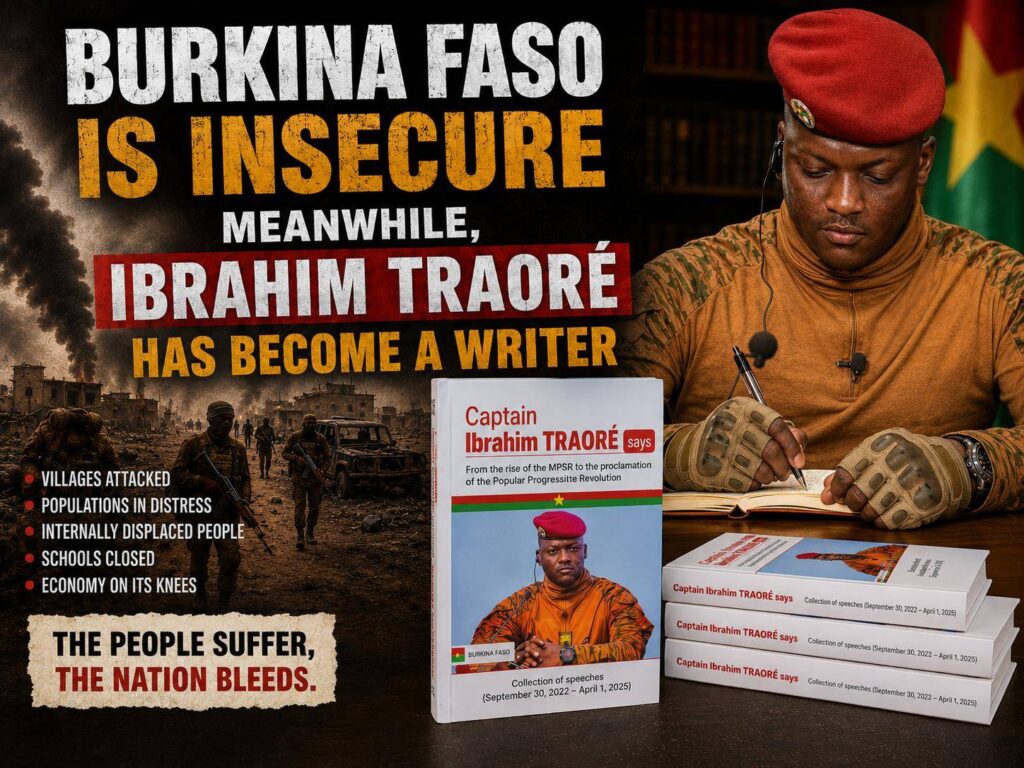
As Burkina Faso plunges deeper into an unprecedented humanitarian and security crisis each day, the recent priorities of the transitional government invite serious scrutiny. The chasm between official communication efforts and the harsh realities on the ground has never appeared wider.
This presents a striking, indeed almost indecent, contrast. On one side, daily reports detail terrorist assaults, besieged communities, and thousands of internally displaced individuals who, with empty stomachs, plead for the restoration of peace and territorial sovereignty. On the other, the gilded halls of the presidency are abuzz with activities promoting a work of propaganda or self-congratulatory narratives.
For a significant segment of the Burkinabè population, the observation is now bitter: the transitional presidency appears to have transformed into an outlet for political communication.
The illusion of words confronting the reality of arms
The recent publication of a book attributed to or dedicated to the figure of Ibrahim Traoré has provoked as much incomprehension as exasperation. In the streets of Ouagadougou and in the most remote provinces, the message from citizens is unequivocally clear: no one desires a book; the populace demands security.
To finance, edit, and promote state-sponsored literature at the very moment when the Defense and Security Forces (FDS) and the Volunteers for the Homeland (VDP) sometimes lack crucial logistical resources in the field suggests an alarming detachment. A conflagration cannot be extinguished with printed pages, nor can lives be safeguarded with mere slogans on a cover.
“The populace does not need stories recounted to them; it needs its homeland restored.” A civil society advocate, preferring anonymity, recently articulated this sentiment.
A breach of moral contract
Upon his ascension to power, Captain Ibrahim Traoré forged a tacit moral contract with the nation: to restore territorial integrity and bring peace where his predecessors had faltered. The trust placed in him was predicated exclusively on this promise of military efficacy.
Today, it is evident that rhetoric has superseded strategy. By focusing the state apparatus on personality cults and political marketing, the regime is incurring the wrath of an exhausted population. For many, the threshold of tolerance has been surpassed. Discontent is mounting, and the popular injunction is becoming radical: if the primary mission of securing the country cannot be fulfilled, it is time to relinquish authority.
What future for the transition?
The incumbent administration finds itself at a critical juncture. Continuing to manage the presidency as a public relations agency at the expense of frontline imperatives will only exacerbate the disconnect with the people.
Burkina Faso does not require publicists at its helm; it demands strategic commanders capable of restoring stability. Should Captain Traoré fail to immediately reorient towards the sole paramount priority—security—history will record that his tenure was inscribed in the ink of illusion, while the nation burned.
You may also like
Le carnet de Malian relance l’enquête sur la migration clandestine au Sénégal
Mamadi Doumbouya de retour à Conakry après une visite d’État en Côte d’Ivoire
Elversberg vs Bayern Munich: kick-off time, tv channel and team news
Gabon : l’association Force ouvre un espace de propositions pour la rentrée
Dakar 2026 : Diomaye Faye confie la flamme olympique à la jeunesse sénégalaise